
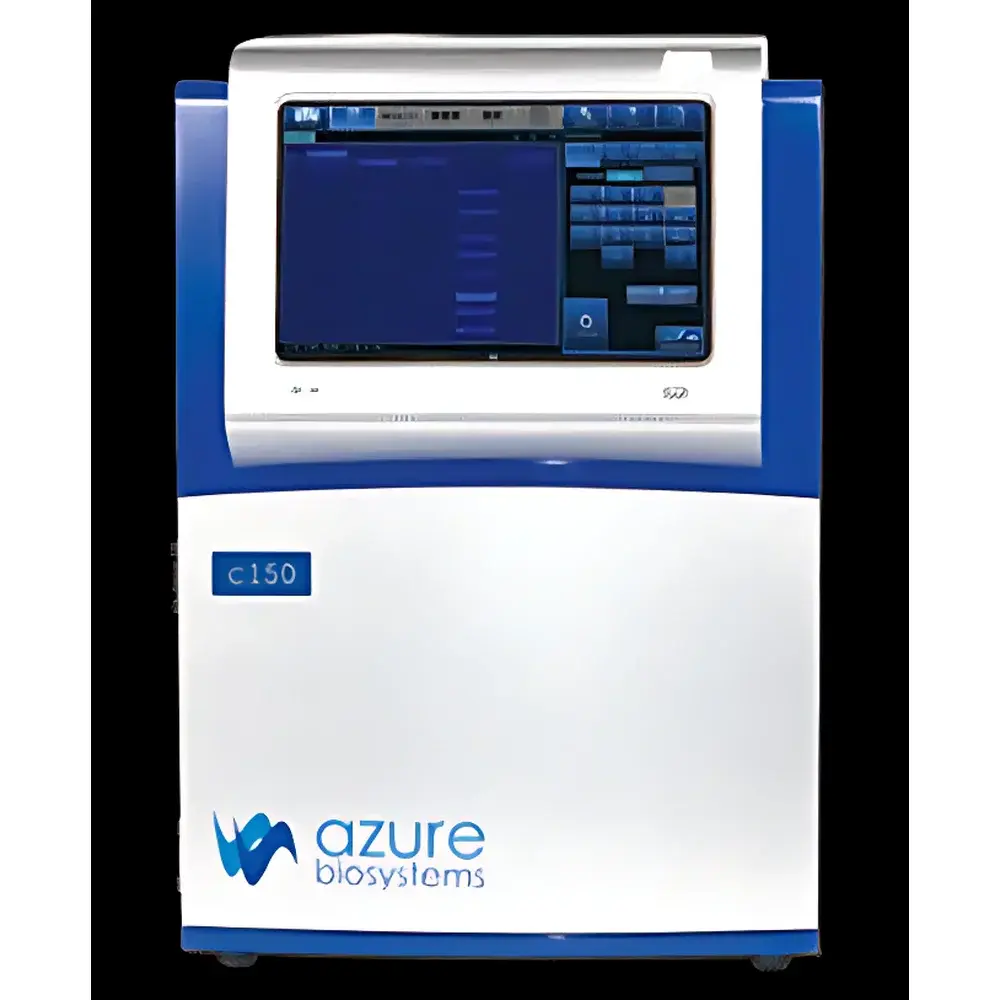
Azure Biosystems C500 Multi-Channel Molecular Imaging System
| Brand | Azure Biosystems |
|---|---|
| Origin | USA |
| Model | C500 |
| Instrument Type | Multi-Color Fluorescent Gel Imaging System |
| CCD Resolution | 8.3 MP |
| Bit Depth | 16-bit |
| Dynamic Range | 4.8 OD |
| CCD Sensor Size | 3/4" |
| Detection Sensitivity | >0.05 ng (for fluorescent DNA/protein stains) |
| Signal-to-Noise Ratio | >56 dB |
| Lens | 6× Zoom Optics |
Overview
The Azure Biosystems C500 Multi-Channel Molecular Imaging System is an integrated, benchtop molecular imager engineered for high-fidelity detection and quantitative analysis across multiple optical modalities—including UV transillumination, white-light reflectance, chemiluminescence, and dual-channel near-infrared (NIR) fluorescence. Built upon a precision-engineered optical platform with a thermoelectrically cooled 8.3-megapixel scientific CCD sensor, the C500 delivers consistent, reproducible imaging performance essential for rigorous life science research and quality-controlled laboratory workflows. Its modular excitation/emission architecture supports simultaneous dual-laser NIR excitation (typically at 685 nm and 785 nm), enabling multiplexed detection of two distinct biomolecular targets on a single blot or gel—without spectral crosstalk or manual filter switching. This capability directly supports quantitative western blotting, co-immunoprecipitation validation, and comparative expression profiling under GLP-aligned experimental conditions.
Key Features
- Integrated 6× motorized zoom lens with fixed f/1.2 aperture ensures optimal light throughput and uniform field illumination across all imaging modes.
- Thermoelectrically cooled CCD (–25°C below ambient) minimizes dark current noise, supporting extended exposure times required for low-signal chemiluminescent and NIR applications.
- Dual-laser NIR excitation system with independently controlled 685 nm and 785 nm diode lasers enables true two-color multiplexing on nitrocellulose or PVDF membranes using IRDye®-labeled secondary antibodies.
- UV transilluminator (302 nm) optimized for ethidium bromide–free nucleic acid staining (e.g., SYBR® Safe, SYBR® Green I) and precise in-gel excision guidance.
- High-intensity blue-light (470 nm) module compatible with next-generation nucleic acid dyes requiring safer excitation wavelengths.
- White-light LED reflectance system calibrated for Coomassie- and silver-stained SDS-PAGE gels, microplates, tissue sections, and X-ray film.
- Touchscreen interface with embedded Linux OS provides standalone operation—no external PC required for routine acquisition or basic quantification.
- Hardware-level auto-exposure and auto-focus algorithms reduce user-dependent variability and accelerate workflow throughput.
Sample Compatibility & Compliance
The C500 accommodates a broad range of sample formats without mechanical adaptation: standard 10 × 10 cm and 15 × 20 cm electrophoretic gels, transfer membranes (nitrocellulose, PVDF), autoradiography films, multi-well plates (6–96-well), Petri dishes, and histological slides. All optical modules comply with IEC 61000-4 electromagnetic compatibility standards and are CE-marked for use in EU-based research laboratories. The system supports audit-trail-enabled acquisition protocols aligned with FDA 21 CFR Part 11 requirements when operated with optional networked software licensing and user-authenticated login. Image metadata—including exposure time, gain, lens position, lamp intensity, and timestamp—is embedded in TIFF and PNG exports per MIAME and MIAPE reporting guidelines.
Software & Data Management
Acquisition and analysis are managed via AzureSpot™ software (v7.x), a validated, Windows-based application offering full instrument control, batch processing, and publication-ready output. Key capabilities include: background subtraction using rolling-ball or polynomial modeling; lane and band identification with adaptive thresholding; molecular weight calibration using ladder interpolation; densitometric quantification with linear dynamic range validation (R² > 0.995 over 4.8 OD); and statistical comparison across replicates. All processing steps are scriptable via Python API integration, enabling automated pipeline deployment in high-throughput core facilities. Raw image files are stored in lossless 16-bit TIFF format with embedded EXIF metadata; processed results export to Excel (.xlsx), PDF, or XML for LIMS integration.
Applications
- Quantitative western blotting with multiplexed normalization (e.g., target protein vs. total protein or housekeeping gene)
- DNA/RNA gel documentation and fragment sizing under non-mutagenic blue-light excitation
- Chemiluminescent detection of low-abundance phosphoproteins or cytokines (sub-fg sensitivity demonstrated with HRP-conjugated antibodies)
- Validation of CRISPR/Cas9 editing efficiency via T7E1 or Surveyor assays
- Cellular assay readouts from viability stains (e.g., Calcein AM/EthD-1) in 96-well plates
- Longitudinal monitoring of protein aggregation in SDS-PAGE under denaturing conditions
- Documentation and analysis of Southern/Northern blots using DIG- or biotin-labeled probes
FAQ
Does the C500 support time-lapse chemiluminescent imaging?
Yes—the system allows programmable multi-frame acquisition with user-defined intervals (1 s to 24 h), ideal for kinetic ELISA or luciferase reporter assays.
Can I upgrade my C500 to C600 functionality in the field?
Yes—hardware upgrades (e.g., additional laser modules, higher-sensitivity sensor, or enhanced optics) are supported via certified field service; software license keys enable expanded modality access.
Is the 16-bit data preserved throughout the entire processing chain?
Yes—AzureSpot™ performs all quantification operations in native 16-bit integer space; no intermediate conversion to 8-bit occurs unless explicitly exported.
What validation documentation is provided for regulatory environments?
A comprehensive IQ/OQ protocol package—including photometric uniformity maps, linearity verification reports, and system suitability test procedures—is supplied with each unit and updated annually per ISO/IEC 17025 recommendations.




