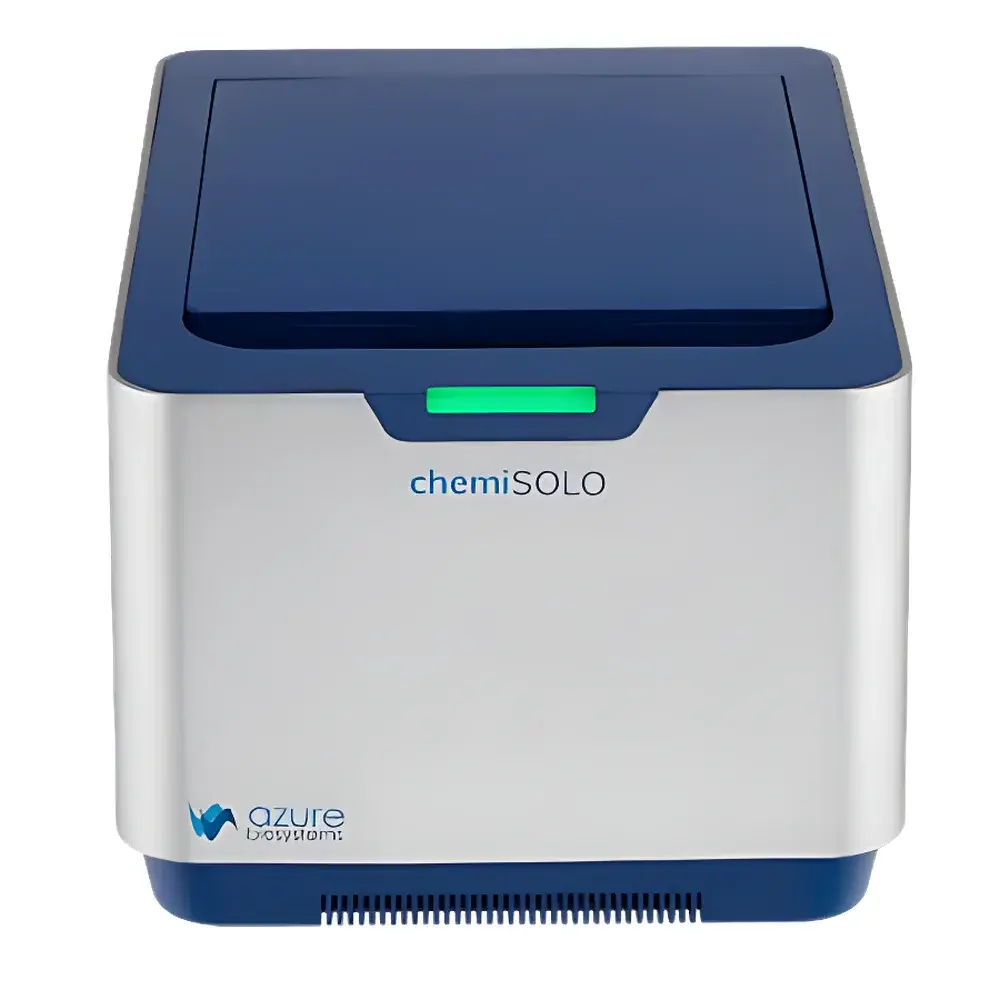
Azure Biosystems chemiSOLO Chemiluminescence Gel Imaging System
| Brand | Azure Biosystems |
|---|---|
| Origin | USA |
| Model | chemiSOLO |
| Instrument Type | Chemiluminescence Gel Imager |
| Camera Sensor | 6.3 MP cooled back-illuminated CMOS |
| Bit Depth | 24-bit |
| Dynamic Range | 7.2 OD (EDR mode) |
| Sensor Size | 2-inch format |
| Detection Sensitivity | sub-femtogram (fg) level |
| Signal-to-Noise Ratio | High SNR |
| Lens System | Motorized autofocus |
Overview
The Azure Biosystems chemiSOLO Chemiluminescence Gel Imaging System is a compact, benchtop-grade imaging platform engineered for quantitative detection of chemiluminescent signals in Western blotting, nucleic acid hybridization, and other low-light molecular assays. It employs a thermoelectrically cooled, back-illuminated CMOS sensor optimized for photon-limited applications—delivering superior quantum efficiency (>80% at 520 nm) and minimal dark current generation. Unlike conventional CCD-based systems, the chemiSOLO leverages modern CMOS architecture with on-chip analog-to-digital conversion and correlated double sampling to ensure high fidelity across extended exposure durations (0.1 ms to 60 min). Its optical path integrates a precision f/0.95 motorized lens assembly with real-time autofocus calibration, enabling consistent focus across variable sample heights—including thick membranes, multi-well plates, and irregular gel cassettes—without manual intervention.
Key Features
- 6.3-megapixel back-illuminated CMOS sensor with deep-cooling capability (−25 °C below ambient), reducing thermal noise for sustained long-exposure acquisition
- Extended Dynamic Range (EDR) imaging mode delivering up to 7.2 optical density (OD) linear dynamic range—enabling simultaneous visualization of weak and saturated bands within a single exposure
- 24-bit digitization with hardware-level gain control and offset adjustment, preserving quantifiable signal integrity across intensity gradients
- Fully motorized f/0.95 lens system with closed-loop autofocus; calibrated via integrated reference target for repeatable focal plane positioning
- Integrated white LED transilluminator (optional UV conversion screen available) supporting visible-light gel documentation, fluorescent stains (e.g., SYBR Safe, Coomassie), and colorimetric assays
- Built-in Wi-Fi and Ethernet connectivity enabling direct remote operation from Windows, macOS, iOS, or Android devices—no client software installation required
Sample Compatibility & Compliance
The chemiSOLO accommodates standard electrophoresis formats including mini-gels (up to 10 × 10 cm), transfer membranes (PVDF, nitrocellulose), microplates (6–96-well), and custom substrates up to 15 × 15 cm. Its uniform illumination field and flat-field correction algorithm ensure spatially consistent sensitivity across the entire imaging area. The system complies with ISO/IEC 17025 requirements for measurement traceability in accredited laboratories and supports audit-ready workflows aligned with GLP and GMP documentation standards. Image metadata—including exposure time, lens position, temperature log, and user ID—is embedded in TIFF headers and exportable in FAIR-compliant formats (e.g., OME-TIFF) for integration into LIMS or ELN platforms.
Software & Data Management
Acquisition and analysis are managed through AzureSpot™ Web—a browser-based application accessible via HTTPS without local installation. It features real-time preview with histogram overlay, automatic exposure optimization, background subtraction (rolling ball and polynomial models), band intensity quantification (integrated density, % volume, normalized ratios), and batch processing with customizable templates. All image data are stored in encrypted local storage or configurable network shares; audit trails record every parameter change, export action, and user login per FDA 21 CFR Part 11 requirements. Raw image files retain full 24-bit depth and support downstream analysis in third-party tools (ImageJ/Fiji, GraphPad Prism, Python scikit-image).
Applications
- Quantitative Western blot analysis using HRP- or AP-conjugated secondary antibodies with luminol- or CSPD-based substrates
- Detection of low-abundance phosphoproteins, transcription factors, and post-translational modifications
- Chemiluminescent nucleic acid hybridization (e.g., Southern/Northern blots with alkaline phosphatase probes)
- Fluorescent protein expression profiling (GFP/RFP/mCherry) under blue-light excitation with appropriate emission filters
- Colorimetric enzyme-linked immunoassays (ELISA) and chromogenic substrate development (e.g., BCIP/NBT, DAB)
- Documentation of Coomassie- or silver-stained SDS-PAGE gels with auto-white-balance and contrast enhancement
FAQ
Does the chemiSOLO support multi-channel fluorescence imaging?
No—the chemiSOLO is optimized exclusively for chemiluminescence and broad-spectrum visible-light imaging. For multiplex fluorescence, consider the Azure Sapphire or Cielo series.
Is calibration required before each use?
No—factory-applied flat-field and dark-frame corrections are applied automatically during acquisition. Optional user-initiated recalibration is available via the maintenance menu.
Can images be exported in publication-ready formats?
Yes—TIFF (24-bit, uncompressed), PNG, JPEG, and PDF exports are supported, with optional inclusion of scale bars, annotation layers, and metadata overlays.
What is the minimum detectable signal level for HRP-based Western blots?
Under standard ECL conditions, the system reliably detects horseradish peroxidase-labeled targets at ≤10 fg per band, as verified using calibrated biotinylated ladder standards (Azure Biosystems P/N 160-0011).
How is data security maintained during remote access?
All web sessions use TLS 1.2+ encryption; authentication is enforced via local user accounts or LDAP integration. No data is transmitted to cloud services unless explicitly configured by the administrator.
Related Products