
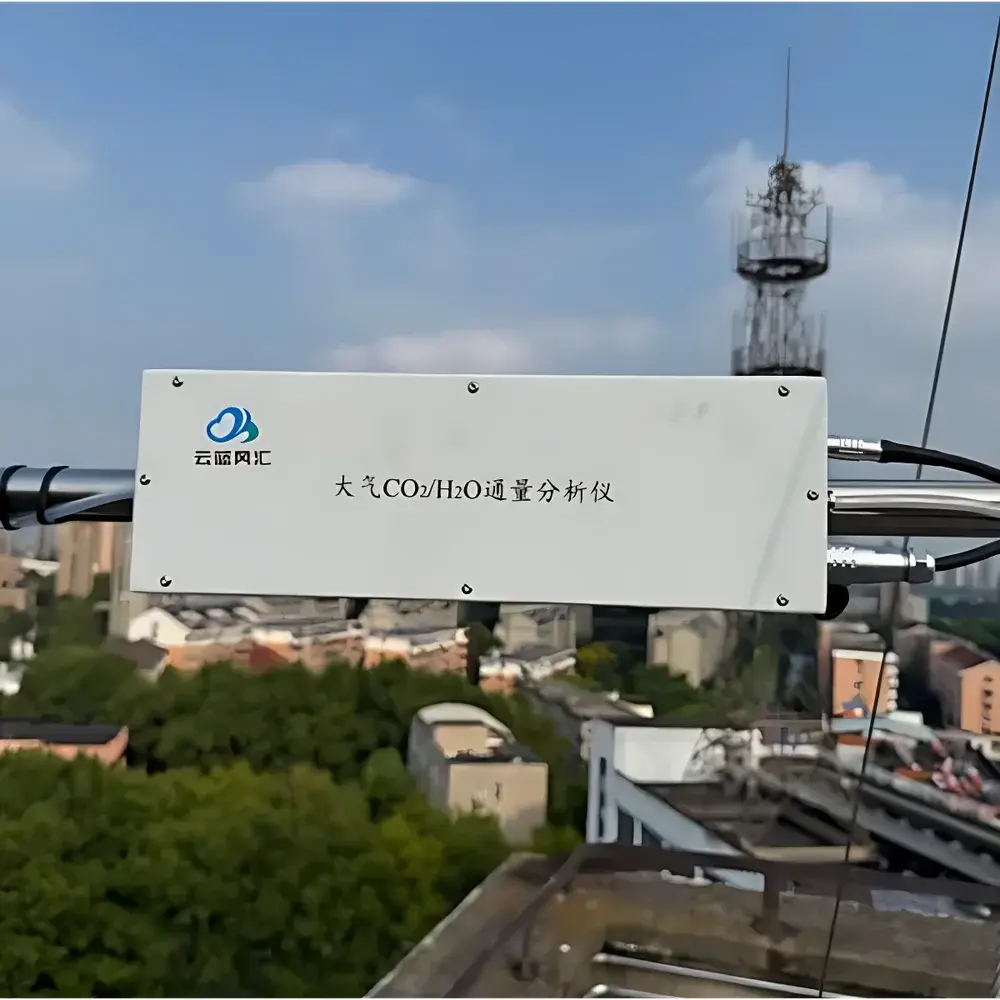
Azure Cloud & Wind Confluence YL-CH7700 Closed-Path Methane (CH₄) Gas Analyzer
| Brand | Azure Cloud & Wind Confluence |
|---|---|
| Origin | Jiangsu, China |
| Manufacturer Type | Authorized Distributor |
| Country of Origin | China |
| Model | YL-CH7700 Closed-Path Methane Gas Analyzer |
| Price | USD 8,400 (approx.) |
| Detection Principle | Tunable Diode Laser Absorption Spectroscopy (TDLAS) at ~1653 nm |
| Measurement Range | 0–25 µmol/mol @ −25°C, 0–40 µmol/mol @ 25°C |
| Resolution (RMS Noise) | 5 ppb @ 10 Hz |
| Linearity | <1% of reading |
| Operating Temperature | −25 to +50°C |
| Operating Pressure | 50–110 kPa |
| Data Output Bandwidth | Up to 20 Hz |
| Communication Interface | Ethernet (up to 40 Hz streaming) |
| Power Supply | 10.5–30 V DC |
| Power Consumption | 8 W (measurement), 16 W (cell cleaning) |
| Optical Path | 0.5 m physical path length, 30 m effective measurement path length |
| Sample Cell Volume | 18 mL |
| Dimensions | Ø14.33 cm × H82.8 cm |
| Weight | 5.2 kg |
| Calibration | Factory-calibrated across CO₂ and H₂O concentration gradients, temperature (−25 to +50°C), and pressure (50–110 kPa) ranges |
Overview
The Azure Cloud & Wind Confluence YL-CH7700 is a high-stability, closed-path methane (CH₄) gas analyzer engineered for continuous, field-deployable eddy covariance (EC) flux measurements in terrestrial and wetland ecosystems. It employs tunable diode laser absorption spectroscopy (TDLAS) at the near-infrared 1653 nm absorption line—selected for its strong CH₄ cross-section and minimal spectral interference from water vapor (H₂O) and carbon dioxide (CO₂). Unlike open-path systems, the YL-CH7700 draws ambient air through a thermally stabilized, heated sample cell via an integrated diaphragm pump, enabling consistent performance under rain, fog, frost, or high-humidity conditions. Its 18 mL ultra-compact optical cell minimizes residence time and system lag, critical for preserving high-frequency turbulence structure required by EC calculations. The instrument is designed for integration into SmartFlux-compatible EC systems, accepting PTPv2 (Precision Time Protocol) time stamps from GPS-synchronized dataloggers to ensure strict temporal alignment with 3D sonic anemometer and auxiliary sensor data.
Key Features
- Water-vapor-resistant TDLAS detection at 1653 nm—eliminates cross-sensitivity to H₂O without real-time correction algorithms
- Closed-path, pump-driven sampling architecture with heated inlet and cell—ensures stable operation across −25°C to +50°C and 50–110 kPa ambient conditions
- Factory calibration traceable across multi-dimensional parameter space: CH₄ (0–40 µmol/mol), CO₂ (0–2000 ppm), H₂O (0–30,000 ppm), temperature (−25 to +50°C), and pressure (50–110 kPa)
- Low power consumption: 8 W during measurement mode; compatible with solar-rechargeable battery systems for remote, off-grid deployments
- High temporal fidelity: 20 Hz analog output bandwidth and 40 Hz Ethernet data streaming support full-resolution covariance computation
- Robust mechanical design: aluminum alloy housing, IP65-rated connectors, and vibration-damped optical bench for long-term field reliability
Sample Compatibility & Compliance
The YL-CH7700 is optimized for atmospheric CH₄ analysis in ambient air streams with particulate loading typical of natural ecosystems (e.g., agricultural fields, peatlands, boreal forests, and tidal marshes). It meets core requirements for ecosystem-scale GHG monitoring under international protocols including ICOS (Integrated Carbon Observation System) Tier 1 specifications and the AmeriFlux/FLUXNET QA/QC guidelines. While not certified to IEC 61000-6-2/6-4 for industrial EMC, its EMI shielding and differential analog outputs comply with common environmental data acquisition standards. All firmware and calibration metadata adhere to CF (Climate and Forecast) Metadata Conventions v1.8, facilitating interoperability with FluxNet processing pipelines and NASA’s ORNL DAAC archiving workflows.
Software & Data Management
The analyzer communicates natively via TCP/IP over Ethernet using a documented ASCII command set and binary data frame protocol. Raw spectral absorbance, temperature, pressure, and diagnostic flags are streamed in real time. Configuration, zero/span validation, and cell cleaning cycles are controlled via a secure web interface (HTTPS) or CLI over serial-over-USB. Data output conforms to the standard EC variable naming schema (e.g., “ch4_mol_mol”, “ch4_sig”, “ch4_noise”) and supports NMEA-0183 timestamping when synchronized to a PTP-enabled GPS clock. For regulatory or audit-trail purposes, all calibration events, firmware updates, and configuration changes are logged with UTC timestamps and user-defined identifiers—enabling partial compliance with GLP documentation practices. Export formats include CSV, NetCDF-4, and HDF5.
Applications
- Long-term CH₄ flux quantification in managed and unmanaged ecosystems (rice paddies, restored wetlands, permafrost margins)
- Soil-atmosphere exchange studies requiring sub-ppb resolution and low drift (<0.5% drift over 30 days)
- Validation of satellite-based CH₄ retrievals (e.g., TROPOMI, GOSAT-2) via ground-truth tower networks
- Process-level modeling of methanogenesis and methanotrophy under climate manipulation experiments (e.g., warming, drought, inundation)
- Mobile platform integration (e.g., on-vehicle or drone-mounted configurations with flow conditioning and pressure regulation)
FAQ
Does the YL-CH7700 require external calibration gases during routine operation?
No—its factory calibration covers broad environmental and compositional gradients. Field zero checks can be performed using synthetic zero air; span verification is recommended annually using certified CH₄ standards traceable to NIST SRM 1658.
Can it operate unattended for >6 months in sub-zero conditions?
Yes—provided the inlet line and pump head are heated to >5°C and the instrument enclosure maintains internal temperature above −15°C via passive insulation or low-wattage heating. The specified −25°C lower limit applies to fully conditioned enclosures.
Is the 30 m effective optical path achieved via multipass reflection?
Yes—the 0.5 m physical cavity uses a Herriott-type multi-pass configuration with 60 reflections, yielding 30 m total path length while retaining compact form factor and thermal stability.
How is water vapor interference mitigated without software correction?
The 1653 nm laser targets a CH₄ absorption feature with intrinsic selectivity: H₂O absorption cross-section is <0.02% of CH₄’s at this wavelength, and residual overlap is suppressed by wavelength modulation spectroscopy (WMS-2f) with harmonic detection.
What level of data quality assurance does the YL-CH7700 support for FLUXNET submissions?
It provides all mandatory QA variables (signal-to-noise ratio, absorption depth, cell temperature stability, pressure compensation residuals) and complies with FLUXNET2015 Level 1 processing requirements when paired with a PTP-synchronized sonic anemometer and proper coordinate rotation.
Related Products







