Azure Cloud & Wind Confluence YL-T10 Stemflow Collector and Data Logger
| Brand | Azure Cloud & Wind Confluence |
|---|---|
| Origin | Jiangsu, China |
| Manufacturer Type | Authorized Distributor |
| Country of Origin | China |
| Model | YL-T10 Stemflow Collector and Data Logger |
| Measurement Range | 0–66,000 mL |
| Resolution | 4 mL |
| Memory Capacity | 16,000 data points |
| Data Download | Infrared interface + USB port |
| Memory Type | EEPROM (non-volatile) |
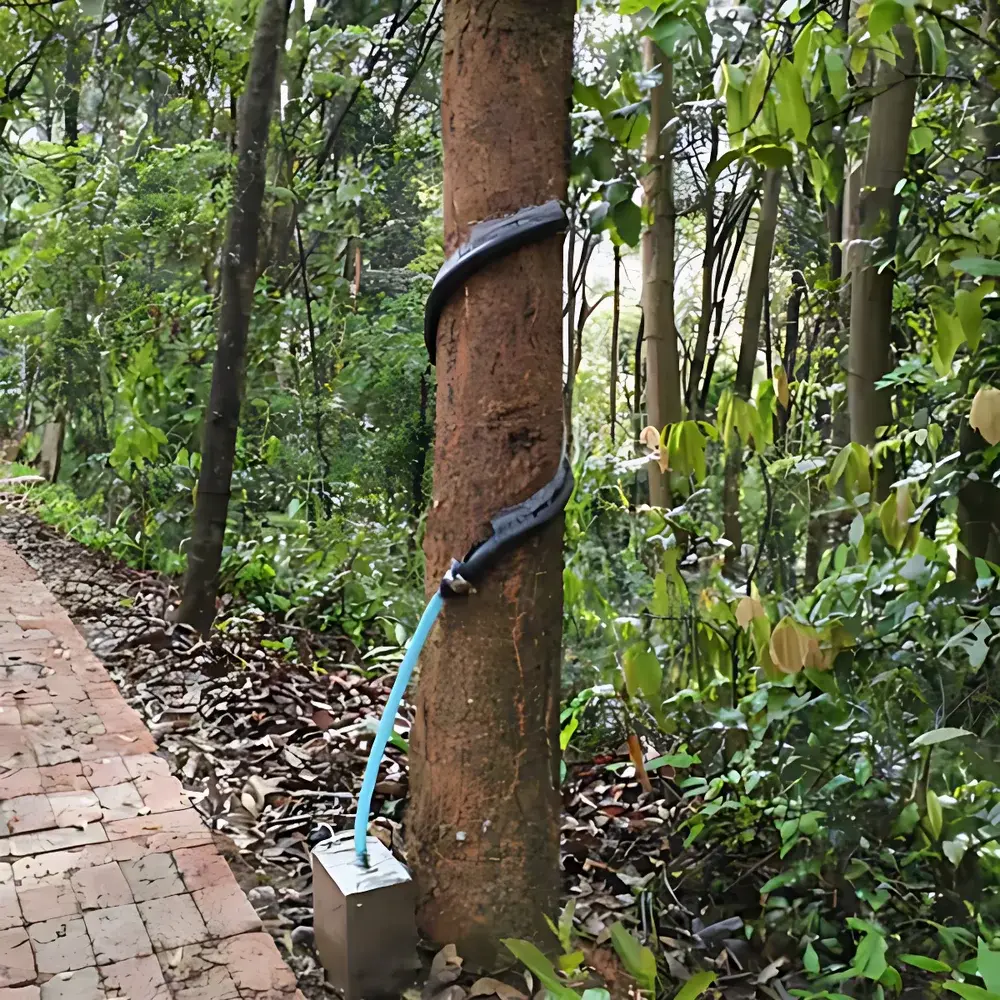
| Enclosure | Fully sealed, weatherproof housing for field deployment on tree trunks or in forest understory |
| LED Status Indicator | Integrated visual status feedback |
| Battery Life | ~12 months (typical field use) |
| Event Time Resolution | 1 second |
| Temperature Sensing Range | −20 to +70 °C |
| Temperature Accuracy | ±0.5 °C |
| Temperature Resolution | 0.1 °C |
| Real-Time Clock Accuracy | ±1 minute per week |
Overview
The Azure Cloud & Wind Confluence YL-T10 Stemflow Collector and Data Logger is a purpose-built environmental monitoring instrument engineered for long-term, unattended quantification of stemflow—the portion of incident precipitation that travels down the bark surface of tree trunks following canopy interception. Stemflow represents a critical hydrological pathway influencing soil moisture distribution, nutrient leaching, microbial activity, and localized erosion dynamics beneath individual trees. Unlike throughfall or rainfall gauges, the YL-T10 integrates a physically coupled collection funnel with an embedded volumetric sensor and time-synchronized datalogger, enabling high-temporal-resolution capture of discrete stemflow events under variable canopy conditions. Its design adheres to established field methodology standards for stemflow measurement (e.g., ISO 18400-102 for soil sampling context, ASTM D4292 for hydrological instrumentation durability), ensuring data compatibility with peer-reviewed ecological modeling frameworks such as SWAT, MIKE SHE, or ecosystem water balance models.
Key Features
- Integrated stemflow funnel assembly with low-profile, adjustable trunk-mounting hardware—designed to minimize canopy disturbance and avoid flow diversion artifacts.
- Volumetric displacement sensor calibrated for continuous accumulation over extended periods; 4 mL resolution supports detection of small-diameter tree events while maintaining linearity across the full 0–66,000 mL range.
- Non-volatile EEPROM memory retains up to 16,000 timestamped records without power; no risk of data corruption during battery replacement or seasonal dormancy intervals.
- Hermetically sealed enclosure rated IP67—resistant to rain, dust, fungal growth, and temperature extremes (−20 to +70 °C), enabling multi-season deployment on hardwoods, conifers, or agroforestry species.
- Onboard temperature sensor (±0.5 °C accuracy) co-located with the collection chamber to support correction of thermal expansion effects in volume calculations and contextual interpretation of sap flow coupling.
- Programmable real-time clock with ±1 minute/week drift tolerance; users define start date/time, logging interval (1 s to 24 h), and auto-reset parameters via infrared configuration tool.
Sample Compatibility & Compliance
The YL-T10 is validated for use on tree stems ≥5 cm DBH (diameter at breast height) across temperate, subtropical, and Mediterranean forest biomes. Its modular mounting system accommodates bark textures ranging from smooth (e.g., beech, maple) to deeply fissured (e.g., oak, pine). All materials—including food-grade silicone gaskets, UV-stabilized ABS housing, and stainless-steel fasteners—meet EU REACH Annex XVII restrictions and are inert under prolonged exposure to tannic acid, phloem exudates, and organic leachates. The device complies with GLP-aligned data integrity principles: each record includes UTC timestamp, cumulative volume, ambient temperature, and internal battery voltage—enabling traceability in regulatory or publication-grade datasets.
Software & Data Management
Data retrieval is performed using the proprietary IR-USB Bridge Tool (Windows/macOS compatible), which establishes encrypted handshake with the logger’s infrared transceiver. Exported CSV files contain ISO 8601 timestamps, milliliter increments, temperature readings, and diagnostic flags (e.g., overflow, low-battery warning, sensor timeout). No cloud dependency or vendor-specific subscription is required. Raw files conform to FAIR data principles (Findable, Accessible, Interoperable, Reusable) and integrate natively with R (via stemflowR package), Python (Pandas + Matplotlib), or MATLAB workflows. Audit trails—including download history, firmware version, and calibration metadata—are preserved locally.
Applications
- Quantifying species-specific stemflow partitioning in mixed-species stands to inform canopy interception parameterization for regional hydrologic models.
- Assessing temporal shifts in stemflow magnitude and timing associated with drought stress, phenological transitions, or invasive pest infestation (e.g., emerald ash borer).
- Validating remote-sensing estimates of forest evapotranspiration by ground-truthing sub-canopy water redistribution patterns.
- Supporting urban forestry initiatives—measuring stemflow from street trees to optimize bioswale loading and stormwater capture efficiency.
- Long-term ecological research (LTER) sites requiring >12-month autonomous operation with minimal site visits.
FAQ
Can the YL-T10 be deployed on sloped terrain or leaning trunks?
Yes—the mounting bracket incorporates a self-leveling gimbal mechanism that maintains vertical orientation of the collection funnel regardless of trunk inclination up to ±15°.
Is firmware upgrade supported in the field?
Firmware updates require connection via the IR-USB Bridge Tool and are delivered as signed binary patches; no internet access is needed during installation.
How is sensor calibration verified post-deployment?
A standardized 50-mL gravimetric validation protocol is included in the user manual; field recalibration is not required under normal operating conditions due to solid-state sensor architecture.
Does the device meet FDA or EPA regulatory requirements for environmental monitoring?
While not certified for clinical or drinking-water applications, its construction, documentation, and data structure align with EPA Method 1669 (ambient water quality monitoring) and ISO/IEC 17025 laboratory environmental data handling guidelines.
What is the recommended maintenance schedule?
Biannual visual inspection for debris accumulation and gasket integrity; no routine cleaning of internal components is necessary due to the sealed design and passive drainage geometry.