
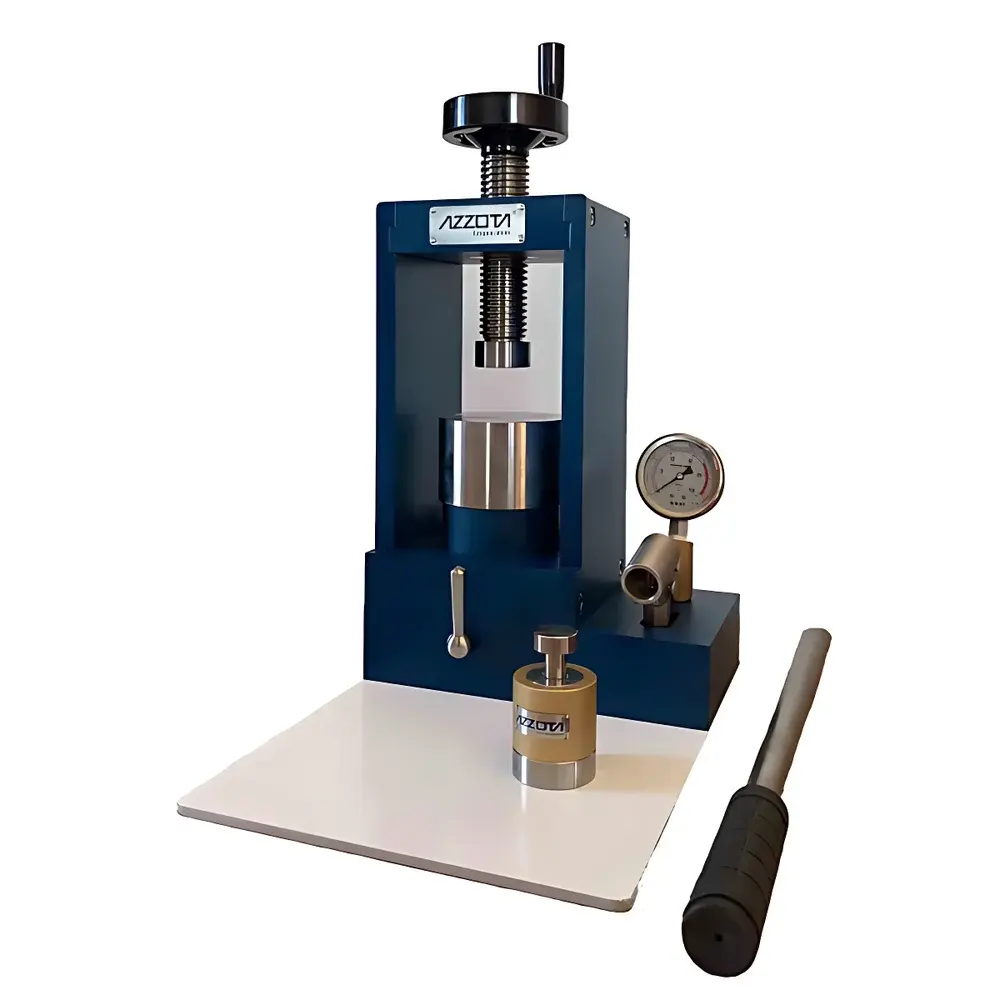
AZZOTA BHY-81B Laboratory Hydraulic Pellet Press
| Brand | AZZOTA |
|---|---|
| Origin | USA |
| Manufacturer Type | Authorized Distributor |
| Import Status | Imported |
| Model | BHY-81B Laboratory Hydraulic Pellet Press |
| Working Pressure | 60 MPa (20 ton force) |
| Clamp Travel Range | 0–10 cm |
| Platen Stroke | 4.5 cm |
| Platen Diameter | 10 cm |
| Pressure Gauge Range | 0–100 MPa |
| Dimensions (W×D×H) | 30 × 25 × 35 cm |
| Net Weight | 30 kg |
| Die Diameter | 13 mm (customizable) |
| Construction | Stainless steel platens |
| Operation | Manual |
| Display | Analog pressure gauge with real-time reading |
Overview
The AZZOTA BHY-81B Laboratory Hydraulic Pellet Press is a precision-engineered manual hydraulic press designed specifically for reproducible sample compaction in analytical preparation workflows. It operates on the principle of static hydraulic force transmission, where hand-pumped oil pressure is converted into controlled, unidirectional compressive load applied between two parallel stainless steel platens. This mechanism ensures high mechanical advantage and minimal force drift during dwell—critical for producing homogeneous, binder-free pellets required in Fourier Transform Infrared (FTIR) spectroscopy, X-ray fluorescence (XRF), and powder X-ray diffraction (PXRD) sample preparation. Unlike pneumatic or motorized systems, the BHY-81B’s purely mechanical design eliminates electrical dependencies, reduces calibration drift, and supports operation in environments with strict electromagnetic compatibility (EMC) or explosion-proof requirements. Its fixed 10 cm platen diameter and 4.5 cm stroke provide optimal alignment stability for sub-millimeter die sets, minimizing edge shear and ensuring uniform density distribution across pellet cross-sections.
Key Features
- Manual hydraulic actuation with dual-stage hand pump for fine-grained pressure control and operator feedback
- Real-time analog pressure gauge (0–100 MPa range) calibrated to ISO 9001 traceable standards, enabling direct correlation between displayed pressure and applied load
- Stainless steel platens (AISI 304) with hardened, ground surfaces (Ra ≤ 0.4 µm) to prevent sample adhesion and ensure repeatable surface contact geometry
- Compact footprint (30 × 25 × 35 cm) and low center of gravity—designed for benchtop integration without vibration isolation platforms
- Adjustable clamp travel (0–10 cm) accommodates stacked die assemblies, spacer rings, and custom-height tooling configurations
- Die compatibility with standard 13 mm diameter punches and dies per ASTM E1792 and ISO 13528; optional adapters available for 6 mm, 10 mm, and 32 mm formats
Sample Compatibility & Compliance
The BHY-81B supports dry, solvent-free compression of diverse powdered matrices—including inorganic salts (e.g., KBr, NaCl), polymers, pharmaceutical actives, geological sediments, and catalyst precursors—without thermal degradation or phase separation. Its 60 MPa maximum working pressure meets the minimum consolidation threshold for FTIR-grade KBr pellets (typically 8–15 tons, ~25–50 MPa), while remaining below the yield stress of common tool steels (e.g., H13, ~1,200 MPa), ensuring long-term die integrity. The system complies with GLP documentation requirements for manual instrumentation: pressure readings are directly observable and non-erasable during operation, supporting audit-ready lab notebooks. Though not electronically validated, its mechanical simplicity aligns with FDA 21 CFR Part 11 Annex A guidance for “non-electronic records,” making it suitable for regulated QC labs performing routine spectral reference material preparation under USP and EP 2.2.25.
Software & Data Management
As a fully manual, non-digital instrument, the BHY-81B does not incorporate embedded firmware, data logging, or software interfaces. All operational parameters—including applied pressure, dwell time, and die configuration—are recorded manually by the user in laboratory notebooks or LIMS-integrated electronic lab notebooks (ELNs). This architecture eliminates cybersecurity vulnerabilities, firmware obsolescence risks, and validation overhead associated with computer-controlled presses. For laboratories requiring digital traceability, third-party USB pressure transducers (e.g., Omega PX409 series) may be mounted externally and interfaced via DAQ systems compliant with ISO/IEC 17025 clause 5.9.2 for measurement uncertainty propagation.
Applications
- Preparation of transparent KBr pellets for mid-IR transmission spectroscopy (ASTM E1421)
- Density-controlled compaction of XRF fusion beads and pressed powder discs for elemental quantification
- Manufacture of standardized reference tablets for NIR method transfer and PLS model development
- Consolidation of battery electrode slurries onto current collectors for electrochemical characterization
- High-pressure pre-forming of ceramic green bodies prior to sintering (≤ 60 MPa)
- Calibration verification of load cells and pressure sensors using NIST-traceable deadweight testers
FAQ
What is the maximum recommended dwell time at full pressure?
For optimal pellet homogeneity and minimal elastic recovery, dwell times between 30–60 seconds are empirically validated for most inorganic matrices. Extended dwell (>120 s) offers diminishing returns and increases risk of platen creep in ambient temperature fluctuations.
Can the BHY-81B be used with heated dies?
No. The press lacks integrated heating capability or thermal management features. Use only ambient-temperature dies; elevated-temperature applications require externally heated platens with independent temperature controllers and safety interlocks.
Is calibration certification included with shipment?
Each unit ships with a factory-issued pressure calibration certificate (ISO/IEC 17025 accredited), valid for 12 months from date of manufacture. Recalibration is recommended annually or after 500 operational cycles, whichever occurs first.
What maintenance intervals are specified for hydraulic oil and seals?
Hydraulic oil (ISO VG 32 mineral oil) must be replaced every 24 months or after 1,000 operating hours. O-ring seals in the pump cylinder should be inspected quarterly and replaced if swelling, cracking, or leakage is observed.
Does AZZOTA offer GMP-compliant installation qualification (IQ) documentation?
Yes—upon request, AZZOTA provides customizable IQ templates aligned with ASTM E2500 and EU Annex 15, including platen parallelism verification, pressure linearity testing, and mechanical stability assessment reports.



