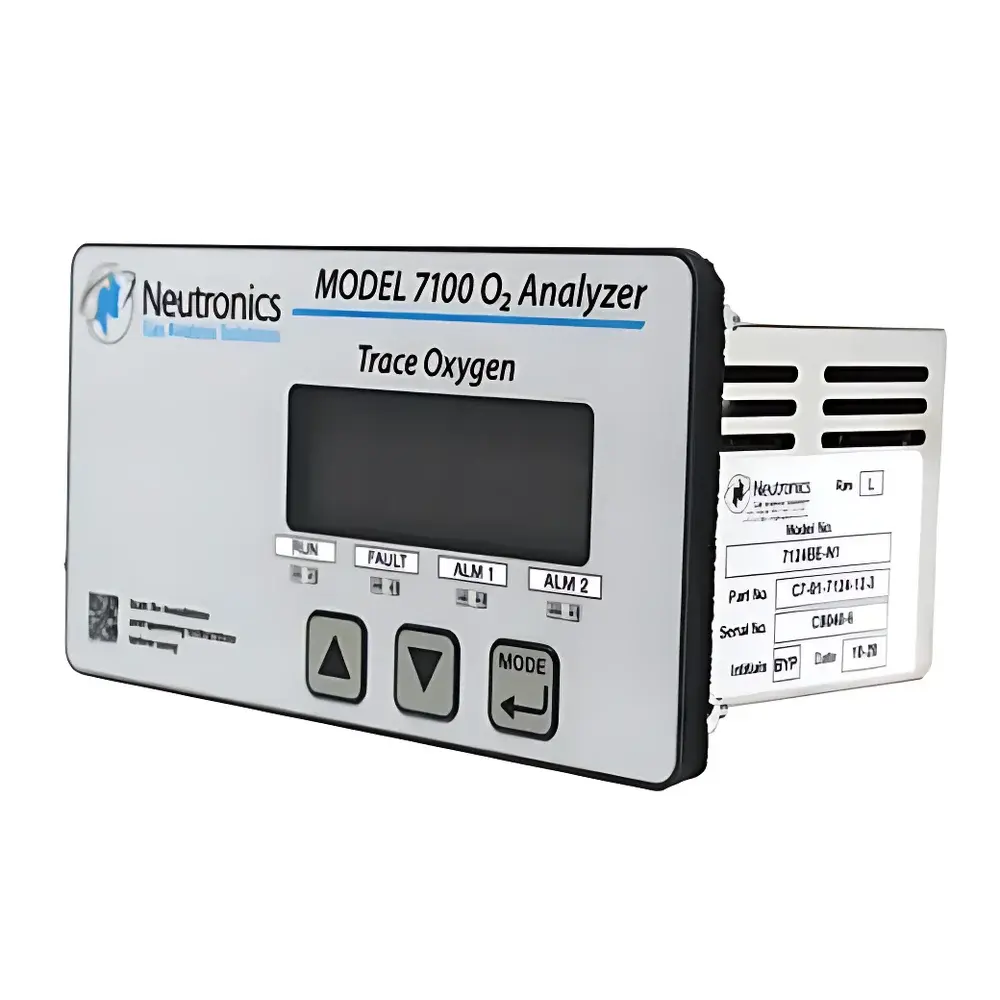
Bacharach Neutronics 7100 Compact Oxygen Analyzer
| Brand | Bacharach |
|---|---|
| Origin | USA |
| Model | 7100 |
| Measurement Range | 0–100 ppm / 0–1000 ppm |
| Sensor Type | Miniature Zirconia (ZR-400) |
| Accuracy | ±2.0% of reading or ±3 ppm (whichever is greater) |
| Response Time (T90) | <10 s at 500 mL/min |
| Display | 0.75" LED numeric |
| Enclosure Rating | Front panel NEMA 4 (IP66), Electronics chassis NEMA 1 (IP20) |
| Operating Temperature | 5–40°C |
| Humidity | 0–95% RH non-condensing |
| Power Input | 90–264 VAC or 24 VDC |
| Analog Outputs | 0–1 VDC, 0–5 VDC, 0–10 VDC, 4–20 mA |
| Digital Interface | RS-232 service port |
| Relay Outputs | 2 field-adjustable alarm relays + 1 fixed system fault relay |
| Sample Connection | 1/8" NPT female |
| Weight | <2.2 kg |
Overview
The Bacharach Neutronics 7100 Compact Oxygen Analyzer is an industrial-grade, zirconia-based electrochemical analyzer engineered for high-stability trace oxygen measurement in inert gas streams, purge environments, and controlled-atmosphere processes. Utilizing a miniature high-temperature zirconia (ZR-400) sensing element operating at ~700°C, the instrument detects oxygen partial pressure via the Nernst principle—generating a millivolt signal proportional to the logarithm of O₂ concentration. This solid-electrolyte cell architecture ensures long-term baseline stability, minimal drift, and immunity to background gas interference (e.g., CO₂, N₂, Ar, He), making it suitable for applications where catalytic or paramagnetic methods exhibit cross-sensitivity or calibration drift. Designed for continuous unattended operation, the 7100 integrates a built-in sampling pump, internal flow control, and temperature-compensated signal processing to deliver repeatable measurements across its dual-range configuration (0–100 ppm and 0–1000 ppm). Its compact footprint and modular sensor mounting—supporting both direct panel integration and remote probe installation via KF vacuum flange options—enable seamless deployment in nitrogen blanketing systems, glovebox monitoring, semiconductor purge lines, heat-treat furnace atmospheres, and pharmaceutical inerting validation.
Key Features
- ZR-400 miniature zirconia sensor with integrated heater and thermocouple for precise thermal regulation and rapid thermal equilibration
- Dual-range auto-ranging capability: 0–100 ppm and 0–1000 ppm full-scale, selectable via front-panel menu or remote command
- Response time T90 < 10 seconds under nominal sample flow (500 mL/min), validated per ASTM D6299 precision protocols
- Weathertight NEMA 4 (IP66) front panel enclosure rated for washdown and outdoor-rated industrial enclosures; electronics chassis meets NEMA 1 (IP20) for indoor control cabinet mounting
- Configurable analog outputs: isolated 4–20 mA (HART-compatible wiring), plus selectable 0–1 VDC, 0–5 VDC, or 0–10 VDC signals for PLC/DCS integration
- Two independently adjustable alarm relays with user-defined setpoints and hysteresis; one dedicated system fault relay for critical diagnostics (e.g., sensor open-circuit, heater failure, power loss)
- LED status indicators: green for normal operation and online status, amber for fault conditions including sensor timeout, calibration overdue, or flow error
- RS-232 serial service port enabling firmware updates, diagnostic logging, and configuration backup per IEC 62443-3-3 secure maintenance practices
Sample Compatibility & Compliance
The Neutronics 7100 is compatible with dry, non-corrosive, particle-free process gases including nitrogen, argon, helium, hydrogen, and carbon dioxide—provided dew point remains below –40°C and hydrocarbon content is <1 ppmv. Condensable vapors, acidic gases (e.g., HCl, SO₂), and halogenated compounds must be removed upstream via appropriate filtration or scrubbing. The analyzer complies with UL 61010-1 (3rd Ed.) for electrical safety and meets EMC requirements per CISPR 11 Group 1, Class A. While not intrinsically safe, it may be installed in Zone 2/Class I Div 2 areas when mounted in approved purged or pressurized enclosures. Data integrity and audit readiness are supported through timestamped event logging (power cycles, alarm triggers, calibration events) aligned with GLP/GMP documentation expectations. Though not FDA 21 CFR Part 11–certified out-of-box, its deterministic relay behavior, non-volatile configuration storage, and RS-232 log export facilitate validation under ISO 13485 or Annex 11 frameworks.
Software & Data Management
The 7100 operates without external software dependency—configuration, calibration, and diagnostics are executed locally via intuitive front-panel navigation. All operational parameters—including range selection, alarm thresholds, analog output scaling, and zero/span calibration coefficients—are stored in non-volatile EEPROM with write-protection logic to prevent inadvertent overwrite. Calibration history (date, operator ID if entered manually, span gas value, pre- and post-calibration readings) is retained for ≥100 entries. The RS-232 interface supports ASCII command protocol for remote readout of real-time O₂ value, status flags, and diagnostic codes—enabling integration into SCADA historians or custom Python/LabVIEW acquisition scripts. No cloud connectivity or proprietary drivers are required; communication adheres to standard EIA/TIA-232-F physical layer specifications.
Applications
- Continuous monitoring of residual oxygen in nitrogen-purged transformers, switchgear, and cable splicing enclosures per IEEE C57.12.00
- Inert atmosphere verification in pharmaceutical lyophilization chambers and API synthesis reactors (USP compliant packaging validation support)
- Heat-treating furnace atmosphere control (e.g., bright annealing of stainless steel, brazing of aluminum alloys)
- Glovebox and dry-room O₂ ingress detection in battery electrode manufacturing and R&D labs
- Quality assurance of high-purity bulk gases supplied to semiconductor fab tools (SEMI F20-0201 trace impurity monitoring)
- Leak testing of sealed packages using accelerated oxygen-permeation challenge protocols
FAQ
What is the recommended calibration frequency for the Neutronics 7100?
Calibration interval depends on application severity and regulatory requirements; Bacharach recommends initial calibration upon installation, followed by quarterly verification using certified zero (N₂ ≥99.999%) and span (e.g., 100 ppm O₂ in N₂) standards. In GMP environments, daily zero checks and weekly span verification are typical.
Can the ZR-400 sensor be replaced in the field?
Yes—the ZR-400 sensor module is a user-replaceable subassembly requiring only a Torx T10 driver; replacement takes <5 minutes and does not require factory recalibration, though post-replacement verification is advised.
Is the 7100 suitable for measuring oxygen in hydrogen-rich environments?
Yes—zirconia sensors are inherently insensitive to H₂ concentration up to 100%, provided gas is dry and free of catalyst poisons (e.g., silicone vapors, metal hydrides); however, thermal conductivity effects from high H₂ content may influence flow-dependent response stability.
Does the unit support Modbus RTU or Ethernet communication?
No—only RS-232 serial communication is natively supported; Modbus or Ethernet requires third-party protocol converters certified for industrial use.
What maintenance is required beyond calibration?
Periodic inspection of inlet filter (if installed), verification of sample line integrity, and visual check of LED indicators constitute routine maintenance; no consumables other than optional particulate filters are required during normal operation.