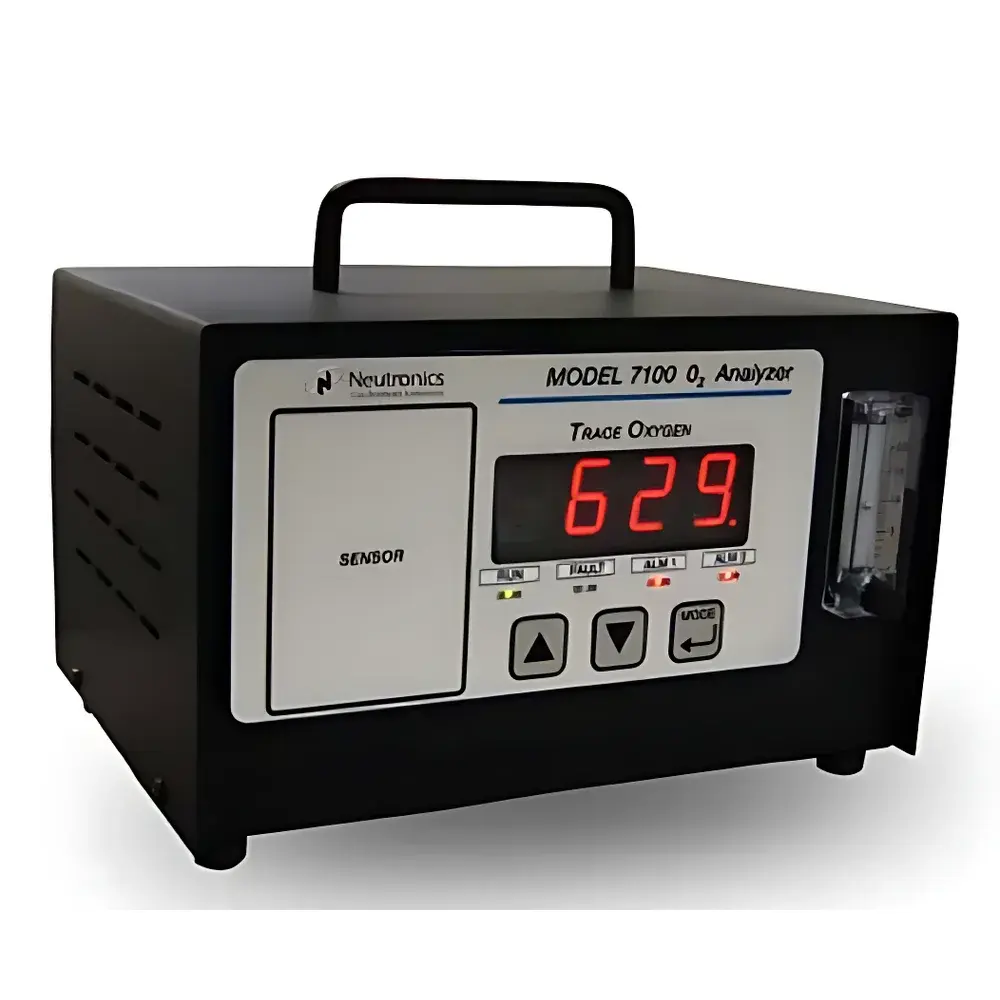
Bacharach Neutronics 7100P Portable Trace Oxygen Analyzer
| Brand | Bacharach |
|---|---|
| Origin | USA |
| Model | 7100P |
| Measurement Range | 0–100 ppm / 0–1000 ppm (auto-ranging) |
| Sensor Type | Miniature Zirconia (ZR-400) |
| Accuracy | ±3 ppm or ±2.0% of reading (whichever is greater) |
| Response Time | <15 s T90 at 500 mL/min |
| Sample Interface | 1/8" NPT female |
| Enclosure Rating | Front Panel — NEMA 4 (IP66), Electronics Chassis — NEMA 1 (IP20) |
| Display | 0.75" LED, dual-color (green = normal/online, yellow = fault) |
| Alarms | Two user-configurable relay alarms + one fixed system-fault relay |
| Analog Outputs | 0–1 VDC, 0–5 VDC, 0–10 VDC, and 4–20 mA |
| Digital Interface | RS-232 service port |
| Power Supply | 90–264 VAC or 24 VDC |
| Operating Temperature | 5–40 °C (41–104 °F) |
| Relative Humidity | 0–95% RH (non-condensing) |
| Weight | <2.2 kg |
Overview
The Bacharach Neutronics 7100P Portable Trace Oxygen Analyzer is an engineered solution for high-precision, field-deployable oxygen quantification in ultra-pure inert gas streams. It employs a miniature zirconia-based electrochemical sensor (ZR-400), operating on the principle of oxygen ion conduction across a stabilized zirconium dioxide electrolyte at elevated temperature (~650 °C). This solid-state sensing architecture delivers stable, drift-resistant performance without consumables or external reference gases—critical for applications demanding long-term reliability in nitrogen, argon, helium, and other high-purity carrier gases. Designed for both spot-check verification and continuous monitoring in mobile or temporary installations, the 7100P integrates a built-in sampling pump, flow-controlled measurement path, and real-time digital display to support rapid, repeatable trace-level analysis down to sub-ppm resolution.
Key Features
- Miniaturized zirconia sensor (ZR-400) with integrated heater and thermistor for precise thermal management and signal stability
- Auto-ranging dual-scale operation: 0–100 ppm and 0–1000 ppm, optimized for detection limits and dynamic range coverage
- Integrated sample pump enabling both extractive and positive-pressure sampling configurations without external vacuum sources
- NEMA 4 (IP66)-rated front panel housing for outdoor or industrial environments—resistant to dust ingress, water jets, and corrosion
- Dual-color LED display (0.75″ digit height) with intuitive status indication: green for operational readiness and online measurement, yellow for fault conditions
- Configurable analog outputs (0–1 VDC, 0–5 VDC, 0–10 VDC, and 4–20 mA) supporting integration into PLCs, DCS systems, or data loggers
- Two independently adjustable alarm relays with user-defined setpoints; plus a dedicated non-adjustable system-fault relay for critical diagnostics
- RS-232 serial service port for firmware updates, calibration verification, and diagnostic logging
Sample Compatibility & Compliance
The 7100P is validated for use with non-reactive, dry, particle-free inert gases including nitrogen (N₂), argon (Ar), helium (He), and hydrogen (H₂) at pressures up to 100 psig. It is not intended for corrosive, condensing, or hydrocarbon-laden streams. While not certified to ATEX or IECEx for hazardous areas, its robust mechanical design and electrical isolation meet general-purpose industrial safety expectations per UL 61010-1 and CE marking requirements (EMC Directive 2014/30/EU, LVD Directive 2014/35/EU). The instrument supports audit-ready operation under GLP and GMP frameworks through timestamped calibration records, relay event logs, and output signal traceability—facilitating compliance with FDA 21 CFR Part 11 when paired with validated data acquisition software.
Software & Data Management
Although the 7100P operates as a standalone analyzer with no embedded graphical interface or onboard storage, its RS-232 port enables bidirectional communication with host systems for remote configuration, real-time data streaming, and calibration parameter upload/download. Third-party SCADA platforms and laboratory information management systems (LIMS) can ingest analog outputs or serial data via standard Modbus RTU or ASCII protocols. Calibration history—including date, operator ID (if entered manually), span gas concentration, and zero offset—is retained in volatile memory and accessible via serial query. For regulated environments, users are advised to implement external logging solutions with electronic signature and audit trail capabilities to satisfy 21 CFR Part 11 requirements.
Applications
- Verification of inert gas purity prior to semiconductor wafer processing, metal heat treatment, and pharmaceutical blanketing
- Leak detection and purge validation in gloveboxes, inert atmosphere chambers, and cryogenic storage systems
- Quality assurance testing of bulk gas deliveries (e.g., liquid nitrogen dewars, high-pressure cylinder banks)
- Field calibration and cross-validation of fixed-mount oxygen analyzers in petrochemical, power generation, and food packaging facilities
- Research and development labs requiring portable, low-drift trace O₂ measurement in controlled gas synthesis or catalysis experiments
FAQ
What is the lowest detectable oxygen concentration?
The instrument achieves a practical lower limit of detection (LOD) of approximately 1 ppm O₂ under optimal flow and temperature conditions, based on sensor noise floor and signal-to-noise ratio.
Can the 7100P be used in humid or wet gas streams?
No. Condensation or excessive moisture will damage the zirconia sensor and compromise accuracy. Sample gas must be dried to a dew point ≤ –20 °C prior to introduction.
Is the ZR-400 sensor replaceable in the field?
Yes. The sensor module is designed for user-level replacement using standard tools and calibrated reference gas—no factory recalibration required if replacement follows documented procedures.
Does the analyzer support automatic zero and span calibration?
It supports manual zero and span adjustments via front-panel controls or RS-232 commands, but does not include automated calibration sequences or solenoid-valve manifolds.
What maintenance intervals are recommended?
Sensor life is typically 18–24 months under continuous operation; annual verification against traceable standards is recommended. Filter elements should be inspected quarterly and replaced if particulate loading is observed.
Related Products