
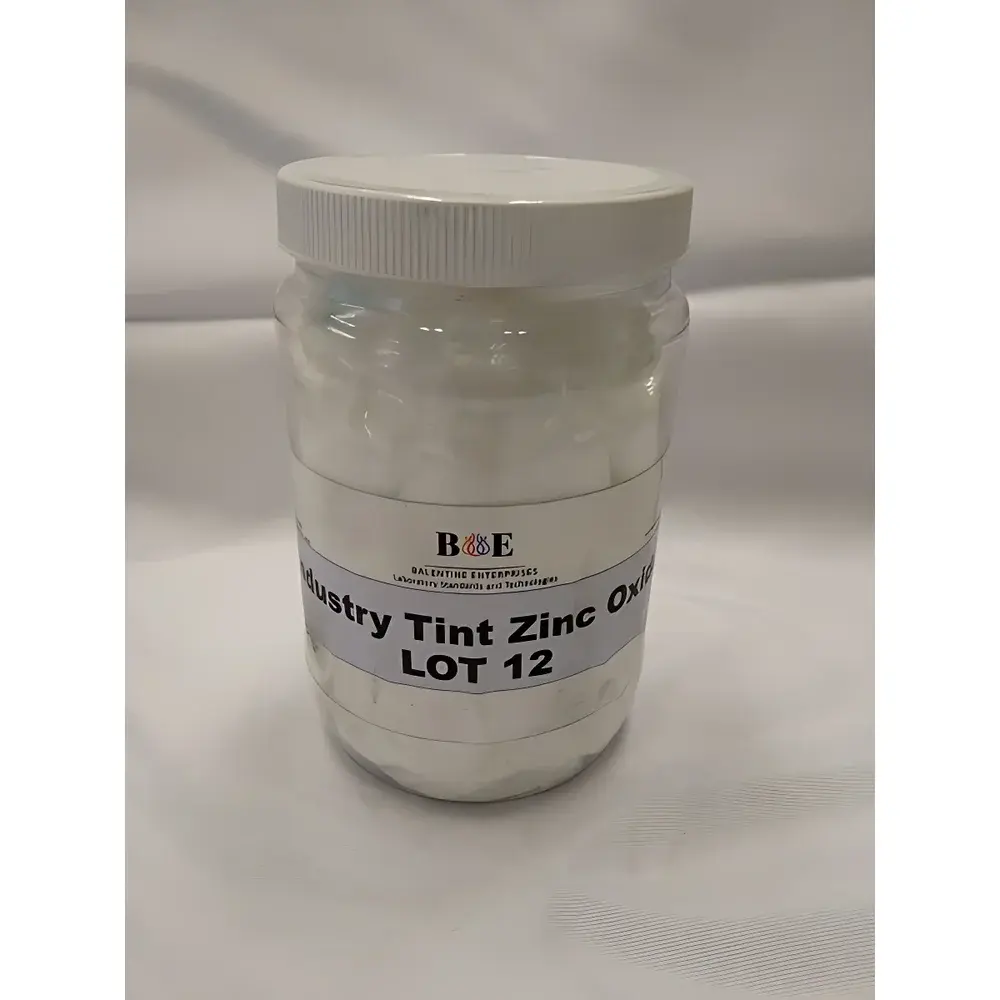
Balentine Enterprises ASTM D3265-Compliant Pigment-Grade Zinc Oxide (ZnO) for Carbon Black Coloring Applications
| Brand | Balentine Enterprises (B&E) |
|---|---|
| Origin | USA |
| Supplier Type | Authorized Distributor |
| Import Status | Imported |
| Material Grade | Pigment-Grade ZnO |
| Purity (ZnO) | >99.9% |
| Specific Surface Area | 2.97 m²/g |
| Pb Content | 0.0011% |
| Cd Content | <0.0001% |
| Fe Content | <0.0001% |
| Moisture | 0.09% |
| +325 Mesh Retain | <0.0001% |
Overview
Balentine Enterprises ASTM D3265-Compliant Pigment-Grade Zinc Oxide is a high-purity, tightly controlled inorganic pigment engineered specifically for colorant systems requiring precise optical neutrality and chemical compatibility with carbon black dispersions. Unlike conventional zinc oxide used in rubber or pharmaceutical applications, this grade conforms strictly to ASTM D3265—Standard Specification for Zinc Oxide Used in Rubber Compounding—and has been further refined for pigmentary performance in coloring formulations. Its crystalline wurtzite structure, low heavy metal impurities, and narrowly distributed particle morphology ensure batch-to-batch reproducibility in tinting strength, dispersion stability, and UV-absorbing consistency. The material exhibits a refractive index of n = 1.9, enabling superior transparency in polymer matrices compared to titanium dioxide (n = 2.6), while maintaining high UV attenuation (>98% UVA/UVB absorption) without compromising chromatic fidelity in carbon black–based systems. This makes it particularly suitable for applications demanding both spectral neutrality and functional performance under accelerated weathering or thermal aging conditions.
Key Features
- Full compliance with ASTM D3265 specification for pigment-grade ZnO, including trace metal limits (Pb, Cd, Fe), moisture content (<0.1%), and sieve retention (+325 mesh <0.0001%)
- High chemical purity (>99.9% ZnO), verified by ICP-OES and XRF analysis per ISO 17025-accredited methods
- Controlled specific surface area (2.97 m²/g), optimized for balanced dispersibility and minimal viscosity build in solvent- and water-based colorants
- Low refractive index minimizes light scattering, preserving depth and clarity in black and near-black formulations
- Thermally stable up to 1800°C; non-hygroscopic and chemically inert toward common organic dispersants and resin binders
- Available in both uncoated and silica/alumina surface-treated variants for enhanced compatibility with acrylic, polyester, and polyurethane dispersion systems
Sample Compatibility & Compliance
This zinc oxide grade demonstrates proven compatibility with carbon black grades such as N110, N220, and N330 in masterbatch, ink, and coating formulations. It meets the raw material requirements specified in ISO 9001-certified manufacturing environments and supports GMP-aligned documentation packages for regulated end uses. While not classified as a pharmaceutical excipient, its impurity profile aligns with USP heavy metals limits and EU REACH Annex XVII thresholds. Batch-specific CoA includes full elemental analysis, BET surface area, loss on ignition (LOI), and particle size distribution (PSD) by laser diffraction (D50 < 0.5 µm). Documentation supports audit readiness for FDA 21 CFR Part 11-compliant quality management systems when integrated into validated production workflows.
Software & Data Management
Balentine Enterprises provides digital batch traceability via secure PDF CoAs embedded with QR-coded lot identifiers. Each certificate includes machine-readable metadata compliant with ASTM E2942 (Standard Practice for Electronic Exchange of Certificate of Analysis Data). For enterprise clients, API integration is available with LIMS platforms (e.g., LabWare, Thermo Fisher SampleManager) to automate QC data ingestion, trend analysis, and non-conformance flagging. All analytical reports conform to ISO/IEC 17025:2017 clause 7.8 requirements for result reporting, including measurement uncertainty statements where applicable (e.g., ±0.03 m²/g for BET surface area).
Applications
- Rubber compounding: Acts as co-activator with stearic acid in sulfur-cured systems, reducing ZnO loading by up to 30% while maintaining scorch safety and crosslink density
- Automotive coatings: Enhances UV resistance in carbon-black-pigmented basecoats without grayish undertones or haze formation
- Functional textiles: Enables durable UV-shielding and antimicrobial performance in polyester and nylon fibers without interfering with dye uptake
- Ceramic glazes: Serves as flux and opacifier in low-temperature frit formulations (≤1150°C), improving gloss and thermal shock resistance
- Defense-grade composites: Incorporated into radar-absorbing materials (RAM) due to intrinsic dielectric loss tangent and infrared absorption coefficient (ε″ > 0.8 at 8–12 µm)
FAQ
Is this material certified to ASTM D3265?
Yes—each production lot undergoes third-party verification against all mandatory test parameters in ASTM D3265, including assay, heavy metals, and sieve analysis.
Can it be used in food-contact or pharmaceutical applications?
No—this grade is designated for industrial pigment and rubber compounding use only; it does not meet USP or EP monograph requirements for excipients.
What is the recommended dispersion method for high-solids ink formulations?
Two-stage process: pre-wet with aliphatic hydrocarbon solvent followed by high-shear homogenization (≥15,000 rpm) for ≥20 minutes; sonication is not required.
Do you provide technical support for formulation optimization?
Yes—Balentine Enterprises offers application engineering support, including rheological profiling, dispersion stability testing, and accelerated weathering correlation studies.
Are SDS and TDS documents available in multiple languages?
English-language SDS and TDS are provided with every shipment; localized versions (German, French, Japanese) are available upon request with 3-business-day lead time.



