
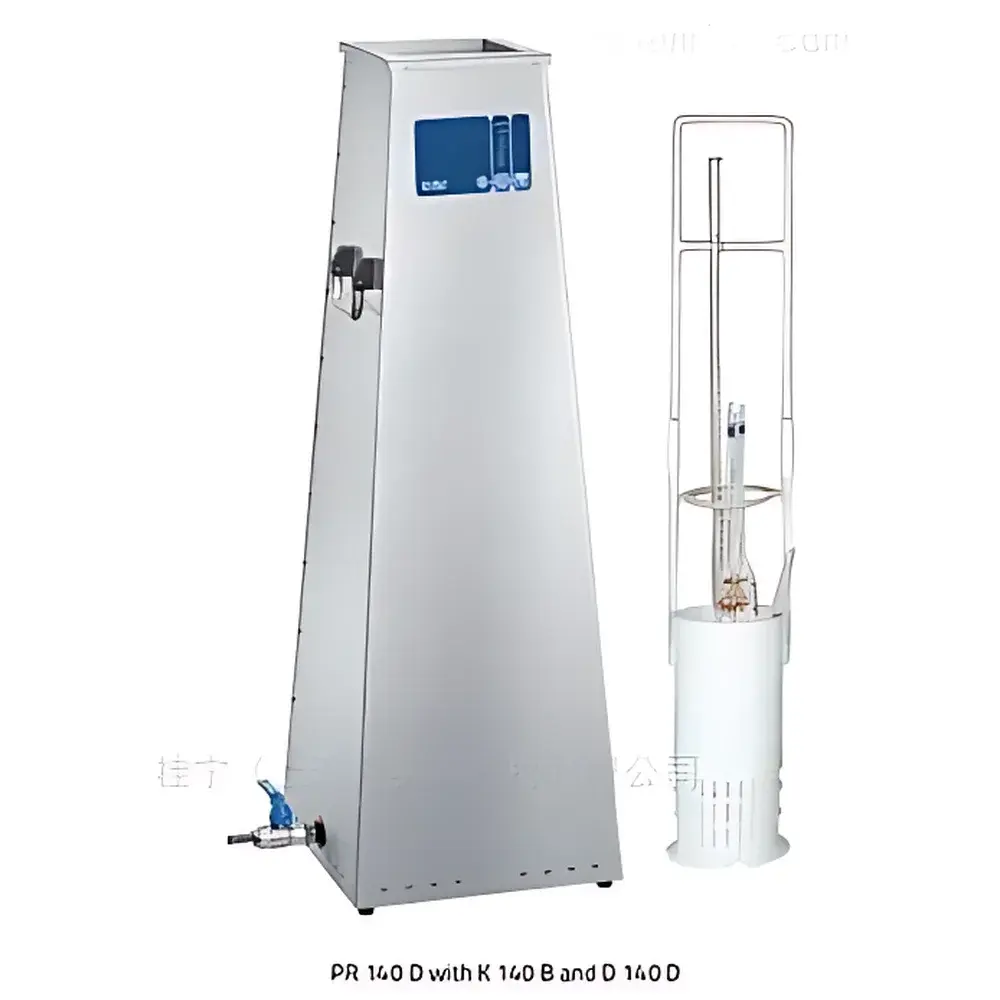
Bandelin PR140D Ultrasonic Pipette Cleaner
| Brand | Bandelin |
|---|---|
| Origin | Germany |
| Model | PR140D |
| Tank Capacity | 5 L |
| Ultrasonic Frequency | 35 kHz |
| Ultrasonic Power Output | 120 W |
| Adjustable Power | Yes |
| Adjustable Temperature | No (PR140D) / Yes (PR140DH) |
| Timer Range | 1–30 min |
| Sound-Dampening Lid | Included |
| Drain Valve | Manual |
| Tank Material | AISI 304 Stainless Steel |
| Max. Pipette Length Supported | 755 mm |
| Compliance | CE, RoHS, ISO 9001-certified manufacturing |
Overview
The Bandelin PR140D Ultrasonic Pipette Cleaner is a purpose-engineered laboratory cleaning system designed specifically for the rigorous decontamination of long, narrow-bore glassware—particularly volumetric pipettes up to 755 mm in length. Operating on the principle of high-frequency ultrasonic cavitation at 35 kHz, the device generates microscopic implosions within the cleaning bath that effectively dislodge particulate residues, organic films, and hydrophobic contaminants—including stubborn lipid deposits—that conventional rinsing or soaking cannot remove. Unlike general-purpose ultrasonic cleaners, the PR140D features an elongated tank geometry optimized for vertical immersion of pipettes, minimizing air entrapment and ensuring uniform energy distribution along the full length of the instrument. Its 5-liter AISI 304 stainless steel tank provides chemical resistance to common alkaline and enzymatic cleaning agents, while the integrated sound-dampening lid reduces ambient noise and prevents solvent evaporation during operation. The PR140D variant operates at ambient temperature; for thermally enhanced cleaning protocols, the PR140DH model (order no. 2065) adds precise digital temperature control up to 80 °C.
Key Features
- Optimized tank dimensions (L × W × H: 300 × 150 × 150 mm) accommodate pipettes and other tall glassware vertically without bending or submersion compromise
- 120 W ultrasonic power output with continuously adjustable amplitude for process optimization across diverse soil types and material sensitivities
- Digital timer with 1–30 minute programmable intervals, supporting repeatable cleaning cycles compliant with internal SOPs
- Integrated degassing mode to remove dissolved air from cleaning solutions prior to ultrasonication—critical for maximizing cavitation efficiency
- Gentle wash mode (Soft Clean) reduces ultrasonic intensity to protect delicate calibrations and etched graduations on Class A pipettes
- Manual bottom-mounted drain valve fabricated from corrosion-resistant brass with PTFE seal, enabling safe, spill-free solution disposal
- CE-marked and manufactured under ISO 9001 quality management systems; RoHS-compliant construction ensures environmental and occupational safety
Sample Compatibility & Compliance
The PR140D is validated for use with borosilicate glass (e.g., Pyrex®, Duran®), fused silica, and chemically resistant plastics such as PTFE and polypropylene. It is not recommended for aluminum, soft metals, or uncoated ceramics due to potential surface erosion under prolonged cavitation. When used with certified cleaning formulations—including Tickopur® R 33 (alkaline, low-foaming) or Tickopur® TR 3 (neutral pH, enzymatic)—the system supports residue removal verification per ASTM D2617 (residue on glass surfaces) and ISO 15883-1 (washer-disinfectors for medical devices). While the PR140D itself is not a sterilizer, its cleaning performance forms a critical prerequisite step for subsequent autoclaving or dry-heat sterilization in GLP/GMP environments. Documentation packages—including factory calibration reports and material certificates—are available upon request to support audit readiness.
Software & Data Management
The PR140D operates via a dedicated front-panel interface with LED display and tactile membrane keys—no external software or PC connection required. All operational parameters (time, power level, degas activation, Soft Clean toggle) are stored in non-volatile memory and recalled after power cycling. Though it lacks USB or Ethernet connectivity, the device’s deterministic, repeatable behavior enables full traceability when paired with laboratory notebook entries or LIMS-integrated workflow logs. For regulated laboratories, manual entry of batch numbers, operator ID, and cleaning cycle parameters satisfies basic 21 CFR Part 11 recordkeeping requirements when combined with institutional procedural controls.
Applications
- Routine cleaning of Class A, B, and AS volumetric pipettes in QC/QA laboratories performing titrations, standard solution preparation, or reference material dilution
- Removal of proteinaceous, lipid-rich, or hemoglobin-bound residues from clinical lab pipettes following ELISA, PCR setup, or blood sample handling
- Pre-cleaning of capillary tubes, burettes, and graduated cylinders prior to gravimetric or photometric calibration
- Supporting ISO/IEC 17025 accreditation by demonstrating consistent, documented cleaning efficacy across analytical instrument prep workflows
- Integration into pharmaceutical manufacturing cleanroom protocols where visual and residue-free validation is mandated pre-use
FAQ
Can the PR140D clean plastic or polypropylene pipettes?
Yes—provided they are rated for ultrasonic exposure and compatible with the selected cleaning agent. Avoid prolonged cycles with high-power settings to prevent micro-fracturing.
Is the 35 kHz frequency suitable for removing biofilm from pipette interiors?
Yes—35 kHz offers optimal penetration depth and cavitation density for sub-millimeter lumens; however, use of enzymatic cleaners (e.g., Tickopur TR 3) is strongly recommended for biofilm disruption.
Does the unit include validation documentation for GMP environments?
The PR140D ships with a CE Declaration of Conformity and ISO 9001 manufacturing certificate. IQ/OQ protocols and installation qualification templates are available separately from Bandelin’s technical support team.
What maintenance is required for long-term reliability?
Monthly inspection of the drain valve seal, quarterly cleaning of transducer mounting surfaces with isopropyl alcohol, and annual verification of timer accuracy using a calibrated stopwatch.
Can I use tap water alone without detergent?
No—deionized or distilled water must be used with a validated cleaning agent. Tap water contains minerals that accelerate transducer fouling and promote scale formation on stainless steel surfaces.



