
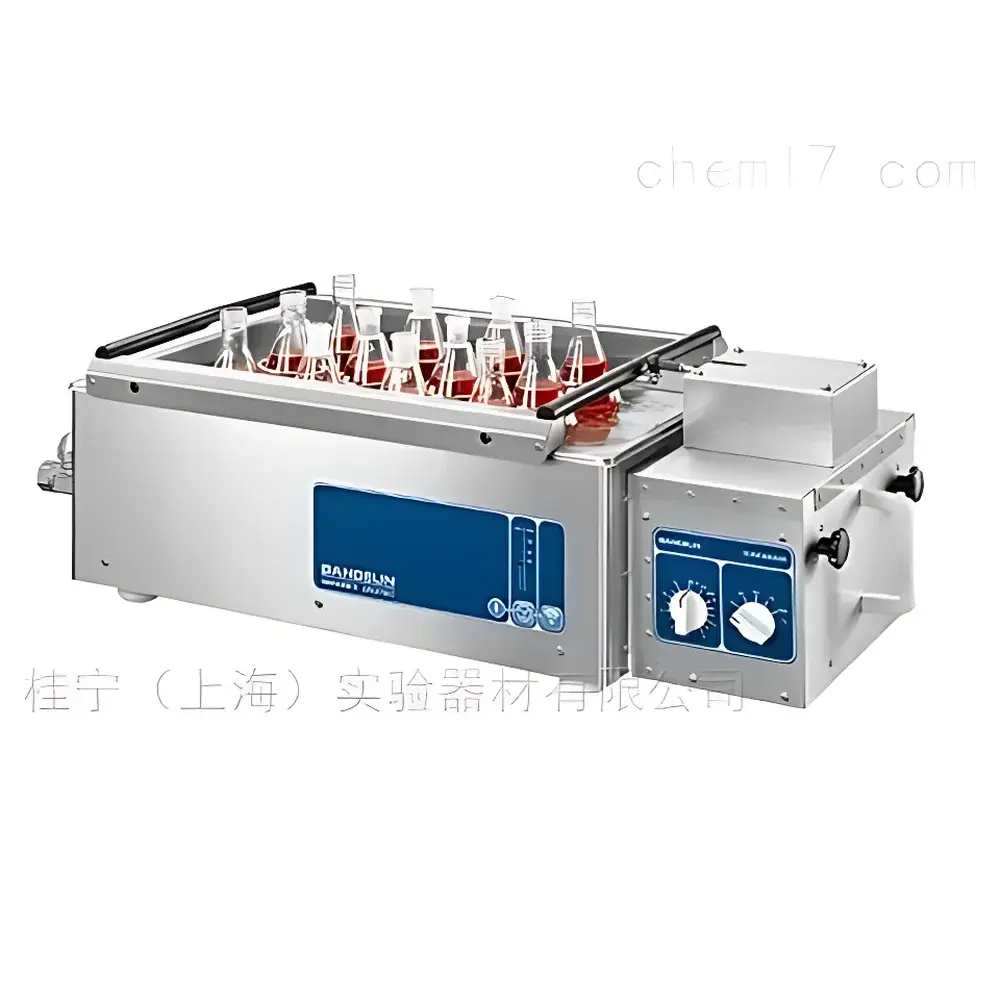
Bandelin SONOSHAKE DT 1028F Ultrasonic Shaking Water Bath
| Brand | Bandelin |
|---|---|
| Origin | Germany |
| Model | DT 1028F |
| Bath Volume | 35 L |
| Temperature Range | 0–100 °C |
| Temperature Stability | ±1 °C |
| Circulation Type | Internal & External |
| Oscillation Platform Dimensions | 410 × 280 mm (L × W) |
| Maximum Load Capacity | 36 × 10 mL vials, 36 × 25 mL vials, 18 × 50 mL vials, 12 × 100 mL vials, or 10 × 250 mL Erlenmeyer flasks |
| Ultrasonic Power (Peak / Nominal) | 1280 W / 320 W |
| Amplitude | 20 mm (load-independent) |
| Reciprocating Motion | 4-step programmable |
| Drain Valve | Yes |
| Optional Clamp | EK10–250 (sold separately) |
Overview
The Bandelin SONOSHAKE DT 1028F is a high-performance ultrasonic shaking water bath engineered for reproducible sample preparation in analytical laboratories. It integrates three orthogonal physical modalities—precise thermostatic control, mechanically driven reciprocating oscillation, and high-intensity ultrasonic cavitation—within a single platform. This tri-modal approach addresses common challenges in heterogeneous sample handling: sedimentation, phase separation, particle agglomeration, and incomplete extraction. Unlike conventional water baths or orbital shakers, the DT 1028F applies synchronized mechanical agitation (via adjustable reciprocating motion) and ultrasonic energy (at nominal 320 W, peak 1280 W) to enhance mass transfer kinetics and promote uniform dispersion across viscous or particulate-laden matrices. Its stainless steel bath chamber maintains temperature stability of ±1 °C across the full 0–100 °C range, making it suitable for enzymatic reactions, solvent-assisted extractions, cell lysis pre-treatment, and dissolution testing where thermal consistency is critical.
Key Features
- Integrated ultrasonic transducer system with load-independent 20 mm amplitude—ensures consistent cavitation intensity regardless of vessel load or liquid height.
- Programmable reciprocating oscillation with four discrete speed/step settings, enabling method optimization for fragile samples (e.g., tissue homogenates) or dense suspensions (e.g., soil extracts).
- Large oscillation platform (410 × 280 mm) accommodates standardized labware configurations: up to 36 × 10 mL or 25 mL vials, 18 × 50 mL, 12 × 100 mL, or 10 × 250 mL Erlenmeyer flasks—compatible with common ISO/ASTM-compliant glassware.
- 35 L stainless steel bath with external/internal circulation pump ensures rapid thermal equilibration and uniform temperature distribution; drain valve facilitates maintenance and fluid replacement.
- Analog interface enables intuitive setting of time, oscillation frequency, and temperature—designed for robust operation in GLP/GMP environments where digital complexity may introduce validation overhead.
- Modular clamp system (EK10–250, optional) allows rapid attachment/detachment of conical flasks without tools; clamping force is calibrated to prevent breakage during high-amplitude motion.
Sample Compatibility & Compliance
The DT 1028F supports aqueous, organic, and mixed-solvent systems within standard laboratory glassware (borosilicate 3.3, Class A volumetric). Its mechanical design conforms to DIN EN 61000-6-2 (immunity) and DIN EN 61000-6-3 (emission) standards. While not certified as medical device or IVD equipment, its performance aligns with method requirements specified in EPA Method 3550C (ultrasonic extraction), ASTM D7084 (polymer dispersion), and ISO 11348-3 (toxicity assay sample homogenization). The heating-only architecture avoids regulatory complications associated with refrigerated units (e.g., F-gas compliance), simplifying facility integration and audit readiness.
Software & Data Management
The DT 1028F operates via analog controls and does not include embedded software or data logging. This design prioritizes operational reliability, electromagnetic compatibility in shared instrumentation rooms, and long-term serviceability—key considerations for core facility labs performing routine QC/QA workflows. Users integrate the unit into validated SOPs using external timers or PLC-based process controllers where electronic recordkeeping (e.g., FDA 21 CFR Part 11 compliance) is required. Temperature calibration can be verified using NIST-traceable PT100 probes; oscillation amplitude and ultrasonic output are factory-characterized per IEC 61000-4-30 and documented in the device’s technical file.
Applications
- Environmental analysis: Extraction of PAHs, PCBs, and heavy metals from soil/sediment using ultrasonic-assisted leaching (EPA 3550C).
- Food safety testing: Homogenization of pesticide residues in fruit/vegetable matrices prior to GC-MS or LC-MS/MS analysis.
- Pharmaceutical R&D: Dissolution profile development for poorly soluble APIs under controlled thermal and mechanical stress conditions.
- Biological sample prep: Gentle lysis of microbial cells or tissue fragments while preserving enzyme activity for downstream ELISA or PCR.
- Materials science: Dispersion of nanomaterials (e.g., graphene oxide, TiO₂ nanoparticles) in polymer precursors or coating formulations.
FAQ
Is the DT 1028F suitable for use with flammable solvents?
Yes, provided the bath temperature remains below the flash point of the solvent and the laboratory adheres to local explosion-protection regulations (e.g., ATEX Zone 2 guidelines); ultrasonic energy input must be reduced to avoid localized superheating.
Can the ultrasonic and shaking functions operate independently?
No—the system is designed for concurrent operation to maximize synergistic effects; however, oscillation speed and ultrasonic power are individually adjustable.
What maintenance is required for long-term reliability?
Annual inspection of transducer coupling integrity, cleaning of stainless steel bath with non-chlorinated detergent, and verification of drain valve seal performance are recommended.
Does Bandelin provide IQ/OQ documentation support?
Yes—factory-issued installation and operational qualification templates are available upon request, aligned with ISO/IEC 17025 and GxP expectations.
Is the EK10–250 clamp compatible with non-Bandelin flask geometries?
It is optimized for standard conical flasks (ISO 4788) with neck diameters between 10 mm and 250 mm; custom adapter plates can be fabricated for atypical vessels.



