
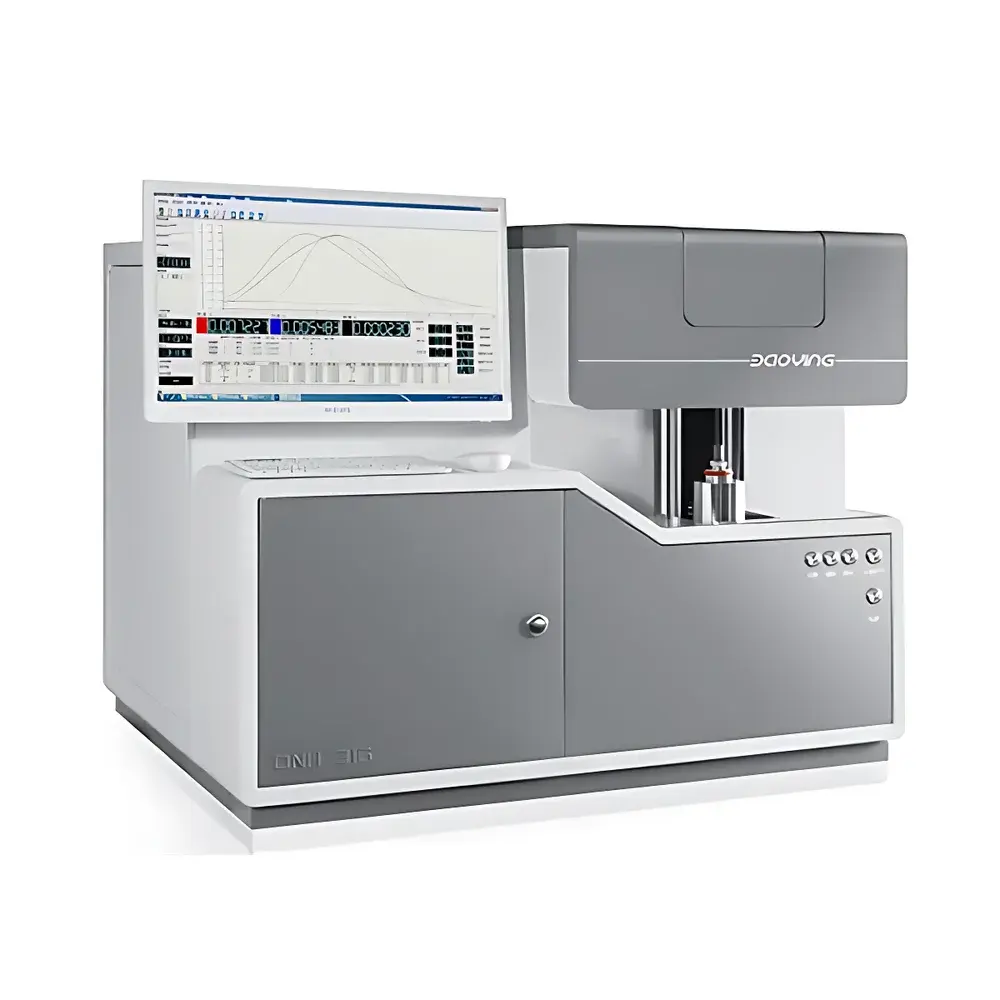
Baoying ON-316 Oxygen-Nitrogen Analyzer
| Brand | Baoying |
|---|---|
| Origin | Shanghai, China |
| Manufacturer Type | Direct Manufacturer |
| Instrument Type | Oxygen-Nitrogen Analyzer |
| Model | ON-316 |
| Detection Principle | Inert Gas Fusion Coupled with Non-Dispersive Infrared (NDIR) and Thermal Conductivity Detection (TCD) |
| Oxygen Range | 0.1 ppm – 5000 ppm (low), 0.5% – 20% (high) |
| Nitrogen Range | 0.1 ppm – 5000 ppm (low), 0.5% – 50% (high) |
| Detection Limit | 0.01 ppm |
| Accuracy | ±1 ppm or RSD ≤ 1% (O₂/N₂) |
| Analysis Time | O₂: 120–180 s |
| N₂ | 120–240 s |
| Pulse Furnace Power | 8.0 kW |
| Detector Configuration | Dual-channel NDIR for oxygen, TCD for nitrogen |
| Sample Form | Solid metals and non-metals (powders, chips, rods, pellets) |
| Compliance Support | ASTM E1019, ISO 14284, GB/T 11261, JIS G 1211 |
Overview
The Baoying ON-316 Oxygen-Nitrogen Analyzer is a high-performance inert gas fusion elemental analyzer engineered for precise, trace-level quantification of oxygen and nitrogen in solid metallic and non-metallic materials. It operates on the principle of high-temperature inert gas fusion: samples are thermally decomposed in a graphite crucible under purified helium or argon atmosphere at temperatures up to 3,000 °C, releasing oxygen as carbon monoxide (CO) and nitrogen as molecular nitrogen (N₂). The evolved gases are swept through a multi-stage purification system—including copper oxide and magnesium perchlorate traps—to remove interfering species such as H₂O, CO₂, and hydrocarbons—before entering parallel detection modules. Oxygen is measured via dual-channel non-dispersive infrared (NDIR) absorption at specific wavelengths (e.g., 4.6 µm for CO), while nitrogen is quantified using a high-stability thermal conductivity detector (TCD). This dual-detection architecture ensures independent, interference-free measurement of both elements within a single analysis cycle.
Key Features
- Adaptive Multi-Chamber Detection Module: Enables seamless switching between low-ppm and high-percentage measurement ranges without hardware reconfiguration.
- Patented Solid-State IR Source & Detector Architecture: Eliminates mechanical choppers and modulated gas flow, delivering long-term baseline stability and improved signal-to-noise ratio (>10⁴:1).
- Digital Pressure Control (EPC): Each gas line incorporates an independent electronic pressure controller, compensating for ambient barometric fluctuations and ensuring consistent carrier gas flow (±0.02 mL/min reproducibility).
- 8.0 kW Graphite Electrode Pulse Furnace: Features proprietary alloy electrodes with superior red-hardness and thermal conductivity; integrated heat-exchange cooling system maintains <30 s cooldown between analyses.
- Automated Leak Integrity Check: Built-in pressure decay test validates system hermeticity prior to each analysis, meeting GLP audit requirements for instrument qualification.
- DTU-Enabled Remote Diagnostics: Optional Data Transmission Unit supports secure, encrypted telemetry for predictive maintenance and firmware updates without onsite intervention.
- Passivated Stainless Steel Gas Pathway: Entire post-furnace gas train constructed from electropolished 316L SS with SilcoNert® surface treatment, minimizing adsorption and memory effects for ultra-trace (<10 ppm) applications.
Sample Compatibility & Compliance
The ON-316 accommodates diverse solid sample geometries—including turnings, chips, powders, rods, and pressed pellets—with mass ranging from 0.05 g to 1.0 g. Its robust furnace design supports refractory alloys (e.g., Ti-6Al-4V, Inconel 718), ceramics (Al₂O₃, SiC), and high-purity silicon wafers. Method validation adheres to ASTM E1019 (Standard Test Methods for Determination of Carbon, Sulfur, Nitrogen, and Oxygen in Steel, Iron, Nickel, and Cobalt Alloys), ISO 14284 (Steel and Iron — Determination of Total Nitrogen Content), and GB/T 11261 (Methods for Chemical Analysis of Ferroalloys). Full audit trail functionality—including user login, method versioning, raw signal archiving, and electronic signature—supports compliance with FDA 21 CFR Part 11 and EU Annex 11 for regulated QC laboratories.
Software & Data Management
The ON-316 is operated via Baoying’s proprietary Analytix™ v4.2 software suite, running on an embedded industrial PC with Windows IoT Enterprise OS. Real-time spectral visualization displays CO and N₂ peak profiles alongside baseline correction curves. Calibration supports single-point, multi-point, and bracketed standardization with automatic drift compensation. All analytical results—including integration parameters, furnace temperature ramp logs, and detector gain settings—are stored in an ACID-compliant SQLite database. Export formats include CSV, XML, and ASTM E1382-compliant LIMS-ready output. Integration with enterprise SQL Server or Oracle databases is enabled via ODBC drivers, supporting centralized result aggregation across multi-site manufacturing networks.
Applications
The analyzer serves critical quality control and R&D functions in aerospace-grade superalloy production, where oxygen content >30 ppm induces embrittlement in titanium castings; in semiconductor-grade silicon wafer manufacturing, where nitrogen segregation affects crystal lattice integrity; and in nuclear fuel pellet fabrication, where stoichiometric O/M ratios must be verified per ASTM C1615. It is also deployed in academic metallurgy labs for studying interstitial solute behavior during phase transformations and in recycling facilities for rapid screening of scrap metal purity prior to remelting.
FAQ
What sample preparation is required prior to analysis?
Samples must be clean, dry, and free of surface oxides or lubricants. Metallic specimens are typically machined into chips or drilled turnings; powders require homogenization and pressing into pellets (5–10 kN). No acid digestion or chemical pretreatment is needed.
How often does the system require recalibration?
Calibration verification is recommended daily using certified reference materials (CRMs) traceable to NIST or BAM. Full multi-point calibration is performed weekly or after major maintenance events such as crucible replacement or detector cleaning.
Is the instrument compatible with existing laboratory informatics systems?
Yes—Analytix™ supports ASTM E1382, ASTM E1482, and HL7 messaging protocols. API endpoints allow bidirectional data exchange with LIMS, MES, and SAP QM modules.
What safety certifications does the ON-316 hold?
The system complies with IEC 61010-1 (Safety Requirements for Electrical Equipment for Measurement, Control, and Laboratory Use) and carries CE marking for EMC Directive 2014/30/EU and Low Voltage Directive 2014/35/EU.
Can hydrogen analysis be added post-purchase?
No—the ON-316 is configured exclusively for oxygen and nitrogen. Hydrogen capability requires the separate Baoying OH-316 platform, which integrates a dedicated TCD channel and modified furnace gas handling for H₂ detection down to 0.05 ppm.




