
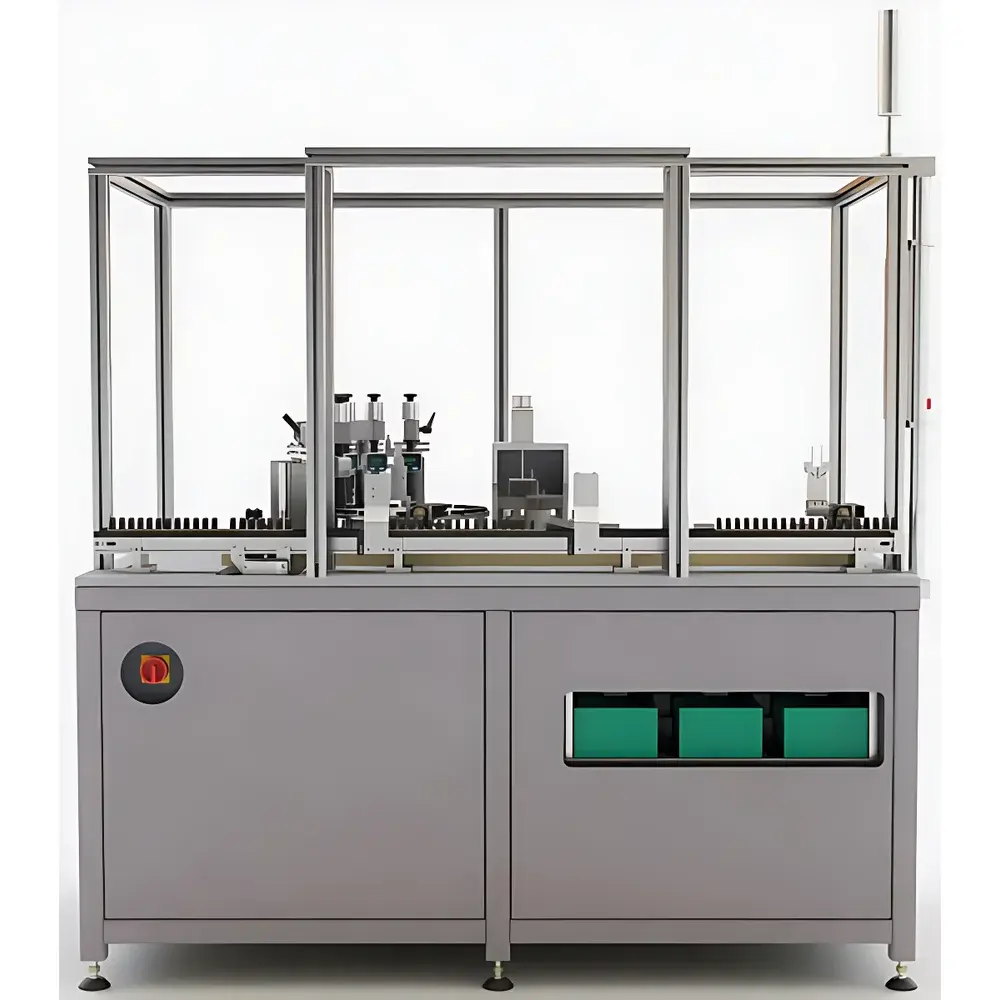
Bareiss HDA 325 Fully Automated Hardness and Density Testing System
| Brand | Bareiss |
|---|---|
| Origin | Germany |
| Model | HDA 325 |
| Hardness Measurement Principle | Shore A (ASTM D2240, ISO 7619-1) |
| Density Measurement Principle | Archimedes’ Principle with Precision Buoyancy Weighing |
| Cycle Time (Hardness + Density) | <20 s per sample |
| Dual-Channel Density Option | ~10 s per sample |
| Operating Duty Cycle | 24/7/365 continuous operation |
| Temperature Monitoring Option | Integrated surface temperature sensor (range: 20–70 °C, resolution: ±0.1 °C) |
| Data Traceability | Sample ID, timestamp, operator ID, environmental metadata |
| Compliance | ISO/IEC 17025-ready architecture, supports GLP/GMP audit trails, FDA 21 CFR Part 11 compliant data handling (with optional electronic signature module) |
Overview
The Bareiss HDA 325 Fully Automated Hardness and Density Testing System is an industrial-grade, dual-parameter metrology platform engineered for high-throughput quality control in elastomer and rubber manufacturing—particularly optimized for Tier-1 tire production facilities. It integrates two fundamental physical property measurements—Shore A hardness (per ASTM D2240 and ISO 7619-1) and volumetric density (via precision Archimedean buoyancy weighing)—into a single synchronized, walk-away workflow. Unlike manual or semi-automated setups, the HDA 325 employs a rigid, vibration-damped mechanical architecture validated for stable operation in typical factory-floor environments (including light structural vibration ≤0.5 g RMS, 5–500 Hz). Its measurement sequence is fully deterministic: sample identification, surface temperature acquisition (optional), Shore A indentation under standardized preload and dwell time, followed by immersion-based density determination with active thermal stabilization of the fluid bath. All stages are coordinated via a real-time deterministic motion controller to ensure repeatability and eliminate operator-induced variability.
Key Features
- Fully automated, unattended operation supporting 24/7/365 duty cycles with mean time between maintenance (MTBM) exceeding 12 months under standard tire plant conditions.
- Hardness + density cycle time ≤20 seconds per sample (standard configuration); dual-channel density option reduces total cycle to ~10 seconds—enabling throughput up to 8,640 samples per day at sustained operational load.
- Integrated surface temperature sensing (optional) with ±0.1 °C resolution, enabling real-time correction of Shore A values based on empirically established thermal sensitivity profiles (e.g., 1–3 Shore A shift per 5 °C change within 20–70 °C range for common SBR/BR/NR compounds).
- Rigid aluminum-alloy frame with anti-vibration feet; calibrated for consistent performance under ambient temperature fluctuations (15–35 °C) and relative humidity ≤80 % RH non-condensing.
- Traceable sample handling: fixed-entry/fixed-exit path ensures linear sample sequencing; each test record includes unique sample ID, timestamp (ISO 8601), operator ID, instrument calibration status, and environmental metadata.
- Embedded 10.1″ industrial touchscreen interface with real-time graphical display of hardness/density trends, deviation overlays, and pass/fail status against user-defined specification limits.
Sample Compatibility & Compliance
The HDA 325 accommodates solid, non-porous rubber blocks (typical dimensions: 25 × 25 × 25 mm to 50 × 50 × 50 mm) with Shore A hardness ranging from 20 to 90. It supports both cured and uncured stock, provided surface geometry permits stable indentation and immersion. The system conforms to mechanical safety requirements per EN ISO 12100 and electrical safety per EN 61000-6-2/6-4. Its metrological architecture aligns with ISO/IEC 17025:2017 clause 7.6 (traceability of measurements) and supports full GxP compliance when configured with optional audit trail logging, electronic signatures, and role-based access control—meeting foundational requirements for FDA 21 CFR Part 11 and EU Annex 11 validation frameworks.
Software & Data Management
The embedded firmware runs on a Linux-based real-time OS with deterministic I/O scheduling. Data is stored locally in encrypted SQLite databases with automatic daily backup to network shares (SMB/CIFS) or USB storage. Export formats include CSV (with header metadata), PDF test reports (ISO-compliant templates), and XML for LIMS/SCADA integration via RESTful API or OPC UA (UA Profile: DataAccess). All data records include cryptographic hash integrity verification. Remote diagnostics and firmware updates are supported over TLS-secured Ethernet or optional LTE module—requiring no inbound firewall ports or persistent VPN tunnels.
Applications
- Tire compound release testing: simultaneous verification of compound hardness consistency and density uniformity across batch and shift boundaries.
- Raw material acceptance: rapid screening of incoming polymer batches (e.g., S-SBR, BR, NR) prior to mixing line feed.
- Process stability monitoring: statistical process control (SPC) charting of hardness/density correlation coefficients to detect early-stage curing anomalies or filler dispersion issues.
- Regulatory documentation: generation of auditable test records for ISO 9001:2015 Clause 8.5.1, IATF 16949 Section 8.6.2, and customer-specific PPAP Level 3 submissions.
- Research & development: correlation studies linking vulcanization kinetics, filler loading, and crosslink density via hardness-density hysteresis mapping.
FAQ
Does the HDA 325 require periodic recalibration with certified reference standards?
Yes—annual calibration against NIST-traceable Shore A durometers and density reference blocks is recommended; the system logs all calibration events with operator ID and certificate numbers.
Can the system integrate with our existing MES without custom middleware?
Yes—native OPC UA server support enables direct bidirectional communication with most modern MES platforms (e.g., Siemens Opcenter, Rockwell FactoryTalk) using standard information models.
Is temperature compensation applied automatically during hardness reporting?
Only when the optional surface temperature sensor is installed and enabled; compensation coefficients are configurable per material group and stored in the method library.
What happens if a sample fails the dimensional tolerance check before testing?
The system rejects the sample, logs the reason (e.g., “height out of range”), and advances to the next unit—no manual intervention required.
How is data security enforced during remote maintenance sessions?
All remote access uses TLS 1.3 with mutual X.509 authentication; sessions are time-limited, session-logged, and terminate automatically after 15 minutes of inactivity.



