
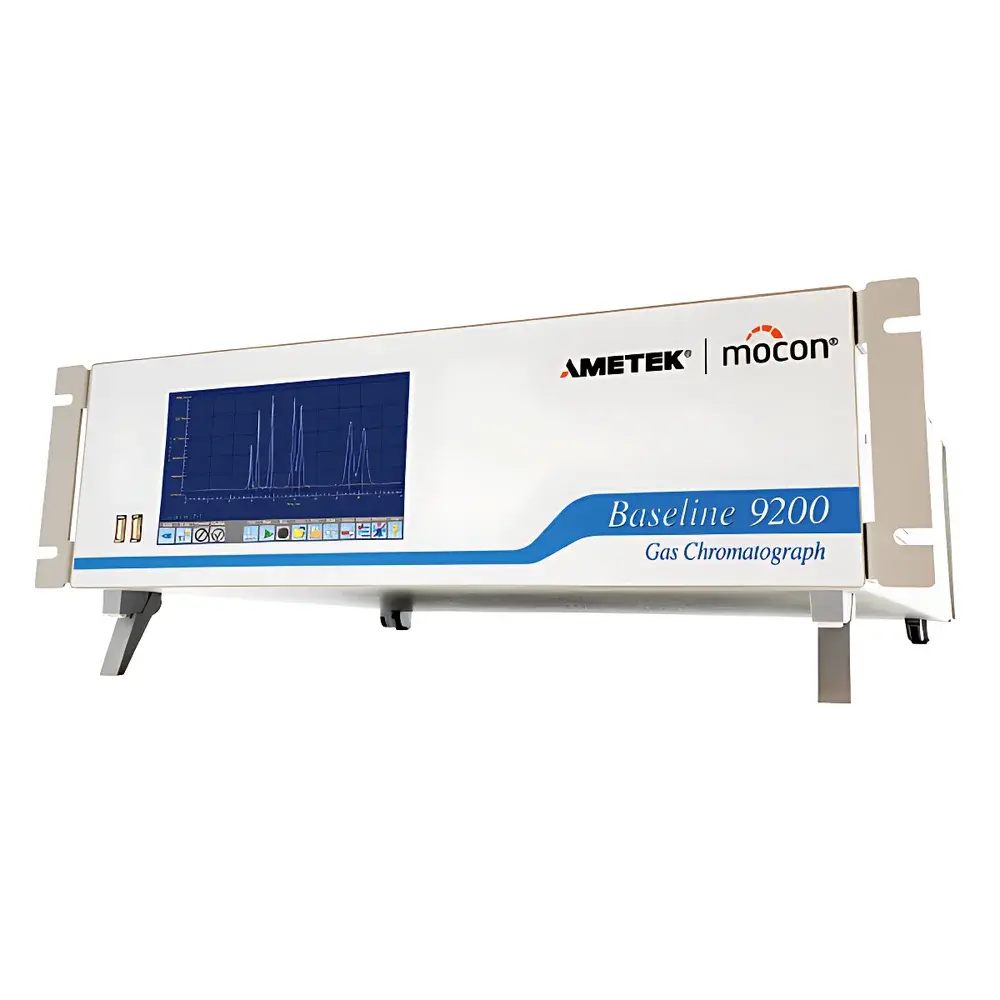
Baseline Baseline 9200 Dual-Detector Gas Chromatograph
| Brand | Baseline |
|---|---|
| Origin | USA |
| Manufacturer Type | Authorized Distributor |
| Origin Category | Imported |
| Model | Baseline 9200 |
| Pricing | Upon Request |
Overview
The Baseline 9200 Dual-Detector Gas Chromatograph is a purpose-built, compact analytical platform engineered for continuous, unattended environmental monitoring and process gas analysis. It operates on the fundamental principle of gas chromatography—separating volatile and semi-volatile compounds in a gaseous sample matrix via differential partitioning between a mobile phase (carrier gas) and a stationary phase (capillary or packed column). Its dual-detector architecture enables simultaneous or sequential detection using two independent, user-selectable detectors—such as Photoionization Detection (PID), High-Sensitivity PID (HS-PID), Flame Ionization Detection (FID), or Thermal Conductivity Detection (TCD)—thereby extending analytical flexibility without requiring hardware reconfiguration. Designed for trace-to-percent-level quantification (sub-ppb to several percent v/v), the system supports compliance-driven applications in ambient air quality monitoring, landfill gas tracking, industrial stack emissions verification, and remediation site surveillance. The instrument’s robust mechanical architecture, integrated electronic pressure control (EPC), and FlowGuard™ sample management system ensure long-term retention time stability and measurement reproducibility under field-deployable conditions.
Key Features
- Dual-detector configuration with hot-swappable detector modules—supports concurrent or alternating detection modes for enhanced method versatility
- Single-valve, dual-column manifold design optimized for rapid cycle times and minimal cross-contamination; configurable for GC-only, GC/GC, or GC/THA (Total Hydrocarbon Analyzer) hybrid operation
- Integrated FlowGuard™ system featuring electronic back-pressure regulation, automated sample bypass, and fail-safe shutdown of fuel, air, and sample flows during fault conditions
- 7-inch full-color capacitive touchscreen interface with intuitive menu navigation, real-time chromatogram display, and on-board method editor
- Onboard data storage capacity supporting ≥12 months of timestamped chromatograms, ASCII results, alarm logs, and calibration records
- Multi-protocol connectivity: RS-232 serial, 10/100BASE-T Ethernet (TCP/IP), isolated 4–20 mA analog outputs (user-programmable range), dry-contact relay outputs (configurable per diagnostic state, concentration threshold, or event type)
- Rack-mountable or benchtop form factor (445 × 310 × 220 mm, 12 kg); IP20-rated enclosure suitable for controlled indoor or sheltered outdoor environments
Sample Compatibility & Compliance
The Baseline 9200 accommodates gaseous samples delivered via single-point or multi-point sampling manifolds, with optional heated sample lines and moisture traps for challenging matrices (e.g., biogas, humid stack effluents). It meets functional requirements aligned with EPA Method TO-15 (VOCs in ambient air), ASTM D6420 (FID-based hydrocarbon analysis), and ISO 8573-5 (compressed air purity testing). While not certified as a Class I Div 2 device, its electrical architecture complies with UL 61010-1 and IEC 61000-6-2/6-3 for electromagnetic compatibility. Data integrity features—including audit-trail-enabled calibration logging, password-protected method editing, and immutable timestamping—support adherence to GLP and GMP documentation practices. Optional firmware upgrades enable 21 CFR Part 11-compliant electronic signatures and user access tiering.
Software & Data Management
The embedded system firmware provides complete local control: method scheduling, automatic zero/span calibration at user-defined intervals (e.g., every 1, 4, or 24 hours), baseline drift correction, peak integration with customizable retention time windows, and real-time concentration calculation using internal calibration curves. All raw and processed data are stored in non-volatile memory and exportable via USB or network transfer in CSV, XML, or vendor-neutral ASCII formats. Remote monitoring and configuration are supported through HTTP-based web interface or Modbus TCP protocol. No proprietary desktop software is required for routine operation; however, optional PC-based Baseline ChromaView™ software enables advanced reporting, trend analysis, and regulatory report generation (e.g., EPA Form R, TRI submissions).
Applications
- Ambient air monitoring for BTEX, chlorinated solvents, and C2–C12 aliphatics in urban or industrial zones
- Landfill and anaerobic digester gas composition analysis (CH₄, CO₂, H₂S, NH₃, VOCs)
- Continuous emission monitoring (CEM) support for fugitive VOC detection in chemical manufacturing facilities
- Soil vapor intrusion assessment using passive or active sampling interfaces
- Indoor air quality (IAQ) surveys in commercial buildings and cleanrooms
- Calibration verification and leak detection in gas distribution networks
FAQ
What detector combinations are factory-supported on the Baseline 9200?
Standard configurations include FID+TCD, PID+TCD, and HS-PID+FID. Custom detector pairings require pre-shipment validation by Baseline Applications Engineering.
Can the 9200 operate fully autonomously for extended periods?
Yes—its onboard scheduler, auto-calibration routines, FlowGuard safety logic, and 12-month data retention enable uninterrupted operation for ≥30 days without manual intervention, assuming stable power and supply gas availability.
Is external PC software mandatory for data retrieval?
No. All data—including chromatograms, concentration reports, and event logs—are accessible via the front-panel interface or exported directly over Ethernet/USB in open-format files.
Does the system support remote diagnostics and firmware updates?
Yes. Secure HTTP and Modbus TCP interfaces allow remote status polling, parameter adjustment, and authenticated firmware upgrades via encrypted channel.
What maintenance intervals are recommended for field-deployed units?
Carrier gas filters: quarterly; detector components (e.g., FID jet, PID lamp): annually or per 2,000 operating hours; column replacement frequency depends on sample matrix severity and is typically 6–24 months.
Related Products







