
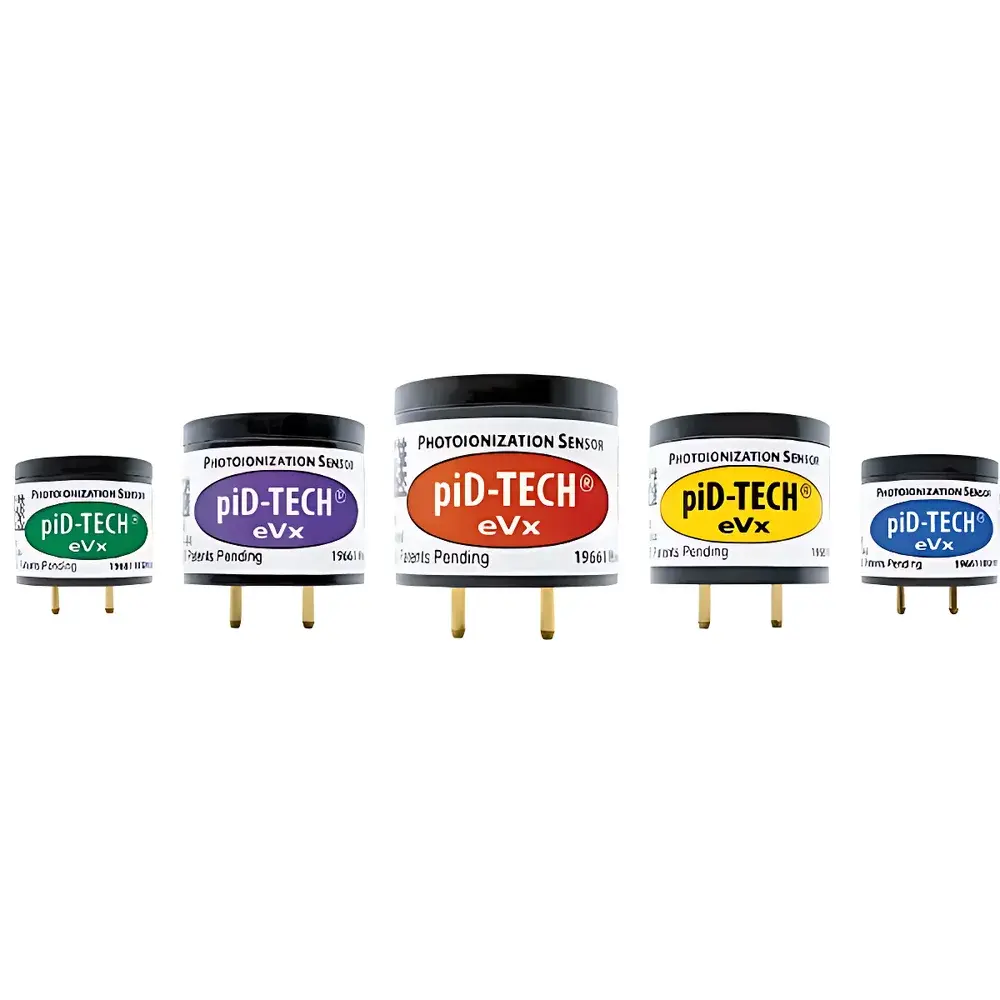
Baseline BASELINE piD-TECH eVx Photoionization Detector (PID) Sensor
| Brand | Baseline |
|---|---|
| Origin | USA |
| Manufacturer Type | Authorized Distributor |
| Origin Category | Imported |
| Model | BASELINE piD-TECH eVx |
| Pricing | Available Upon Request |
Overview
The Baseline BASELINE piD-TECH eVx Photoionization Detector (PID) Sensor is a high-performance, intrinsically safe gas sensing module engineered for reliable detection of volatile organic compounds (VOCs) in ambient air. Operating on the principle of ultraviolet (UV) photoionization, the sensor emits photons from a stable, long-life UV lamp (typically 10.6 eV or configurable 9.8/11.7 eV options) to ionize VOC molecules with ionization potentials below the lamp’s photon energy. The resulting ion current is measured between biased electrodes and linearly correlated to VOC concentration—enabling quantitative, real-time monitoring across ppb-to-ppm ranges. Designed for integration into portable, transportable, and fixed-site environmental monitoring systems, the eVx series delivers laboratory-grade sensitivity and stability while conforming to industrial form-factor constraints typical of 4-series electrochemical sensor footprints. Its core architecture supports OEM deployment in air quality stations, industrial hygiene instruments, leak detection tools, and continuous emission monitoring systems (CEMS) requiring regulatory-compliant VOC data.
Key Features
- Intrinsically safe design certified to UL 913 (Class I, II, III, Division 1), CAN/CSA C22.2 No. 157, ATEX II 2G Ex ia IIC T4 Ga, and IECEx Ex ia IIC T4 Ga standards
- Robust electromagnetic shielding minimizing RF interference in electrically noisy environments
- Modular 4-series mechanical interface compatible with standard sensor housings and PCB mounting patterns
- Dual-stage particulate filtration (pre-filter + hydrophobic membrane) protecting lamp and electrodes from dust, moisture ingress, and aerosol fouling
- Integrated lamp restart circuit ensuring consistent, repeatable ignition without voltage spikes or thermal stress
- Onboard linear voltage regulation delivering stable bias and lamp drive—critical for low-drift baseline performance over temperature and time
- Electrode geometry and guard-ring design actively suppressing humidity-induced signal offset (typical drift < ±2% RH effect)
- Fast response time (T90 < 3 seconds) and exceptional baseline stability (drift < 0.5% FS/week under controlled conditions)
- Service-friendly construction: field-cleanable optical path, replaceable lamp and filter assemblies, no specialized tools required
- Extended operational lifetime: UV lamp rated for ≥ 12,000 hours; electrode stack designed for >5 years of continuous operation in typical ambient deployments
Sample Compatibility & Compliance
The eVx PID sensor detects over 300 VOCs—including benzene, toluene, xylene (BTX), styrene, chlorinated solvents, aldehydes, and terpenes—provided their ionization potential is lower than the lamp energy. It is not responsive to methane, ethane, CO, CO2, NOx, or most inorganic gases. The sensor complies with ISO 16000-29 (indoor air—VOC measurement using PID), ASTM D5466 (standard test method for VOC analysis by PID), and supports data integrity requirements aligned with EPA Method TO-15 and EU EN 14662 for ambient VOC monitoring. Its intrinsic safety certifications enable deployment in Zone 0/1 hazardous locations per IEC 60079-0 and NEC Article 500. For regulated environments, the sensor’s analog output (0–5 V or 4–20 mA) and digital UART interface support audit-ready data logging when paired with compliant host firmware supporting 21 CFR Part 11 electronic signatures and GLP/GMP audit trails.
Software & Data Management
The eVx operates as a calibrated analog/digital transducer and requires host-level firmware for full functionality. Baseline provides comprehensive integration documentation—including pinout schematics, calibration coefficients (span gas-specific sensitivity factors), temperature compensation algorithms, and diagnostic registers (lamp health status, filter saturation flag, zero drift alert). OEMs may implement real-time baseline correction via dual-sensor zero-reference schemes or periodic automated zero cycles using clean-air purge valves. Raw ion current signals are linear within ±2% FS across its five selectable measurement ranges (e.g., 0–10 ppm, 0–100 ppm, up to 0–10,000 ppm isobutylene-equivalent), enabling flexible range-switching logic in embedded applications. All calibration and maintenance events are timestamped and stored in non-volatile memory for traceability.
Applications
- Fixed-site ambient air quality monitoring networks (AQMS) measuring urban/industrial VOCs per national air quality directives
- OEM integration into personal exposure monitors for occupational health compliance (OSHA PEL, ACGIH TLV)
- Soil vapor intrusion assessment tools used in brownfield remediation and Phase II ESAs
- Leak detection and repair (LDAR) instruments meeting EPA 40 CFR Part 60, Subpart VV and OOOOa requirements
- Indoor air quality (IAQ) dashboards in smart buildings and healthcare facilities
- Mobile monitoring platforms (drones, vehicles) for fugitive emission mapping
- Process safety interlocks in chemical handling and storage areas
FAQ
What VOCs can the eVx sensor detect?
It detects VOCs with ionization potentials below the installed UV lamp energy (e.g., 10.6 eV lamp detects compounds with IP < 10.6 eV, including aromatics, ketones, amines, and many halogenated organics).
Is calibration required—and how often?
Yes. Initial two-point calibration (zero and span) is mandatory. Recommended recalibration interval is every 3–6 months depending on exposure history, though field zero checks can be performed daily.
Can the sensor operate in high-humidity environments?
Yes—the electrode design and hydrophobic filtration mitigate humidity interference; performance remains stable up to 95% RH non-condensing.
Does the eVx support digital communication protocols?
It provides UART (TTL-level) output for digital diagnostics and configuration, alongside standard analog outputs (0–5 V or 4–20 mA). Modbus RTU support is available via optional host interface boards.
What is the expected service life of the UV lamp?
Rated minimum lifetime is 12,000 operating hours at nominal drive current; actual longevity depends on duty cycle and ambient temperature profile.
Related Products







