
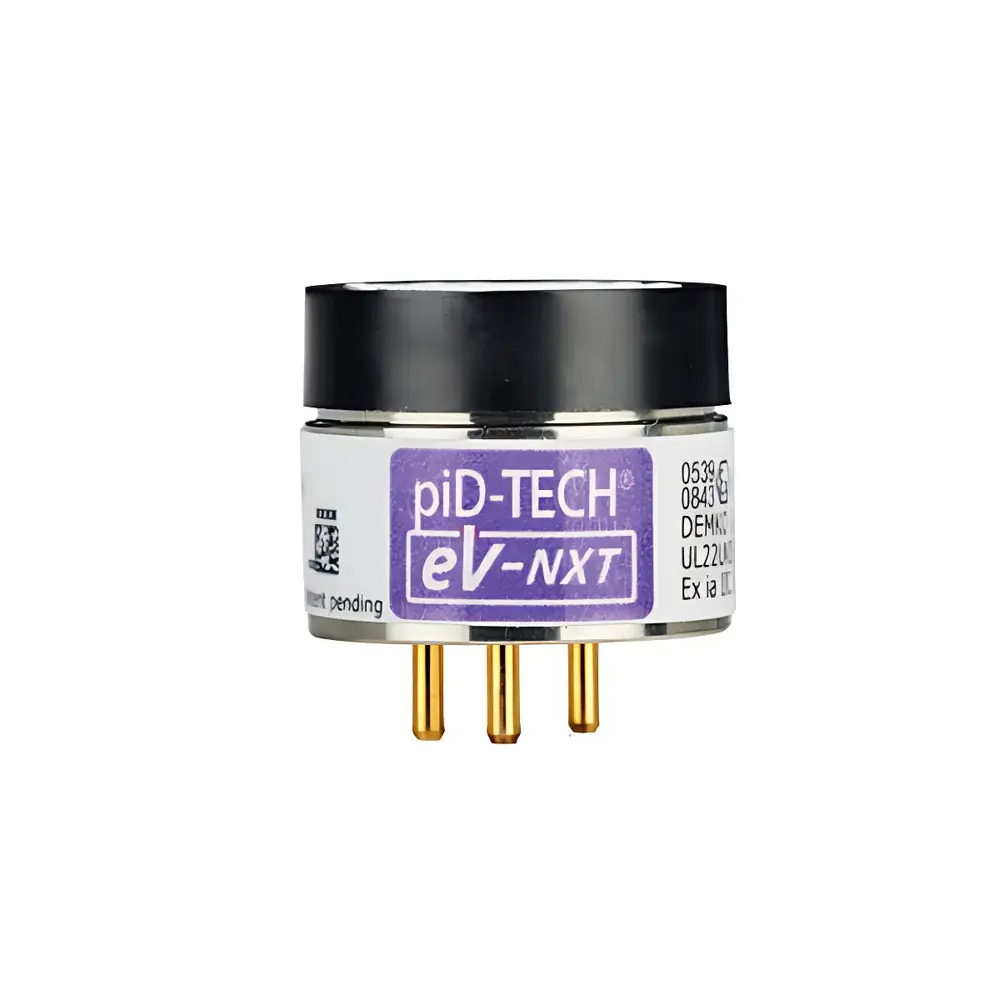
Baseline eV-NXT 045-111 Purple Photonic Ionization Detector (PID) Sensor
| Brand | Baseline |
|---|---|
| Origin | USA |
| Manufacturer Type | Authorized Distributor |
| Import Status | Imported |
| Model | eV-NXT 045-111 |
| Detection Range | 0–2,000 ppm |
| LOD | 100 ppb |
| T90 Response Time | < 3.5 s |
| Typical Sensitivity | 2.4 mV/ppm |
| Measurement Condition | 100 ppm |
| Operating Voltage | Low-Voltage DC |
| Power Consumption | Ultra-Low |
| Intrinsic Safety Rating | Certified |
| Onboard Fault Detection | Yes |
Overview
The Baseline eV-NXT 045-111 Purple Photonic Ionization Detector (PID) sensor is an engineered solution for continuous, reliable detection of volatile organic compounds (VOCs) in demanding environmental and industrial monitoring applications. Unlike conventional metal-oxide or electrochemical sensors, the eV-NXT operates on the principle of photoionization—using a stable 10.6 eV ultraviolet lamp to ionize VOC molecules in sampled air. The resulting ion current is linearly proportional to analyte concentration, enabling quantitative measurement across a broad dynamic range. Designed specifically for outdoor air quality networks, confined-space entry verification, and low-concentration fugitive emission monitoring, this sensor delivers high-fidelity data under variable ambient conditions—without requiring frequent recalibration or temperature compensation algorithms.
Key Features
- Enhanced inter-sensor reproducibility: Tight manufacturing tolerances ensure ±5% unit-to-unit sensitivity variation at 100 ppm isopropanol—enabling true plug-and-play integration into multi-node sensor arrays.
- Robust environmental stability: Maintains baseline drift < ±2% over –20 °C to +50 °C and 10–95% RH (non-condensing), eliminating need for active humidity compensation circuits.
- Ultra-low power architecture: Operates at ≤1.8 VDC with average current draw 2 years in typical 15-minute polling intervals.
- Integrated diagnostic subsystem: Real-time lamp intensity monitoring, electrode contamination detection, and open-circuit fault identification provide traceable confidence in every reported value.
- Intrinsically safe design: Certified per UL 913 Class I, Division 1, Groups A–D and ATEX II 1G Ex ia IIC T4 Ga—suitable for deployment in hazardous locations without additional barrier systems.
Sample Compatibility & Compliance
The eV-NXT 045-111 detects over 300 VOCs—including benzene, toluene, xylene, styrene, acetone, and formaldehyde—with near-equivalent response factors relative to isobutylene calibration gas. It excludes non-ionizable species (e.g., methane, CO, CO2, NOx) and exhibits minimal cross-sensitivity to ambient ozone or water vapor. The sensor complies with EPA Method TO-15 and ASTM D5466-22 for fixed-site VOC monitoring. Its analog output (0–5 V DC) and digital UART interface support seamless integration into SCADA, IoT gateways, and EPA-compliant data loggers. Full audit trails—including sensor uptime, lamp hours, and self-test logs—are retained onboard for GLP/GMP-aligned validation workflows.
Software & Data Management
Baseline provides the eV-NXT Configuration Utility—a Windows/Linux-compatible application enabling field adjustment of zero offset, span gain, alarm thresholds, and sampling interval. All configuration changes are digitally signed and timestamped. Raw analog output is compatible with third-party platforms supporting Modbus RTU or ASCII serial protocols. For regulatory reporting, the sensor’s internal memory stores 30 days of 1-minute averaged data with millisecond-resolution timestamps. Optional firmware updates include enhanced spectral filtering algorithms to suppress interference from UV-absorbing particulates—validated against ISO 17025-accredited reference instruments.
Applications
- Urban and regional ambient air quality monitoring networks (AQMS), particularly for tracking BTEX and oxygenated VOCs during photochemical smog episodes.
- Real-time fence-line monitoring at petrochemical facilities, landfills, and wastewater treatment plants per EPA 40 CFR Part 63 Subpart HH.
- Portable and wearable personal exposure monitors used by industrial hygienists conducting OSHA PEL or ACGIH TLV assessments.
- Indoor air quality (IAQ) systems in schools, hospitals, and office buildings—deployed alongside CO2 and PM2.5 sensors for comprehensive health risk profiling.
- Leak detection and repair (LDAR) programs requiring rapid-response, battery-operated tools compliant with EPA Method 21.
FAQ
What VOCs does the eV-NXT 045-111 detect most effectively?
It delivers optimal sensitivity for aromatic hydrocarbons (e.g., benzene, ethylbenzene), chlorinated solvents (e.g., trichloroethylene), and ketones (e.g., MEK)—all with ionization potentials < 10.6 eV.
Can this sensor be calibrated using isobutylene only?
Yes—baseline calibration with 100 ppm isobutylene is standard; response factors for other VOCs are provided in the NIST-traceable calibration certificate shipped with each unit.
Is the 10.6 eV lamp user-replaceable?
Yes—the UV lamp module is field-swappable with no optical alignment required; typical lamp lifetime exceeds 12,000 operating hours.
Does the sensor require zero-air purge between measurements?
No—it employs a diffusion-based sampling design with no moving parts or external pump; zero stabilization occurs passively within 60 seconds after power-on.
How is data integrity ensured during long-term unattended operation?
Onboard watchdog timers, cyclic redundancy checks (CRC-16) on all serial communications, and write-protected flash memory prevent corruption—even during brownout events or electromagnetic interference.







