
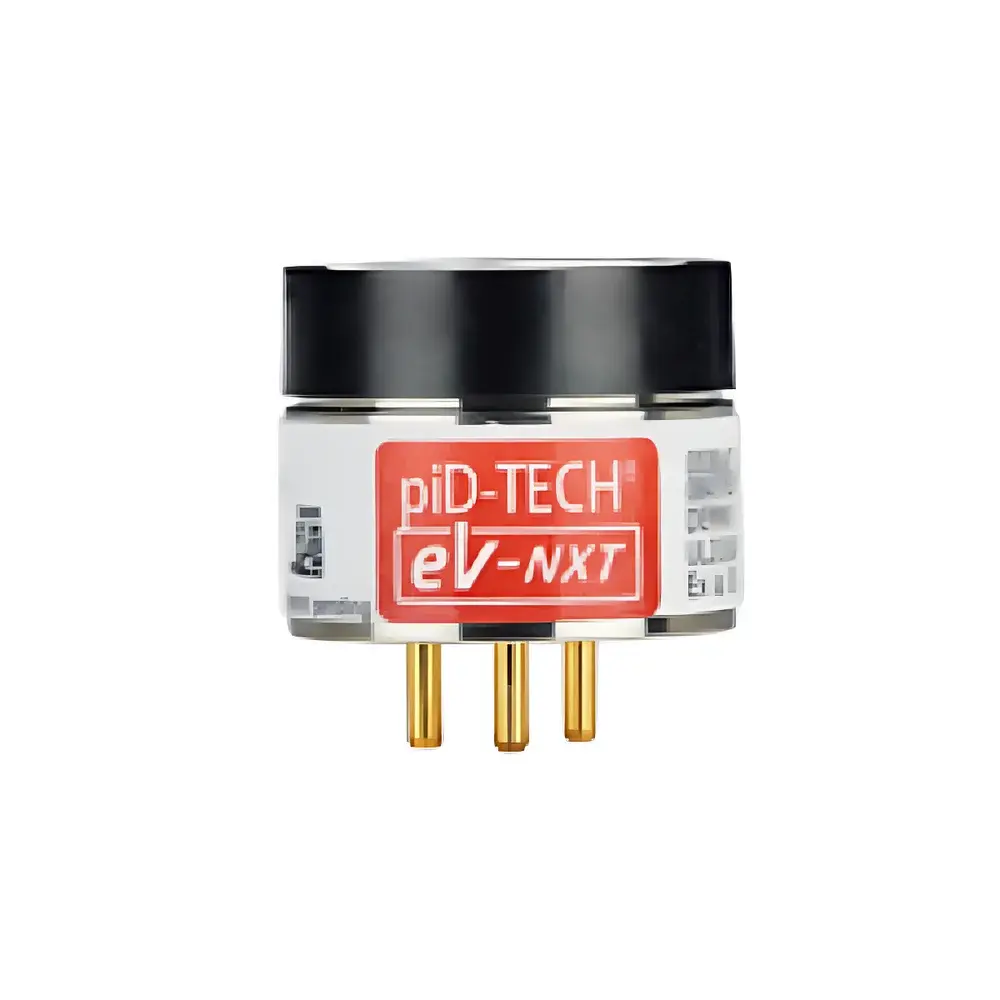
Baseline eV-NXT 045-112 Red PID Sensor Module
| Brand | Baseline |
|---|---|
| Origin | USA |
| Model | eV-NXT 045-112 |
| Detection Range | 0–200 ppm |
| LOD | 10 ppb |
| T90 | < 3.5 s |
| Typical Sensitivity | 12 mV/ppm |
| Operating Condition | 100 ppm |
| Power Requirements | Low-voltage, low-power design |
| Compliance | Intrinsically Safe (IS) certified |
Overview
The Baseline eV-NXT 045-112 Red PID Sensor Module is a high-performance photoionization detector (PID) sensor engineered for precision volatile organic compound (VOC) measurement in demanding environmental and industrial monitoring applications. Utilizing ultraviolet (UV) lamp-based photoionization at 10.6 eV photon energy, the sensor ionizes VOC molecules with ionization potentials below this threshold—enabling selective, real-time detection of aromatic hydrocarbons, ketones, aldehydes, amines, and many halogenated compounds. Unlike catalytic bead or metal oxide semiconductor (MOS) sensors, the eV-NXT platform delivers linear analog output with minimal cross-sensitivity to humidity and CO₂, making it suitable for outdoor air quality networks, fence-line monitoring, confined space entry verification, and continuous emissions monitoring systems (CEMS) pre-screening.
Key Features
- Enhanced inter-sensor reproducibility: Tight manufacturing tolerances ensure consistent calibration transfer across units—critical for multi-node sensor networks and OEM integration where field replacement must maintain system-level accuracy without recalibration.
- Wide operational envelope: Stable baseline performance across –20 °C to +50 °C ambient temperature and 15–95% RH (non-condensing), validated per IEC 60068-2 environmental stress testing protocols.
- Low-power architecture: Designed for battery-operated or energy-constrained deployments; typical operating voltage is 3.3 V DC with average current draw 12 months of operation on standard Li-SOCl₂ cells in intermittent-read configurations.
- Intrinsically safe (IS) construction: Certified to UL 913 Class I, Division 1, Groups A–D and ATEX/IECEx standards for hazardous locations—enabling deployment in petrochemical facilities, wastewater treatment plants, and fuel storage sites.
- Onboard diagnostic self-test: Continuous internal validation of lamp intensity, electrode bias, and signal chain integrity; fault conditions are reported via digital status flag or analog output deviation, reducing false positives and increasing operator confidence in alarm decisions.
Sample Compatibility & Compliance
The eV-NXT 045-112 detects VOCs with ionization potentials ≤10.6 eV—including benzene (9.24 eV), toluene (8.82 eV), xylene (8.57 eV), styrene (8.47 eV), acetone (9.70 eV), and formaldehyde (10.88 eV, partially detectable due to fragmentation). It exhibits negligible response to methane, ethane, CO, CO₂, NOₓ, and common inorganic gases—ensuring specificity in complex matrix environments. The module complies with ISO 16000-29 (indoor air—determination of VOCs using PID), ASTM D5197 (standard test method for ambient air analysis), and supports GLP-compliant data acquisition when integrated with audit-trail-enabled controllers meeting FDA 21 CFR Part 11 requirements.
Software & Data Management
The analog 0–5 V or 4–20 mA output is compatible with industry-standard SCADA, PLC, and data loggers (e.g., Campbell Scientific CR1000X, Siemens Desigo CC). Baseline provides optional firmware-upgradable digital interface modules (I²C or UART) enabling direct connection to embedded Linux or RTOS platforms. Calibration history, diagnostic logs, lamp usage hours, and temperature-compensated raw signal data can be timestamped and exported in CSV or JSON format. When deployed in networked configurations, sensor metadata—including serial number, calibration date, and IS certificate expiry—is embeddable in MQTT payloads for centralized asset management and predictive maintenance workflows.
Applications
- Urban and regional ambient air quality monitoring networks targeting BTEX and oxygenated VOCs
- Fence-line and perimeter monitoring at refineries, chemical manufacturing sites, and landfills
- Indoor air quality (IAQ) assessment in schools, hospitals, and office buildings per ASHRAE Standard 62.1
- Leak detection and repair (LDAR) programs compliant with EPA Method 21 and EU IED Annex VIII
- Mobile monitoring platforms—including drone-mounted VOC mappers and vehicle-based survey systems
- Pre-alarm screening in fixed gas detection systems prior to triggering high-level toxic or combustible alarms
FAQ
What VOCs does the eV-NXT 045-112 detect?
It responds to VOCs with ionization potentials ≤10.6 eV, including aromatics, terpenes, chlorinated solvents, and many oxygenates—but not methane, ethane, or formaldehyde (which lies just above the lamp’s ionization threshold).
Is field calibration required after installation?
No—inter-unit repeatability enables true plug-and-play integration; however, periodic bump testing with 100 ppm isopropyl alcohol (IPA) or benzene is recommended per OSHA 1910.120 and IEC 61511 functional safety guidelines.
Can this sensor operate outdoors without enclosure?
It must be installed in an IP65-rated housing with hydrophobic membrane filtration to prevent particulate ingress and condensation; Baseline offers compatible weatherproof enclosures (e.g., ENC-PIR-01) rated for continuous outdoor exposure.
Does it support temperature and humidity compensation?
Yes—the onboard thermistor and capacitive RH sensor feed real-time correction coefficients into the analog signal path, maintaining ±5% reading stability across its full specified operating range.
How is intrinsic safety maintained during firmware updates?
All digital communication interfaces are galvanically isolated and power-limited per IEC 60079-11; firmware updates occur only in non-hazardous zone service mode and do not affect IS certification validity.
Related Products







