
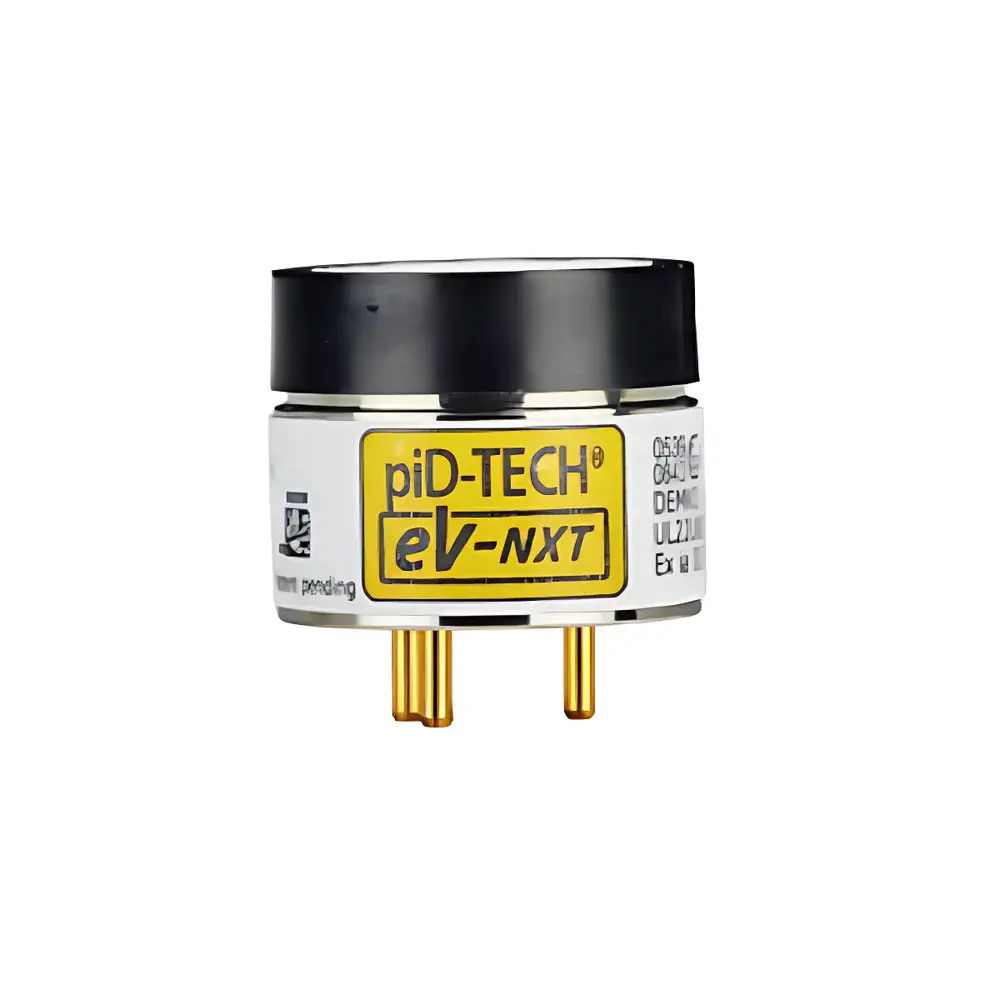
Baseline eV-NXT 045-113 Yellow PID Sensor Module
| Brand | Baseline |
|---|---|
| Origin | USA |
| Model | eV-NXT 045-113 |
| Detection Range | 0–20 ppm |
| LOD | 1.0 ppb |
| T90 | < 6.5 s |
| Typical Sensitivity | 118 mV/ppm |
| Measurement Condition | 10 ppm |
| Operating Voltage | Low-Voltage DC |
Overview
The Baseline eV-NXT 045-113 Yellow PID Sensor Module is a high-performance photoionization detector (PID) sensor engineered for precise, reliable, and low-power volatile organic compound (VOC) monitoring in demanding environmental and industrial applications. Utilizing ultraviolet (UV) lamp-based photoionization at 10.6 eV photon energy, the sensor ionizes VOC molecules with ionization potentials below this threshold—enabling selective detection of aromatic hydrocarbons (e.g., benzene, toluene), alkenes, ketones, aldehydes, and many chlorinated solvents. Unlike broad-spectrum electrochemical or metal-oxide sensors, the eV-NXT platform delivers quantifiable, linear analog output calibrated to isobutylene-equivalent response, supporting trace-level measurement integrity across variable ambient conditions. Its compact OEM form factor integrates seamlessly into portable gas analyzers, fixed-area monitors, and unmanned air quality stations requiring regulatory-grade data fidelity.
Key Features
- Enhanced inter-sensor reproducibility (< ±5% full-scale deviation), enabling true plug-and-play replacement without field recalibration
- Stable baseline performance across –20 °C to +50 °C operating temperature and 15–95% RH non-condensing humidity
- Low-power operation (typical 120 mW at 3.3 V DC), extending battery life in portable and solar-powered deployments
- Onboard self-diagnostics including UV lamp status monitoring, electrode contamination detection, and signal drift compensation
- Intrinsically safe design compliant with UL 913 Class I, Division 1, Groups A–D (pending certification documentation); suitable for hazardous locations
- Fast dynamic response: T90 < 6.5 seconds ensures real-time tracking of transient VOC plumes during leak detection or fugitive emission surveys
Sample Compatibility & Compliance
The eV-NXT 045-113 is optimized for detection of VOCs with ionization potentials ≤ 10.6 eV, including but not limited to benzene (9.24 eV), styrene (8.47 eV), formaldehyde (10.88 eV — partial response), and acetone (9.70 eV). It exhibits minimal cross-sensitivity to common interferents such as CO₂, methane, and water vapor under standard calibration conditions. The sensor meets key regulatory alignment requirements for ambient air monitoring per EPA Method TO-15 and ASTM D5466, and supports data acquisition protocols compatible with ISO 16000-6 (indoor air VOC sampling) and EN 14662 (ambient VOC measurement). Its analog 0–5 V output and optional UART interface facilitate integration into systems designed for GLP-compliant logging and audit-ready traceability.
Software & Data Management
While the eV-NXT 045-113 operates as a standalone analog sensor module, it is fully compatible with Baseline’s proprietary SensorLink firmware suite for OEM system integrators. This embedded software layer enables automatic gain compensation, temperature/humidity compensation coefficients (stored in onboard EEPROM), and configurable alarm thresholds with hysteresis. When integrated into networked monitoring platforms, raw sensor output can be time-stamped, filtered using moving-average or Savitzky-Golay algorithms, and exported in CSV or JSON format. For regulated environments—including those subject to FDA 21 CFR Part 11 or EU Annex 11—the host system may implement electronic signatures, audit trails, and role-based access control around eV-NXT-derived VOC concentration values.
Applications
- Real-time outdoor air quality networks targeting benzene and BTEX compounds near traffic corridors and industrial perimeters
- Fugitive emission detection in petrochemical facilities, refineries, and storage terminals per EPA OOOOa compliance workflows
- Indoor air quality assessment in schools, offices, and healthcare settings per ASHRAE Standard 62.1
- Soil vapor intrusion screening during Phase II environmental site assessments
- Portable personal exposure monitors for HAZMAT teams and industrial hygienists conducting short-term exposure limit (STEL) evaluations
- Integration into UAV-mounted gas mapping systems for landfill methane/VOC co-monitoring
FAQ
What VOCs does the eV-NXT 045-113 detect most effectively?
It provides optimal sensitivity for VOCs with ionization potentials between 7.5 and 10.6 eV—including aromatics, terpenes, and unsaturated aliphatics—while exhibiting negligible response to permanent gases and saturated alkanes like propane or butane.
Is calibration required before deployment?
Yes; Baseline recommends initial two-point calibration (zero air and 10 ppm isobutylene) prior to field use. The sensor supports automated span-check routines when paired with compatible controller firmware.
Can this sensor operate in high-humidity outdoor environments?
Yes—its patented electrode geometry and hydrophobic membrane reduce humidity-induced baseline drift, maintaining < ±2% FS error across 15–95% RH at steady-state conditions.
Does the yellow housing indicate a specific optical filter or lamp configuration?
The yellow housing denotes the 10.6 eV lamp variant with enhanced UV transmission stability and extended lamp lifetime (> 12,000 hours typical), distinct from the 9.8 eV or 11.7 eV variants in the eVx series.
Is the eV-NXT 045-113 compatible with third-party data loggers?
Yes—its 0–5 V analog output and defined pinout conform to industry-standard OEM interface specifications (e.g., RS-485 optional via adapter board), supporting integration with Campbell Scientific, Onset HOBO, and other certified environmental data acquisition systems.







