
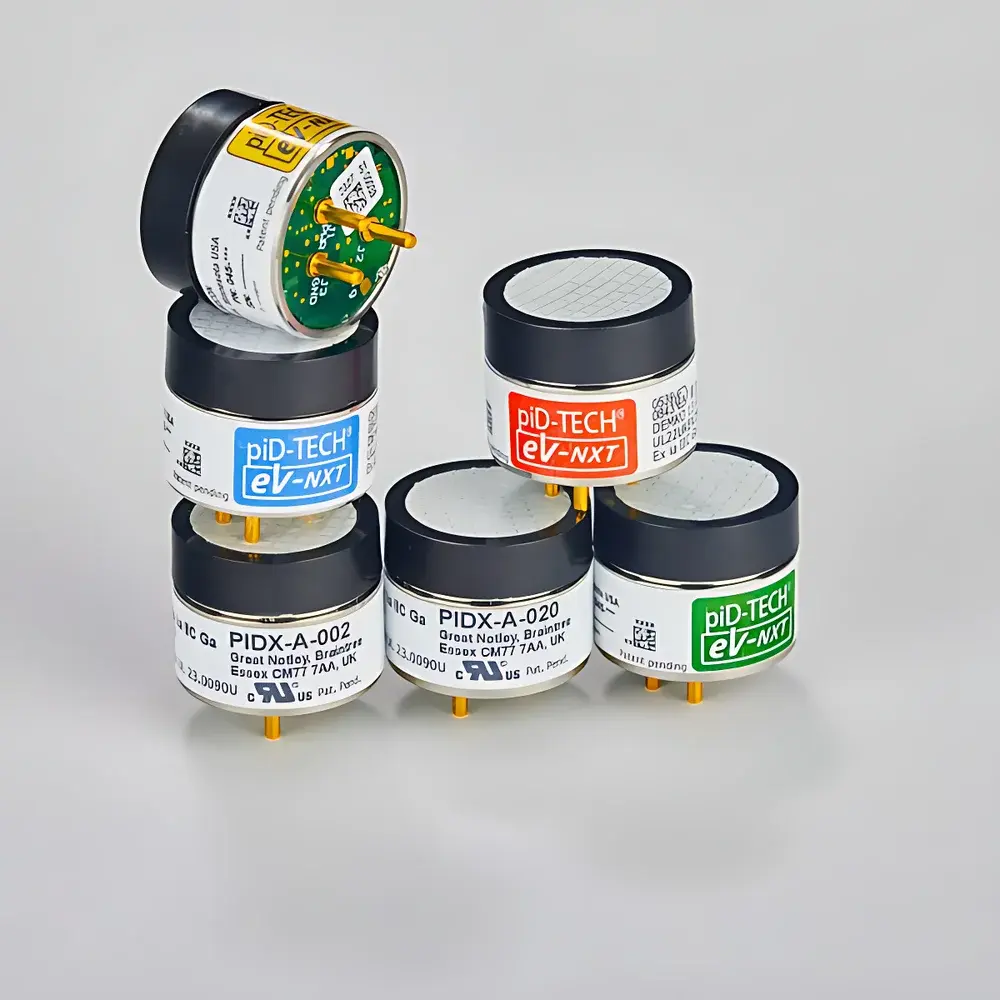
Baseline PID-TECH eV-NXT Photoionization Detector Sensor
| Brand | Baseline |
|---|---|
| Origin | USA |
| Manufacturer Type | Authorized Distributor |
| Origin Category | Imported |
| Model | BASELINE PID-TECH eV-NXT |
| Pricing | Available Upon Request |
Overview
The Baseline PID-TECH eV-NXT Photoionization Detector (PID) sensor is an engineered solution for precise, reliable, and field-deployable volatile organic compound (VOC) detection across environmental monitoring, industrial hygiene, and process safety applications. Operating on the principle of ultraviolet (UV) photoionization—where VOC molecules are ionized by high-energy UV photons emitted from a stable lamp—the eV-NXT generates a current proportional to analyte concentration, enabling quantitative real-time measurement down to sub-ppb levels. Unlike conventional PID sensors susceptible to humidity drift, lamp aging, or cross-sensitivity, the eV-NXT integrates proprietary internal voltage regulation, hydrophobic particulate filtration, and temperature-compensated signal processing to maintain baseline stability across ambient conditions ranging from –20 °C to +50 °C and 0–95% RH (non-condensing). Its design complies with fundamental requirements for continuous emission monitoring (CEM), ambient air quality networks (e.g., EPA Method TO-15 support), and confined space entry protocols.
Key Features
- Ultra-stable baseline performance: Engineered for <1 ppb zero drift over 24 hours at constant temperature/humidity, critical for long-term unattended operation in ambient air stations.
- Enhanced inter-sensor reproducibility: Tight manufacturing tolerances yield ±3% relative standard deviation across production lots—enabling scalable multi-sensor arrays without individual calibration offsets.
- Integrated fault diagnostics: Onboard lamp-status monitoring, UV intensity tracking, and open-circuit/short-circuit detection provide real-time health reporting via analog or digital interface (RS-485/Modbus RTU).
- Intrinsic safety certified: UL 913, CAN/CSA C22.2 No. 157, ATEX II 2G Ex d ia IIC T4 Ga, and IECEx Ex d ia IIC T4 Ga compliant—suitable for Zone 1 hazardous locations without external barriers.
- Low-power architecture: Operates at 3.3–5.0 VDC, consuming <80 mW during active measurement—optimized for battery-powered portable instruments and solar-wireless nodes.
- Robust environmental resilience: Hydrophobic membrane filter minimizes moisture condensation and particulate fouling; no routine solvent cleaning required—maintenance intervals exceed 12 months under typical urban air conditions.
Sample Compatibility & Compliance
The eV-NXT detects >95% of common VOCs with ionization energies below its lamp photon energy (10.6 eV standard, optional 11.7 eV lamp available), including benzene, toluene, xylene (BTX), styrene, formaldehyde (with catalytic pre-concentrator), and chlorinated solvents such as trichloroethylene. It exhibits minimal response to CO2, CH4, NOx, and water vapor—reducing false positives in humid or combustion-rich environments. The sensor meets key regulatory alignment criteria for EPA Reference Method PS-11 (for portable VOC analyzers), ISO 16000-25 (indoor air VOC sampling), and OSHA 29 CFR 1910.1200 (Hazard Communication Standard) exposure assessment workflows. Data integrity supports GLP-compliant logging when paired with validated firmware and audit-trail-enabled host systems.
Software & Data Management
The eV-NXT outputs linear 0–5 V analog signal or Modbus RTU over RS-485, enabling seamless integration into SCADA, PLC, or custom DAQ platforms. Baseline provides open communication protocol documentation and sample Arduino/Pico firmware libraries for rapid prototyping. When deployed in networked air quality stations, the sensor’s diagnostic flags (lamp degradation, filter saturation, temperature excursion) feed directly into cloud-based dashboards (e.g., ThingSpeak, AWS IoT Core) for predictive maintenance scheduling. Firmware updates preserve traceability per FDA 21 CFR Part 11 requirements when used in regulated environmental compliance applications—supporting electronic signatures, audit trails, and role-based access control through compatible host software.
Applications
- Ambient air quality monitoring networks: Continuous BTX and aromatic VOC tracking near industrial perimeters, transportation corridors, and urban background sites.
- Industrial leak detection and repair (LDAR): Quantitative screening of flanges, valves, and connectors per EPA Method 21—integrated into handheld survey tools or fixed perimeter monitors.
- Indoor air quality (IAQ) assessment: Real-time VOC profiling in schools, hospitals, and office buildings—correlating with occupant symptom surveys and ventilation efficiency metrics.
- Soil vapor intrusion (SVI) investigations: Sub-slab and groundwater plume monitoring using diffusion samplers coupled to low-flow PID manifolds.
- Process safety instrumentation: Integration into emergency shutdown (ESD) loops for hydrocarbon processing units where rapid VOC surge detection triggers ventilation or isolation actions.
FAQ
What lamp lifetime can be expected under continuous operation?
Typical UV lamp service life exceeds 10,000 hours at 25 °C ambient; output decay is monitored continuously, and firmware alerts trigger at 80% initial intensity.
Is field recalibration required?
No routine recalibration is needed; factory calibration certificates (NIST-traceable isobutylene) are provided. Field verification using certified gas standards is recommended annually or after physical shock/exposure to high-concentration VOCs.
How does the eV-NXT handle high-humidity environments?
An integrated hydrophobic PTFE membrane and thermally stabilized detector chamber suppress humidity-induced baseline shift—validated per IEC 60068-2-30 damp heat testing (95% RH, 40 °C, 24 h).
Can the sensor be used in explosive atmospheres?
Yes—its intrinsic safety certifications (ATEX, IECEx, UL, CSA) permit direct installation in Zone 1 (gas) and Class I, Division 1 hazardous locations without additional explosion-proof enclosures.
What interfaces are supported for OEM integration?
Standard analog (0–5 V, 4–20 mA optional) and digital (RS-485, Modbus RTU) outputs; pin-compatible footprint with legacy eVx series simplifies hardware redesign.







