
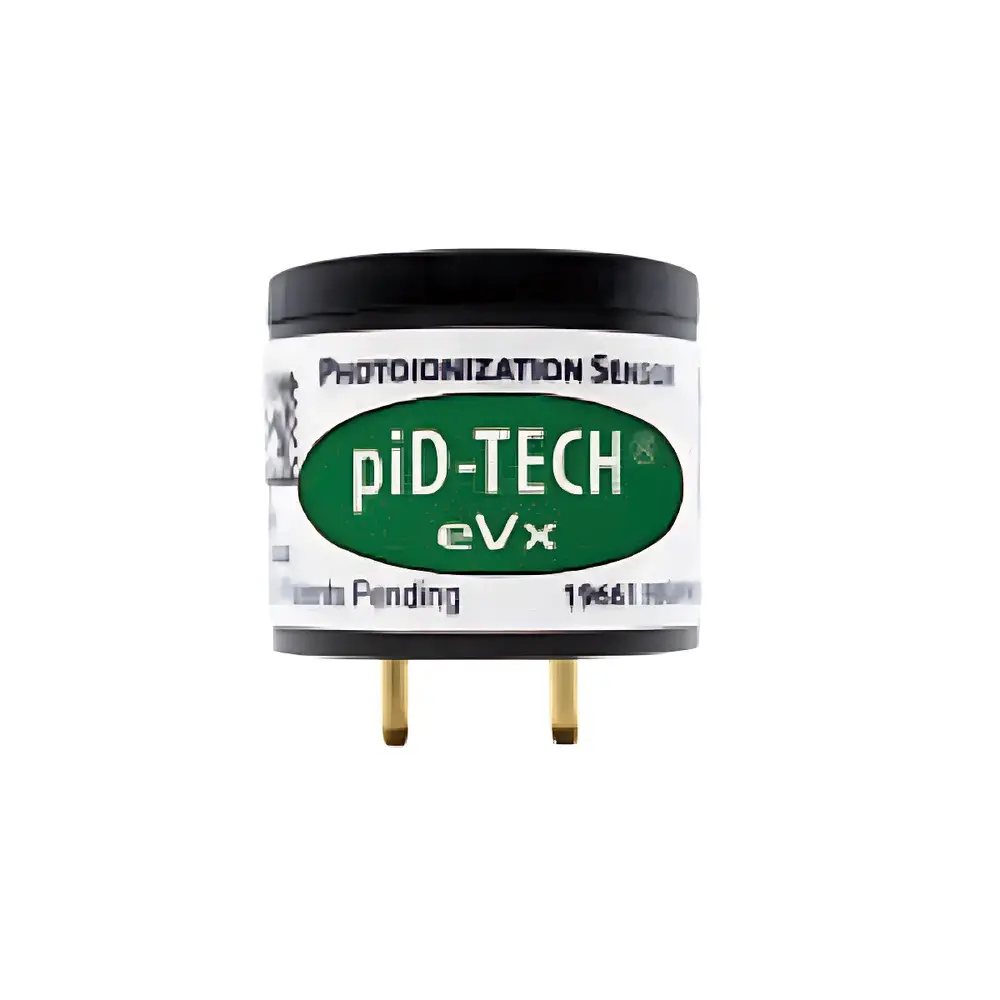
Baseline piD-TECH® eVx™ 045-010 Intrinsically Safe Photoionization Detector (PID) Sensor
| Brand | Baseline |
|---|---|
| Origin | USA |
| Manufacturer Type | Authorized Distributor |
| Origin Category | Imported |
| Model | piD-TECH® eVx™ 045-010 |
| Pricing | Available Upon Request |
| Certification | UL, CAN/CSA C22.2 No. 60079-0, ATEX II 2G Ex d [ia] IIC T4 Ga, IECEx Ex d [ia] IIC T4 Ga |
| Detection Range | 0–10,000 ppm isobutylene equivalent |
| Minimum Detectable Quantity (MDQ) | 500 ppb (isobutylene) |
| T90 Response Time | < 2 s (typical) |
| Lamp Lifetime | > 12,000 hours |
| Operating Temperature | –20 °C to +50 °C |
| Humidity Range | 0–95% RH (non-condensing) |
| Output Signal | 0–5 V DC analog |
| Power Supply | 5.0 V ±0.1 V DC |
| Ingress Protection | IP67-rated housing |
| Filter Configuration | Dual-stage particulate & hydrophobic membrane filter |
| Temperature Drift | < 0.05% FS/°C |
| Humidity Compensation | Electrode-based active suppression |
Overview
The Baseline piD-TECH® eVx™ 045-010 is an intrinsically safe, fourth-generation photoionization detector (PID) sensor engineered for high-fidelity, real-time detection of volatile organic compounds (VOCs) in ambient air and industrial process streams. Based on vacuum ultraviolet (VUV) lamp photoionization at 10.6 eV photon energy, the sensor ionizes VOC molecules with ionization potentials below this threshold—enabling broad-spectrum detection of aromatics, aliphatics, ketones, amines, and sulfur-containing compounds without chemical-specific calibration. Unlike catalytic bead or metal oxide semiconductor sensors, the PID principle delivers linear, non-destructive, and compound-class-selective response across its full 0–10,000 ppm isobutylene-equivalent range. Designed for integration into portable, transportable, and fixed-mount gas monitoring platforms, the eVx™ 045-010 adheres to rigorous functional safety requirements for Zone 1/21 hazardous locations and supports OEM development under IEC 61508 SIL 2-aligned system architectures.
Key Features
- Intrinsically safe design certified to UL 60079-0, CAN/CSA C22.2 No. 60079-0, ATEX II 2G Ex d [ia] IIC T4 Ga, and IECEx Ex d [ia] IIC T4 Ga for use in flammable atmospheres
- Dual-stage filtration system comprising hydrophobic membrane and graded particulate barrier to prevent sensor fouling and extend service intervals
- Patented lamp restart circuit ensuring consistent ignition reliability and minimizing warm-up variability across thermal cycles
- Long-life 10.6 eV VUV lamp with >12,000 hours operational endurance and factory-traceable spectral output verification
- Integrated electrode-based humidity compensation architecture that actively suppresses signal drift induced by ambient moisture (0–95% RH, non-condensing)
- Onboard linear voltage regulator delivering stable 5.0 V ±0.1 V supply to critical analog stages, reducing noise-induced baseline fluctuation
- Shielded stainless-steel housing with IP67 ingress protection and 4-series mechanical footprint compatible with standard OEM mounting interfaces
- T90 response time < 2 seconds for isobutylene under controlled laboratory conditions, validated per ISO 16000-23 Annex B protocols
- Negligible temperature coefficient (< 0.05% full scale per °C), enabling deployment across uncontrolled environmental gradients without active thermal stabilization
Sample Compatibility & Compliance
The eVx™ 045-010 exhibits uniform sensitivity to VOCs with ionization potentials ≤10.6 eV—including benzene (9.24 eV), toluene (8.82 eV), xylene (8.57 eV), acetone (9.70 eV), and formaldehyde (10.88 eV, partial response). It is not responsive to methane, ethane, CO, CO₂, NOₓ, or H₂S. The sensor complies with EN 50104:2017 for toxic gas detectors and meets functional safety requirements for incorporation into systems compliant with IEC 61511 (process industry) and IEC 62061 (machinery). Its construction satisfies RoHS 2011/65/EU and REACH SVHC screening criteria. Calibration traceability follows NIST-traceable isobutylene standards, and field verification aligns with EPA Method TO-15 and ASTM D5466 procedures.
Software & Data Management
While the eVx™ 045-010 operates as a standalone analog transducer (0–5 V DC output proportional to VOC concentration), it is fully compatible with Baseline’s proprietary SensorLink™ SDK for OEM firmware integration. The SDK provides register-level access to internal diagnostics—including lamp health status, filter saturation flag, temperature-compensated raw counts, and self-test pass/fail indicators. When embedded in systems supporting FDA 21 CFR Part 11, audit trails for calibration events, zero/span adjustments, and firmware updates can be generated and digitally signed. Raw data streams support timestamped logging at ≥10 Hz sampling rates, facilitating compliance with GLP/GMP environmental monitoring records per ISO/IEC 17025 Clause 7.7.
Applications
- Fixed-site perimeter monitoring for petrochemical refineries, tank farms, and landfill gas collection systems
- OEM integration into multi-gas personal monitors (PGMs) used by HAZMAT teams and industrial hygienists
- Real-time emission verification in fenceline monitoring networks compliant with EPA OTM-33A and EU Directive 2010/75/EU (IED)
- Indoor air quality (IAQ) assessment in smart building management systems detecting solvent off-gassing from adhesives, coatings, and cleaning agents
- Process safety interlocks in pharmaceutical cleanrooms where VOC excursions may compromise ISO Class 5–8 environments
- Mobile survey platforms including drone-mounted VOC mappers for rapid plume delineation during spill response
FAQ
What VOCs does the eVx™ 045-010 detect?
It detects all VOCs with ionization potentials ≤10.6 eV, including aromatic hydrocarbons, chlorinated solvents, alcohols, esters, and amines. Compounds such as methane, ethane, carbon monoxide, and carbon dioxide are not detected.
Is field calibration required?
Yes—periodic span calibration using certified isobutylene gas (or application-specific surrogate) is recommended every 30–90 days depending on exposure history and regulatory requirements. Zero calibration may be performed with filtered ambient air or nitrogen.
Can the sensor operate in high-humidity environments?
Yes—the integrated electrode-based humidity suppression system maintains measurement integrity up to 95% RH non-condensing. Condensation must be prevented via proper sample conditioning (e.g., Nafion dryers or chilled mirrors).
What is the expected service life under continuous operation?
The VUV lamp is rated for >12,000 hours; the dual-filter assembly typically requires replacement every 6–12 months in typical urban ambient air. Full sensor recalibration is advised after lamp or filter replacement.
Does Baseline provide technical support for OEM integration?
Yes—Baseline’s Applications Engineering team offers schematic review, PCB layout consultation, firmware interface validation, and pre-compliance EMC testing guidance for customers integrating the eVx™ platform into end-user instruments.







