
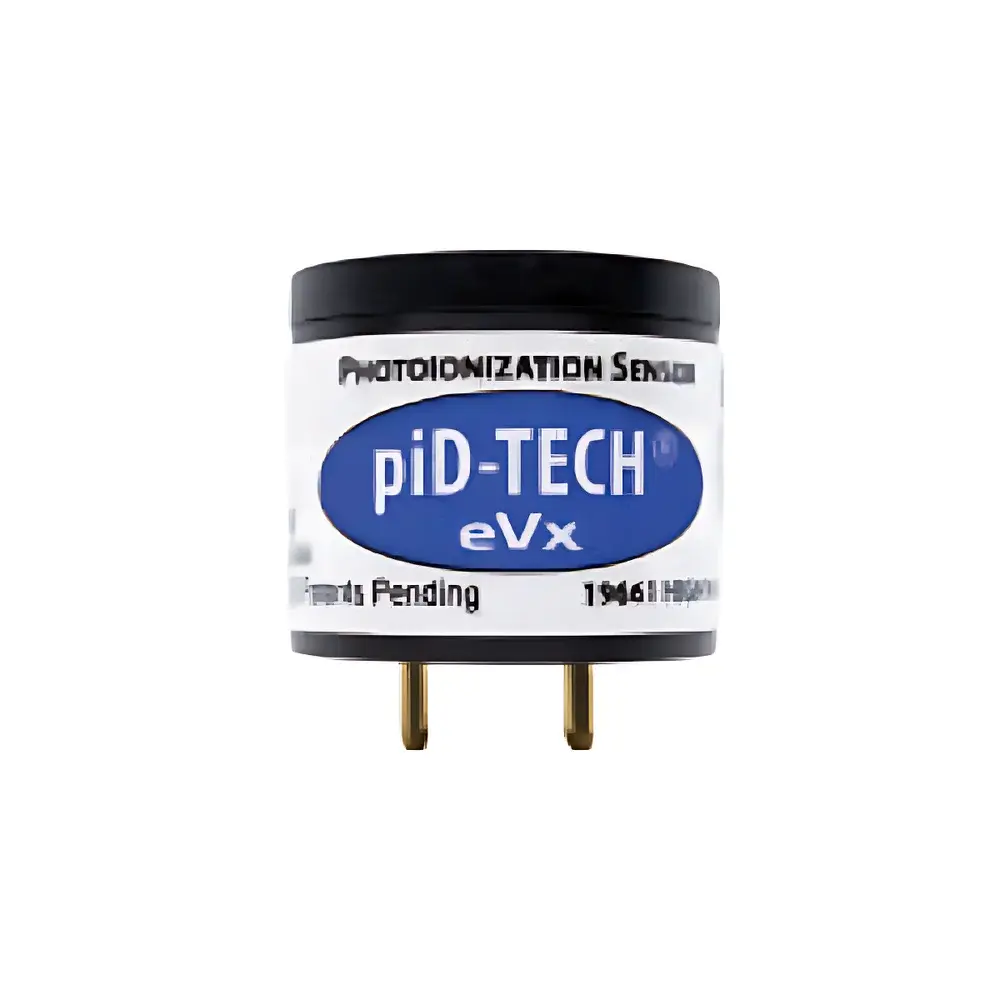
Baseline piD-TECH® eVx™ 045-014 Intrinsically Safe Photoionization Detector (PID) Sensor – Blue Variant
| Brand | Baseline |
|---|---|
| Origin | USA |
| Manufacturer Type | Authorized Distributor |
| Origin Category | Imported |
| Model | piD-TECH® eVx™ 045-014 |
| Pricing | Available Upon Request |
| Detection Range | 2 ppm |
| Minimum Detectable Quantity (MDQ) | 0.5 ppb |
| T90 Response Time | < 4 s (typical) |
| Certification | UL, CAN/CSA C/US, ATEX II 1G, IECEx Ex ia IIC T4 Ga |
| Sensor Architecture | 4-Series Compatible Form Factor |
| Lamp Life | > 12,000 hours |
| Operating Temperature Range | –20 °C to +50 °C |
| Humidity Compensation | Electrode-based suppression |
| Filtering | Dual-stage particulate protection |
| Power Supply | Internal linear regulation for signal stability |
| Maintenance | Field-serviceable, cleanable electrode assembly |
Overview
The Baseline piD-TECH® eVx™ 045-014 is a certified intrinsically safe photoionization detector (PID) sensor engineered for high-fidelity, real-time detection of volatile organic compounds (VOCs) in ambient air and industrial process streams. Utilizing vacuum ultraviolet (VUV) lamp excitation at 10.6 eV photon energy, the sensor ionizes VOC molecules with ionization potentials below this threshold—enabling quantitative measurement of over 1,500 compounds including benzene, toluene, xylene (BTX), styrene, chlorinated hydrocarbons, and aliphatic/aromatic solvents. Unlike catalytic bead or metal oxide semiconductor (MOS) sensors, PID technology delivers compound-class selectivity without cross-sensitivity to CO₂, methane, or humidity-induced drift—making it ideal for environmental monitoring, confined space entry verification, industrial hygiene, and continuous emissions monitoring system (CEMS) integration. This blue-labeled variant (045-014) is calibrated for a 2 ppm full-scale range with a sub-part-per-trillion MDQ of 0.5 ppb, optimized for low-concentration regulatory compliance applications such as EPA Method 21 leak detection or OSHA PEL monitoring.
Key Features
- Intrinsically safe design certified to UL 913, CAN/CSA C22.2 No. 157, ATEX II 1G Ex ia IIC T4 Ga, and IECEx Ex ia IIC T4 Ga—enabling deployment in Zone 0/1 hazardous locations without additional barriers.
- Robust 4-series mechanical footprint ensures drop-in compatibility with existing OEM gas detection platforms designed for electrochemical sensor modules.
- Dual-stage particulate filtration minimizes fouling from dust, oil mist, and aerosols—extending calibration interval and reducing false alarms.
- Integrated lamp restart circuit ensures consistent lamp ignition across temperature gradients and battery voltage fluctuations, improving measurement reproducibility over time.
- Electrode-based humidity compensation architecture actively suppresses signal attenuation caused by ambient RH up to 95% non-condensing—eliminating need for external drying tubes or Nafion membranes.
- Linear internal voltage regulation maintains stable gain and baseline offset under varying supply conditions (e.g., 3.3 V–5.5 V DC), supporting battery-powered portable instrumentation.
- Field-maintainable construction allows cleaning of UV window and ionization chamber using isopropyl alcohol and lint-free swabs—no soldering or recalibration required post-service.
Sample Compatibility & Compliance
The eVx™ 045-014 demonstrates broad compatibility with saturated and unsaturated hydrocarbons, ketones, esters, ethers, amines, and sulfur-containing VOCs—excluding compounds with ionization potentials >10.6 eV (e.g., formaldehyde, methane, ethane). It meets performance criteria specified in ASTM D5403 (standard test method for VOC content by PID), ISO 16000-18 (indoor air—determination of VOCs), and EN 14662 (ambient air quality—guidance on PID use for aromatic hydrocarbon monitoring). Its certification portfolio supports global deployment under EU ATEX Directive 2014/34/EU, Canadian Electrical Code Rule 18-000, and U.S. NEC Article 500. The sensor operates reliably within –20 °C to +50 °C and 15–95% RH, with negligible thermal coefficient (<±0.02% FS/°C) and no zero drift attributable to condensation or thermal shock.
Software & Data Management
While the eVx™ 045-014 is an analog-output (0–2 V or 4–20 mA) sensor module, its signal integrity enables seamless integration into data acquisition systems compliant with FDA 21 CFR Part 11 (when paired with audit-trail-capable host firmware), ISO/IEC 17025-accredited calibration workflows, and GLP/GMP validation protocols. Baseline provides OEM partners with full electrical interface documentation—including pinout schematics, load resistance recommendations, and noise floor characterization—and supports custom firmware development via SDKs compatible with ARM Cortex-M and ESP32 microcontroller platforms. All factory calibrations are traceable to NIST-certified isobutylene standards, with optional certificate of conformance (CoC) and uncertainty reporting available upon request.
Applications
- Fixed-point ambient air quality monitoring networks targeting BTX, styrene, and chlorinated solvents near petrochemical facilities and landfills.
- OEM integration into portable multi-gas detectors for HAZMAT response teams requiring simultaneous VOC, H₂S, CO, and O₂ measurement.
- Real-time fugitive emission monitoring per EPA 40 CFR Part 60 Subpart VV and LDAR program requirements.
- Indoor air quality (IAQ) assessment in laboratories, cleanrooms, and healthcare settings where low-level solvent exposure must be verified against ACGIH TLVs.
- Process safety interlocks in pharmaceutical manufacturing suites where solvent vapor accumulation poses explosion or toxicity risk.
FAQ
What VOCs can the eVx™ 045-014 detect?
It detects VOCs with ionization potentials ≤10.6 eV—including aromatics, olefins, ketones, aldehydes (except formaldehyde), amines, and many halogenated compounds—but not permanent gases like CO, CH₄, or NH₃.
Is field calibration possible without specialized equipment?
Yes—zero calibration can be performed in clean air; span calibration requires certified isobutylene or benzene standard gas (100 ppb–1 ppm), which may be delivered via permeation tube or dynamic dilution system.
How does humidity compensation work without active drying?
The sensor employs a dual-electrode configuration where one electrode measures humidity-induced current offset and subtracts it digitally from the primary ion current—preserving sensitivity while eliminating desiccant maintenance.
Can this sensor replace older 4-series PID modules directly?
Yes—the mechanical envelope, pin layout, and electrical interface match legacy 4-series specifications, enabling plug-and-play upgrade paths for OEMs maintaining legacy hardware platforms.
What is the expected service life under continuous operation?
The VUV lamp is rated for ≥12,000 hours of operation; electrodes and filters typically require cleaning every 6–12 months depending on particulate loading, with no scheduled replacement parts needed within first 3 years.







