
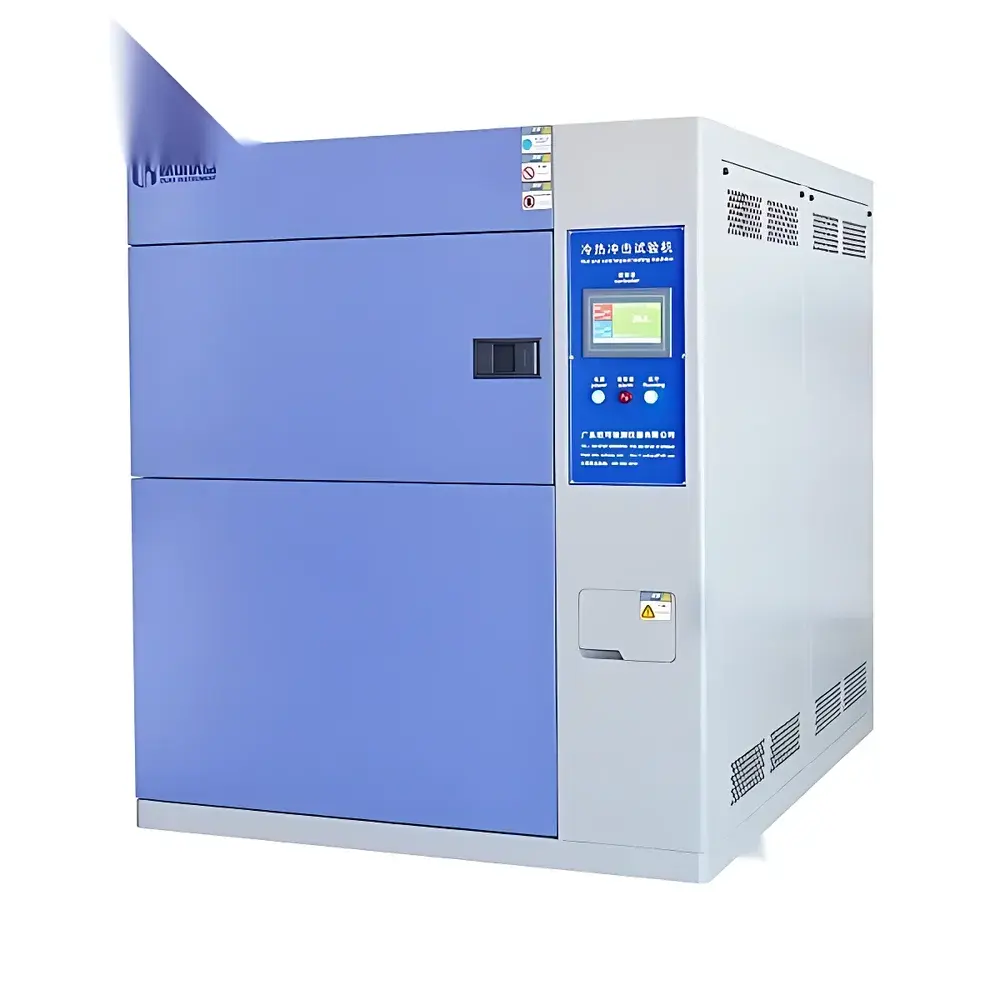
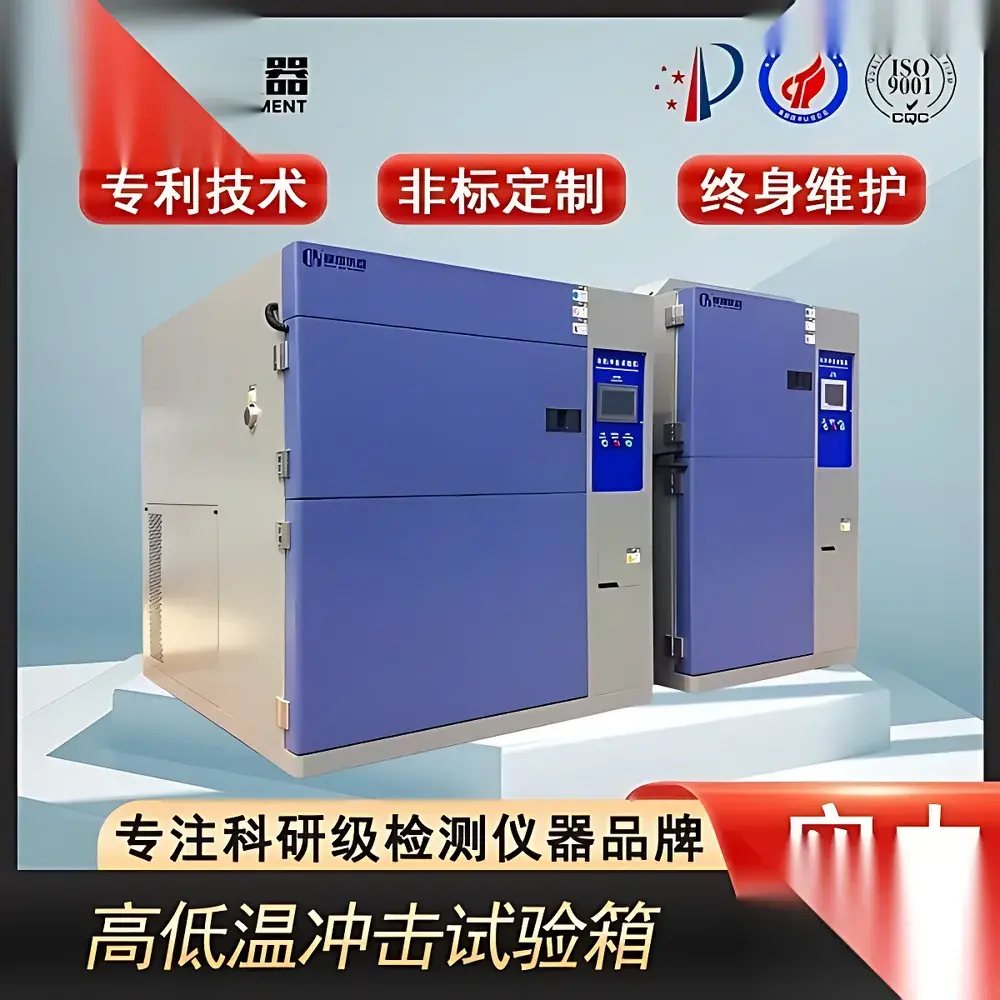
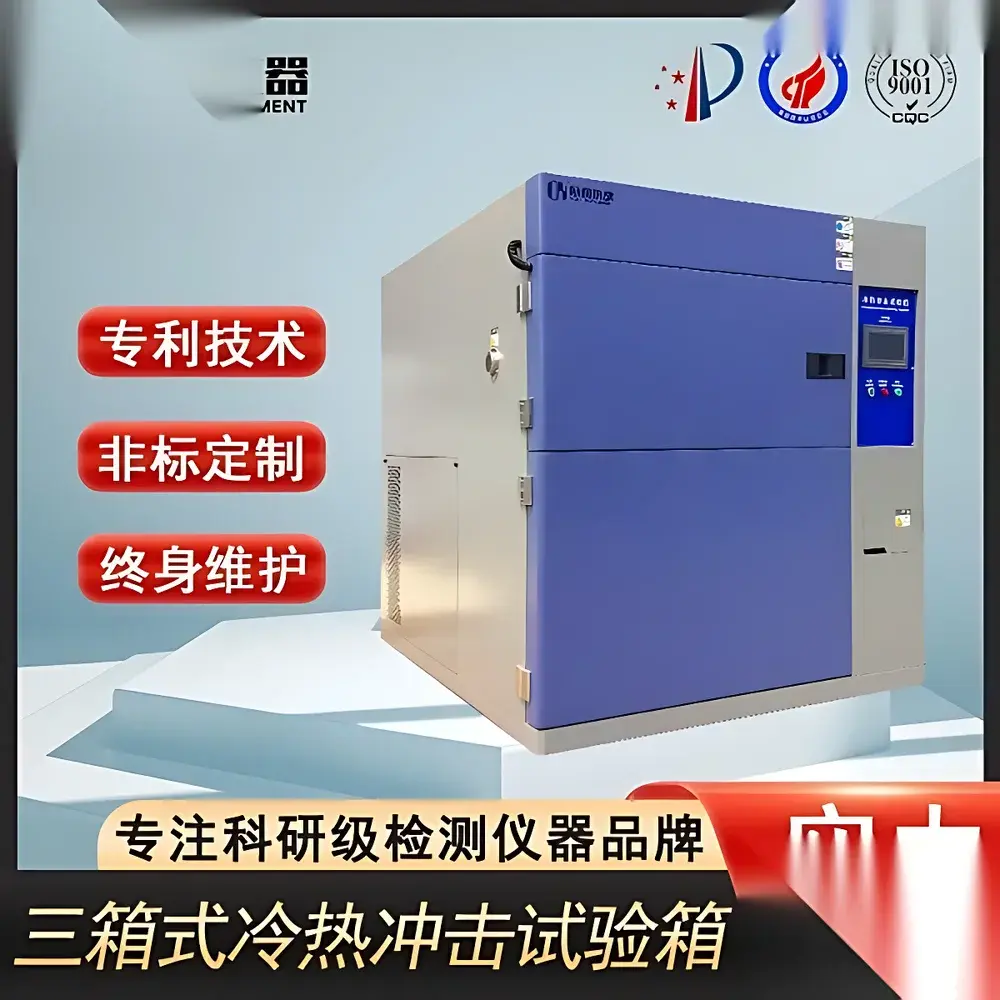
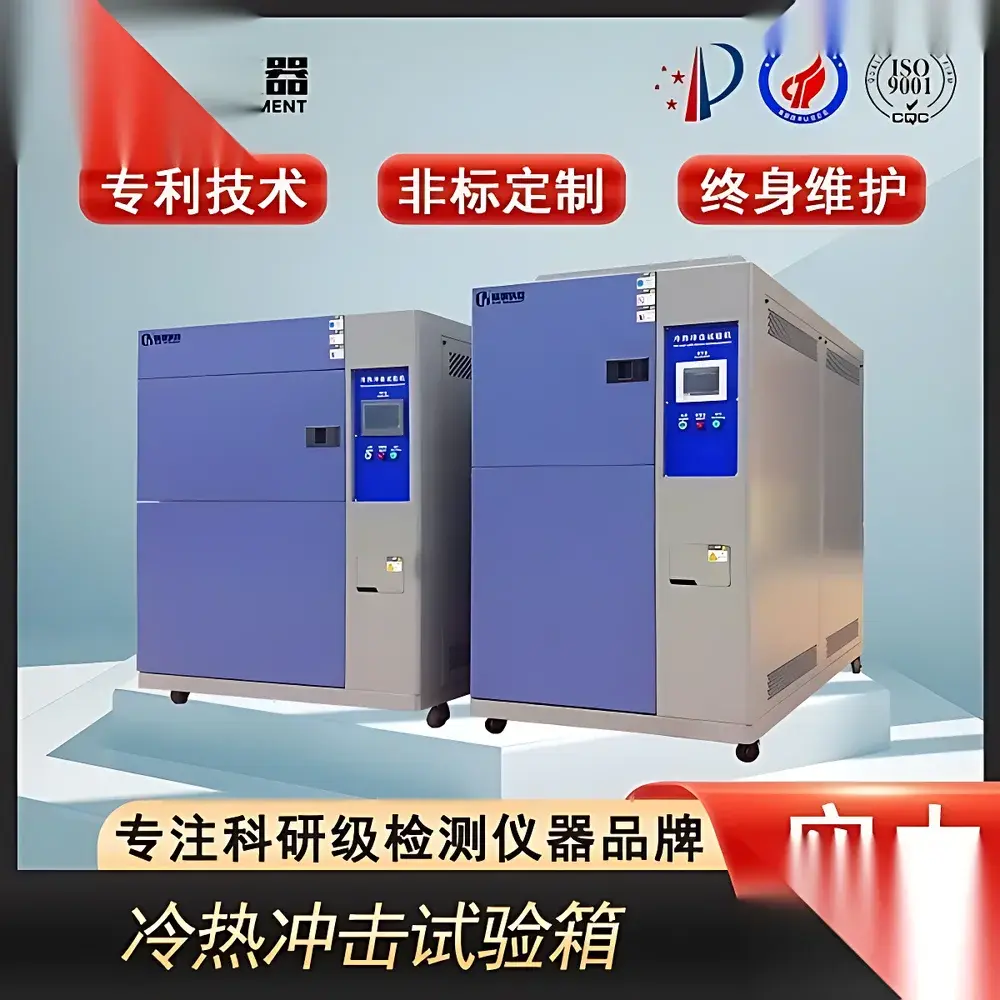
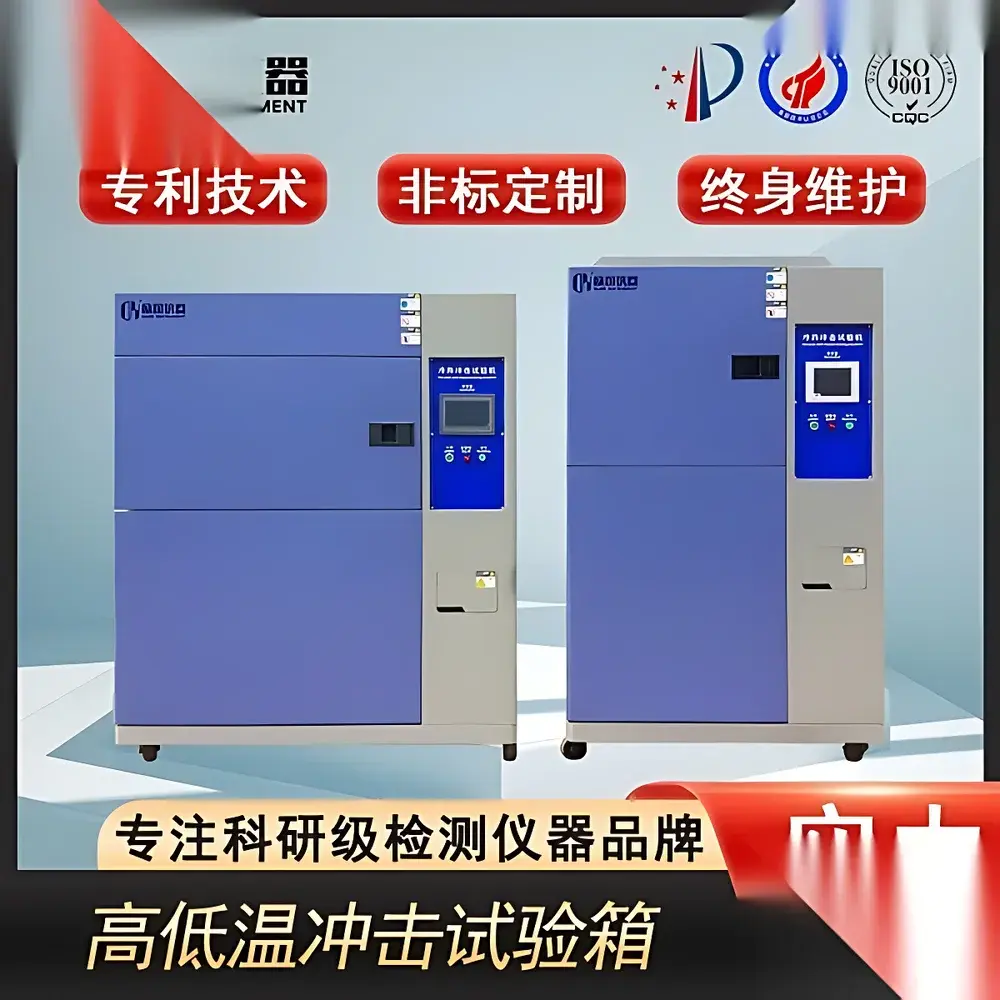
Two-Basket Thermal Shock Test Chamber
| Key Features | Dual-chamber design (hot/cold) with pneumatic door switching |
|---|---|
| Temperature Range | Hot Zone RT to +200°C, Cold Zone RT to −70°C |
| Test Zone Range | +60°C to +150°C (heat shock), 0°C to −45/−55/−65°C (cold shock) |
| Temperature Uniformity | ±2.0°C |
| Temperature Control Accuracy | ±0.5°C |
| Recovery Time | <5 min |
| Preheating Time (RT→150°C) | ~30 min |
| Precooling Time (RT→−70°C) | ~85 min |
| Refrigeration System | Twin-stage cascade refrigeration using R404A/R23 |
| Construction | Interior – SUS#304 mirror-finish stainless steel |
| Insulation | High-density fire-retardant PU foam |
| Power Supply | AC 380 V ±5%, 50 Hz ±0.5 Hz, 3-phase 5-wire |
| Optional Customization | Internal dimensions scalable per user requirements |
Overview
The Two-Basket Thermal Shock Test Chamber is an engineered environmental test system designed to evaluate the reliability and structural integrity of electronic components, automotive parts, aerospace assemblies, and advanced materials under rapid, repeated transitions between extreme high and low temperatures. Unlike single-chamber thermal cycling systems, this dual-basket configuration employs physically separated hot and cold zones—each thermally isolated and independently controlled—to deliver true thermal shock conditions in accordance with established international test protocols. The chamber operates on a static sample principle: the test specimen remains fixed within a transfer basket, which is pneumatically actuated to shuttle between the hot and cold chambers. This architecture eliminates thermal mass interference from chamber walls and ensures precise, repeatable exposure profiles. The system implements a two-stage cascade refrigeration cycle—comprising a high-temperature stage (R404A) and a low-temperature stage (R23)—to achieve stable operation down to −70°C while maintaining rapid thermal transition performance. All thermal control algorithms are calibrated for compliance with IEC 60068-2-14 (Test N: Change of Temperature) and ASTM D5229/D5229M for temperature shock qualification.
Key Features
- Dual independent thermal reservoirs: Hot zone (RT to +200°C) and cold zone (RT to −70°C), each equipped with dedicated heating elements and refrigeration circuits
- Pneumatically actuated transfer mechanism ensuring repeatable, vibration-minimized basket movement between zones
- High-efficiency twin-stage cascade refrigeration system with energy modulation capability for optimized power consumption and compressor longevity
- Precision temperature control with ±0.5°C accuracy and ±2.0°C uniformity across the test volume
- Thermal recovery time under 5 minutes after zone transition—validated per MIL-STD-810H Method 503.5
- Internal construction using mirror-finish SUS#304 stainless steel for corrosion resistance and cleanroom compatibility
- Fire-retardant, high-density polyurethane insulation with thermal conductivity ≤0.022 W/m·K
- Standard 50 mm diameter cable port and dual-tier stainless steel shelves for flexible DUT mounting
Sample Compatibility & Compliance
This chamber accommodates a broad range of sample geometries through customizable internal volumes (standard models: 49 L to 225 L). Its static-basket design supports PCBs, solder joints, MEMS devices, battery modules, optical sensors, and molded plastic housings without mechanical fixation constraints. The system meets full regulatory alignment with multiple national and international standards, including: GB/T 2423.1–2001 (cold testing), GB/T 2423.2–2001 (dry heat), GB/T 2423.22–2002 (temperature change), GJB 150.5–86 (military temperature shock), SJ/T 10186–91 (two-chamber thermal shock specification), IEC 60068-2-14, and EIA-364-32 (connector thermal shock evaluation). It supports traceable test execution under GLP and GMP environments when integrated with compliant data logging and audit trail software.
Software & Data Management
The chamber integrates with optional PC-based control software supporting real-time monitoring, programmable multi-step shock profiles (e.g., 100 cycles of −55°C ↔ +125°C with 10 s dwell), automatic calibration logging, and CSV-exportable temperature/time datasets. All operational parameters—including setpoints, actual chamber temperatures, door status, compressor runtime, and alarm history—are timestamped and stored locally with 30-day retention. When configured with network-enabled controllers, the system supports remote access via HTTPS-secured web interface and can be incorporated into centralized test management platforms compliant with FDA 21 CFR Part 11 for electronic records and signatures.
Applications
- Qualification of avionics modules for DO-160 Section 4.5 thermal shock compliance
- Accelerated life testing of EV battery packs per ISO 16750-4 and SAE J2380
- Solder joint reliability assessment for Class III electronics (IPC-J-STD-001, IPC-A-610)
- Material delamination analysis in multilayer ceramic capacitors (MLCCs) and chip-scale packages
- Validation of hermetic seal integrity in medical implantable device enclosures
- Thermal fatigue evaluation of adhesive bonds used in LED packaging and automotive lighting systems
FAQ
What distinguishes a two-basket thermal shock chamber from a three-chamber (horizontal) design?
The two-basket configuration uses one shared transfer basket moving between separate hot and cold zones, minimizing thermal inertia and enabling faster transitions. Three-chamber systems isolate test, hot, and cold zones—offering higher throughput for batch testing but requiring larger footprint and greater energy input.
Is external cooling water required for operation?
Yes. The cascade refrigeration system requires a dedicated closed-loop cooling water supply at 10 m³/h capacity, typically delivered via an externally installed cooling tower. Water inlet temperature must remain ≤32°C for nominal performance.
Can the chamber be validated for IQ/OQ/PQ protocols?
Yes. Documentation packages—including as-built drawings, sensor calibration certificates (NIST-traceable Pt100 probes), and FAT/SAT reports—are available upon request to support installation, operational, and performance qualification per ISO/IEC 17025 and ASTM E2500.
What safety interlocks are implemented?
Dual redundant door position sensors, overtemperature cutoffs (±5°C deviation limit), refrigerant pressure monitoring, and emergency stop circuitry compliant with IEC 60204-1 are standard. All interlocks feed into a SIL2-rated safety PLC.
Are custom temperature ranges or internal configurations supported?
Yes. Engineering consultation is provided for non-standard hot/cold zone limits (e.g., −80°C cold zone), extended dwell times, inert atmosphere purging (N₂), or integration with in-situ electrical biasing fixtures.



