
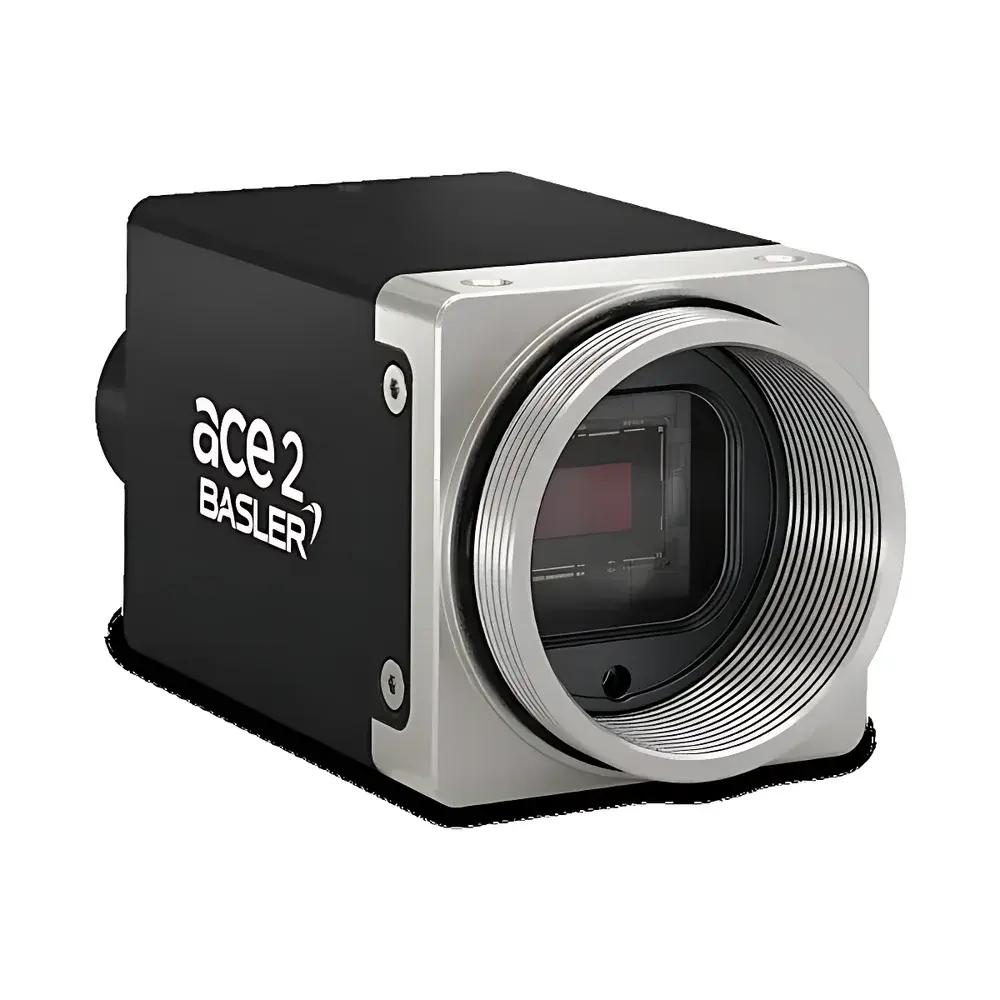
Basler racer 2 R2L2048-62G5C 5GigE Line Scan Camera
| Brand | BASLER |
|---|---|
| Origin | Germany |
| Model | Basler racer 2 R2L2048-62G5C |
| Interface | 5 Gigabit Ethernet (5GigE) |
| Sensor | GPixel GL3504 CMOS linear image sensor |
| Resolution | 2048 pixels (1-line) |
| Pixel size | 7 µm |
| Line rate | up to 62 kHz |
| Mounting | M42 × 0.75 thread |
| Compliance | RoHS, CE, FCC Class A |
| Operating temperature | 0–50 °C |
| Housing material | aluminum alloy |
Overview
The Basler racer 2 R2L2048-62G5C is a high-performance industrial line scan camera engineered for precision continuous imaging in demanding automated inspection, web monitoring, and scientific measurement applications. Unlike area-scan cameras, this device acquires images one line at a time—making it uniquely suited for high-speed, motion-synchronized capture of continuously moving objects such as printed substrates, metal strips, semiconductor wafers, or pharmaceutical blister packs. Its core imaging engine is the GPixel GL3504 CMOS linear sensor—a monochrome, single-line device with 2048 active pixels, each measuring 7 µm in pitch. The sensor’s architecture supports global shutter operation, eliminating motion distortion during rapid line acquisition. Coupled with a native 5 Gigabit Ethernet interface, the camera delivers sustained data throughput of up to 62,000 lines per second while maintaining deterministic latency and low jitter—critical for synchronization with encoder signals or PLC-triggered motion control systems.
Key Features
- High-speed line rate: Up to 62 kHz line frequency enables real-time inspection of materials moving at speeds exceeding 5 m/s when paired with appropriate optics and illumination.
- 5GigE interface: Provides robust, long-distance (up to 100 m over standard Cat6a cable), noise-immune data transmission without requiring frame grabbers—reducing system complexity and integration overhead.
- Global shutter CMOS sensor: Ensures geometric fidelity and temporal accuracy across the entire line, essential for metrology-grade measurements and defect localization.
- Compact, ruggedized aluminum housing: IP50-rated enclosure with M42 × 0.75 lens mount ensures mechanical stability and thermal consistency in factory-floor environments.
- Onboard image preprocessing: Includes programmable gain, offset correction, pixel binning (2×, 4×), and LUT-based gamma adjustment—minimizing host CPU load and enabling edge-ready operation.
- GenICam-compliant firmware: Fully supports GenICam v3.1 and PFNC pixel format standards, ensuring seamless interoperability with HALCON, OpenCV, Common Vision Blox, and other major machine vision SDKs.
Sample Compatibility & Compliance
The R2L2048-62G5C is optimized for use with telecentric, f-theta, or custom line-scan lenses delivering uniform illumination and diffraction-limited resolution across the full 2048-pixel aperture. It supports standard industrial lighting configurations—including LED line lights with strobe synchronization—and integrates natively into motion-controlled setups via hardware trigger inputs (opto-isolated) and encoder pulse counting modes. From a regulatory standpoint, the camera conforms to EU RoHS Directive 2011/65/EU and carries CE marking under the Electromagnetic Compatibility (EMC) and Low Voltage Directives. It meets FCC Class A emission limits for industrial environments and operates within IEC 61000-6-2 immunity requirements. While not certified for intrinsic safety or explosion-proof use, its design aligns with general-purpose automation equipment guidelines per ISO 13849-1 PL d and IEC 61508 SIL 2 functional safety principles when deployed in supervised architectures.
Software & Data Management
Basler’s pylon Camera Software Suite (v6.x) provides full configuration, live preview, and streaming control via GUI or command-line interface. All parameters—including exposure time, line rate, trigger mode, and user-defined regions of interest—are accessible through standardized GenAPI features. For production deployment, the camera supports persistent parameter storage in non-volatile memory and offers audit-trail-capable logging via pylon’s built-in event recorder. When integrated into regulated environments (e.g., pharmaceutical packaging lines or automotive Tier-1 supplier QA labs), the pylon SDK can be configured to comply with FDA 21 CFR Part 11 requirements—including electronic signatures, user access levels, and immutable change logs—when used in conjunction with validated application software and documented SOPs. Raw image data is output in standard Bayer or mono8/mono12 formats, compatible with HDF5, TIFF, or vendor-neutral industrial file protocols such as GenTL Stream Buffers.
Applications
- Web inspection: Real-time detection of coating defects, scratches, pinholes, or registration errors on continuous rolls of paper, foil, or polymer film.
- Semiconductor wafer metrology: Edge profile analysis, notch detection, and die alignment verification prior to dicing.
- Food & beverage quality assurance: Label integrity checks, fill-level verification, and foreign object detection on high-speed bottling lines.
- Recycling sorting systems: Spectral reflectance profiling and material classification using multi-spectral line scan configurations.
- Scientific imaging: Time-resolved absorption spectroscopy, laser-induced fluorescence mapping, and particle trajectory tracking in fluid dynamics experiments.
FAQ
What is the maximum achievable line rate under full-resolution operation?
The camera achieves up to 62,000 lines per second at native 2048-pixel resolution with default settings; actual throughput depends on packet size, network configuration, and host buffer management.
Does the camera support hardware triggering from an external encoder?
Yes—it features two opto-isolated digital inputs supporting quadrature encoder decoding and position-triggered line acquisition with sub-microsecond jitter.
Can multiple Basler racer 2 cameras be synchronized in a multi-line setup?
Yes—via shared free-run clock distribution or master-slave triggering using the camera’s TTL-compatible sync I/O ports and pylon’s Multi-Camera Synchronization feature.
Is firmware upgrade supported in-field without disassembly?
Yes—firmware updates are performed over 5GigE using pylon or Basler’s command-line tool “pylon-updater”, preserving all user-configured parameters.
What operating systems are officially supported?
Windows 10/11 (64-bit), Linux (Ubuntu 20.04/22.04 LTS, kernel ≥5.4), and select real-time OS variants including QNX and VxWorks via custom driver packages.




