
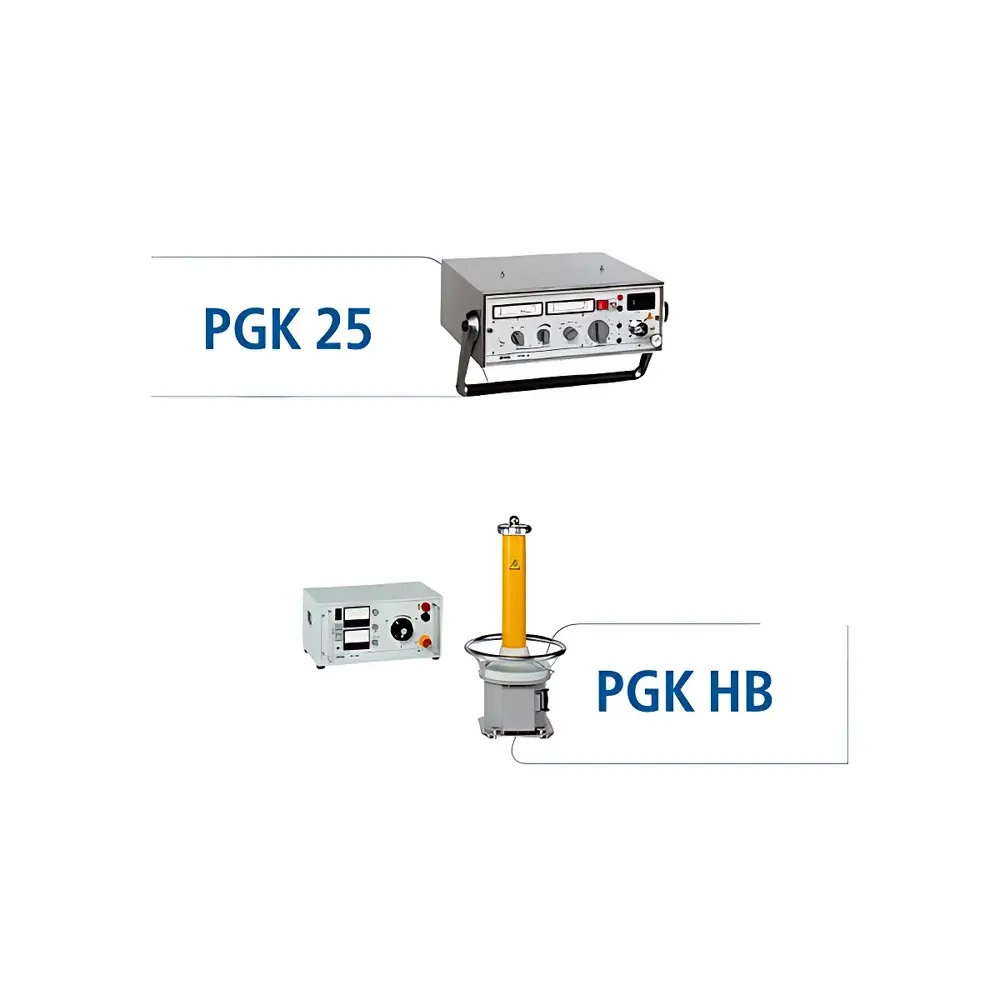
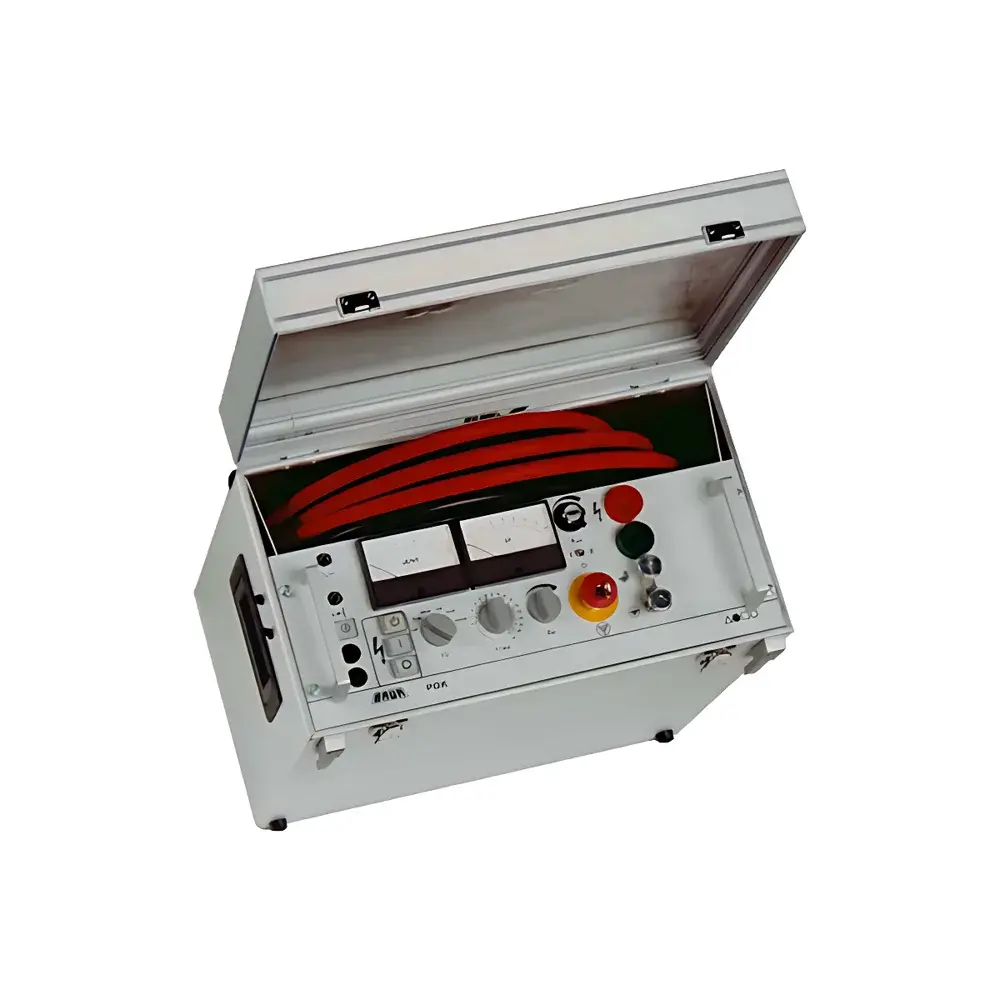
BAUR PGK 25 Portable DC High-Voltage Test Set
| Brand | BAUR |
|---|---|
| Origin | Austria |
| Model | PGK 25 |
| Output Voltage Range | 0–5 kV DC and 0–25 kV DC |
| Weight | 16.5 kg |
| Timer Range | 1–30 min (±1 min) |
| Compliance | IEC 60502, IEEE 400.2, VDE 0276-620, EN 61010-1 |
Overview
The BAUR PGK 25 is a portable, field-deployable DC high-voltage test set engineered for dielectric integrity verification of low-voltage (LV) and medium-voltage (MV) power cables—primarily polymeric-insulated cables such as XLPE and EPR. It operates on the principle of DC withstand voltage testing, a standardized method for detecting gross insulation defects—including moisture ingress, voids, contaminants, or mechanical damage—prior to commissioning or after repair. Unlike AC hipot testing, DC testing applies a unidirectional potential that stresses insulation with minimal capacitive charging current, enabling stable, low-power operation ideal for battery-assisted or generator-powered field environments. The PGK 25 complies with key international test standards including IEC 60502-2 (for rated voltages up to 30 kV), IEEE 400.2-2013 (Guide for Field Testing of Shielded Power Cable Systems Using DC), and VDE 0276-620 (German standard for cable acceptance testing). Its design prioritizes operational safety, measurement traceability, and regulatory alignment—making it suitable for use in utility substations, industrial plant commissioning, and third-party inspection workflows under GLP-aligned quality systems.
Key Features
- Two selectable DC output ranges: 0–5 kV (for LV cables up to 1 kV) and 0–25 kV (for MV cables up to 36 kV system voltage), each continuously adjustable via precision potentiometer with analog + digital dual-scale readout.
- Integrated electromechanical timer with user-settable duration from 1 to 30 minutes (±1 minute tolerance), automatically terminating voltage application and initiating safe discharge upon expiration.
- Direct high-voltage measurement at the output terminal using calibrated resistive dividers, eliminating measurement uncertainty introduced by long HV leads or external meters.
- Mechanical safety interlock system that physically prevents HV activation unless the grounding switch is fully disengaged and the test circuit is verified open-circuit via internal continuity check.
- Ruggedized aluminum enclosure with IP54-rated ingress protection, shock-absorbing rubber feet, and ergonomic carrying handles—optimized for repeated transport across rough terrain, trenches, and confined substation access points.
- Self-contained discharge circuit with visual LED indicators and audible confirmation tones, ensuring residual energy dissipation within <15 seconds post-test per IEC 61010-1 Clause 6.7.3 requirements.
Sample Compatibility & Compliance
The PGK 25 is validated for testing single-core and three-core shielded cables with copper or aluminum conductors, insulated with cross-linked polyethylene (XLPE), ethylene propylene rubber (EPR), or impregnated paper (limited to non-draining types). It supports both sheath testing (conductor-to-sheath) and conductor-to-ground configurations. All test procedures align with mandatory pre-energization requirements specified in national grid codes (e.g., UK ENA TS 43-4, Germany TAB 2012, U.S. NESC Article 235). Device certification includes full conformity to EN 61010-1:2010 for electrical safety, CE marking under the Low Voltage Directive (2014/35/EU), and electromagnetic compatibility per EN 61326-1:2021. Traceable calibration certificates (ISO/IEC 17025 accredited) are available upon request for audit readiness in ISO 55001 or ISO 9001-certified asset management programs.
Software & Data Management
While the PGK 25 operates as a standalone analog-digital hybrid instrument without embedded firmware or USB connectivity, its test parameters and outcomes are fully compatible with BAUR’s optional PC-based documentation suite—BAUR TestManager Pro. This Windows application enables structured logging of test records (date/time, operator ID, cable ID, applied voltage, duration, leakage current trend, pass/fail status), automatic generation of PDF test reports compliant with IEEE 400.2 Annex B templates, and export to CSV for integration into CMMS platforms (e.g., SAP PM, IBM Maximo). All reports include digital signatures, audit trails, and timestamped metadata satisfying FDA 21 CFR Part 11 requirements when deployed in regulated infrastructure projects.
Applications
- Acceptance testing of newly installed LV/MV distribution cables prior to energization in municipal grids and industrial campuses.
- Post-repair verification following fault location and joint replacement operations.
- Periodic maintenance testing for aging cable networks where partial discharge (PD) detection is impractical due to site constraints.
- Third-party certification for turnkey EPC contractors delivering infrastructure to utilities under strict contractual test protocols.
- Educational labs conducting hands-on high-voltage engineering training aligned with CIGRÉ TB 613 guidelines.
FAQ
What voltage classes is the PGK 25 rated for?
It supports DC test voltages up to 25 kV, making it suitable for cables rated up to 36 kV system voltage (e.g., 12/20 kV, 18/30 kV, 26/36 kV) per IEC 60502-2 Table 12.
Does it meet IEEE 400.2 requirements for field DC testing?
Yes—the device implements all critical functional requirements: adjustable voltage ramp rate, hold-time accuracy, automatic discharge, and leakage current monitoring capability (via optional external microammeter interface).
Can it be used for sheath integrity testing?
Yes—its dual-range output and floating ground architecture support conductor-to-sheath and sheath-to-ground configurations per IEC 60229 and ENA TS 43-4.
Is calibration traceable to national standards?
Factory calibration is performed against PTB-traceable reference standards; accredited field recalibration services are available through BAUR’s global partner network.
What safety certifications does it carry?
EN 61010-1:2010 (Measurement Category CAT III 1000 V), CE, RoHS, and compliance with German DGUV Regulation 3 (formerly BGV A3) for high-voltage equipment operation.
Related Products






