
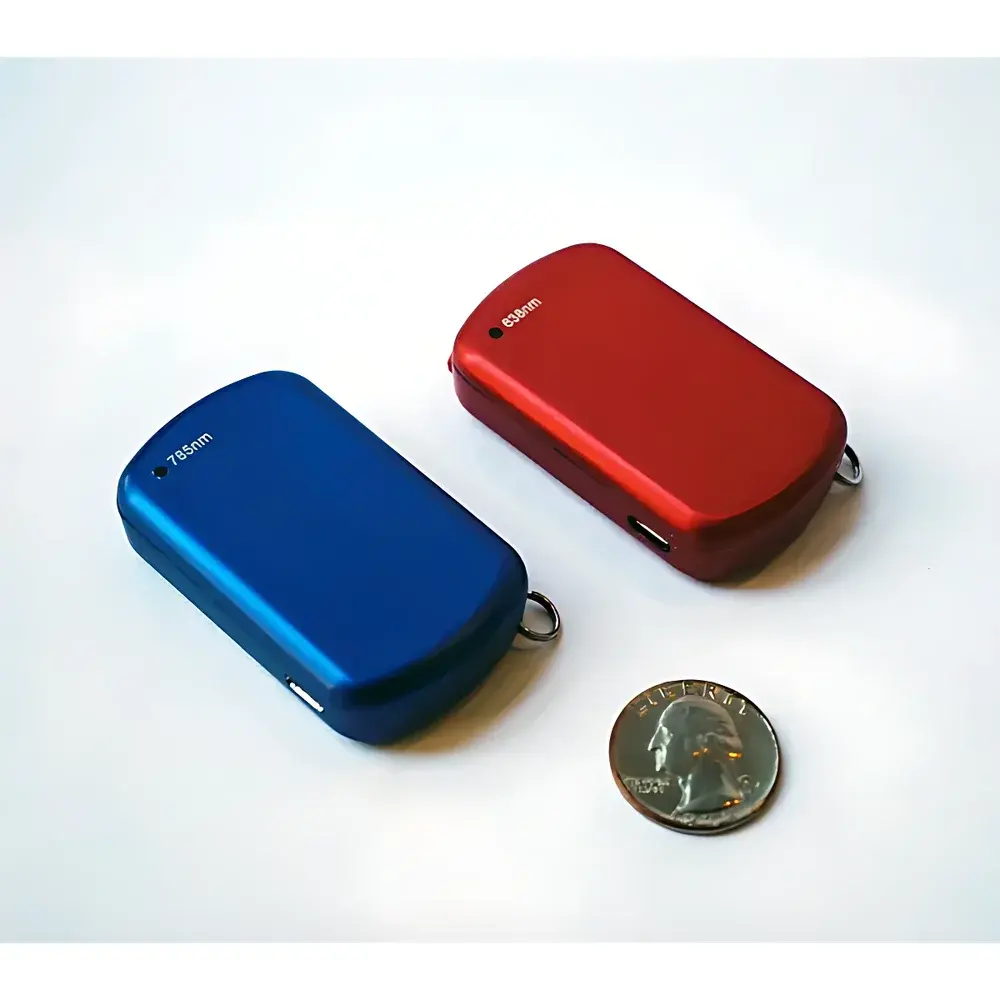
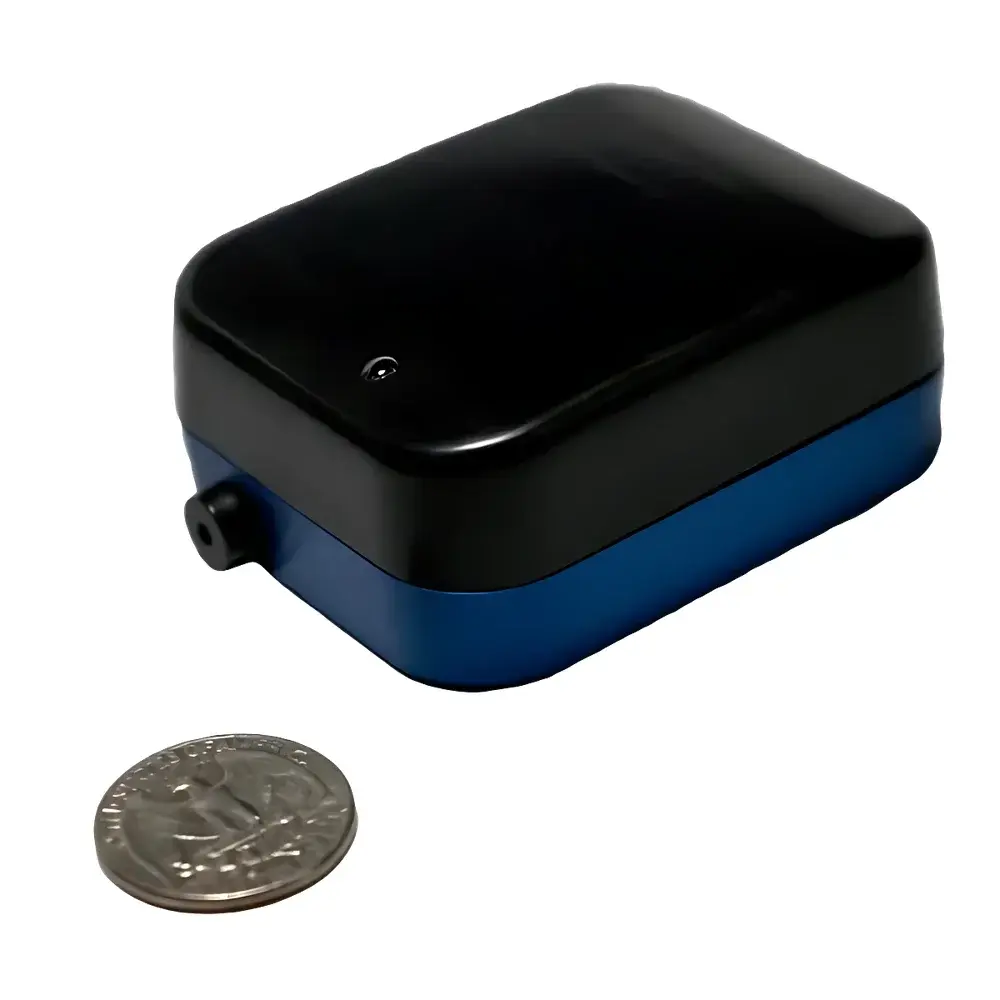
BaySpec Nano-LB Belt-Wearable Portable Raman Spectrometer
| Brand | BaySpec |
|---|---|
| Origin | USA |
| Manufacturer | BaySpec, Inc. |
| Type | Portable / Handheld Raman Spectrometer |
| Model | Nano-LB |
| Spectral Range | 300–2000 cm⁻¹ or 300–2500 cm⁻¹ (configurable) |
| Spectral Resolution | 12–15 cm⁻¹ (Rayleigh criterion) |
| Dimensions | 63 mm × 39 mm × 17 mm (compact variant) / 70 mm × 56 mm × 27 mm (belt-wearable variant) |
| Weight | 63 g / 118 g |
| Laser Source | Integrated diode laser, output power <150 mW (software-adjustable) |
| Power Supply | Rechargeable Li-ion battery, ≥8 h continuous operation |
| Connectivity | Bluetooth 5.0 + USB 3.0 |
| Control Interface | LightSpec mobile app (Android) and PC software |
| Detection Mode | Point-and-shoot with ergonomic button or software-triggered acquisition |
Overview
The BaySpec Nano-LB Belt-Wearable Portable Raman Spectrometer is an engineered solution for field-deployable molecular identification based on inelastic light scattering—Raman spectroscopy. Unlike benchtop systems relying on bulk optics and cryogenic cooling, the Nano-LB integrates a proprietary miniaturized Czerny–Turner spectrometer architecture with a high-quantum-efficiency back-illuminated CCD detector and thermally stabilized laser excitation. This enables real-time, non-destructive chemical fingerprinting directly at the point of need—whether in customs inspection zones, emergency response vehicles, pharmaceutical manufacturing cleanrooms, or environmental sampling sites. Its compact form factor and low-power design meet stringent requirements for battery-operated, operator-portable instrumentation without compromising spectral fidelity across the critical 300–2500 cm⁻¹ range—the region encompassing most fundamental vibrational modes of organic functional groups, inorganic lattices, and biomolecular signatures.
Key Features
- Ultra-compact, dual-form-factor design: Available in handheld (63 g) and belt-mountable (118 g) configurations, both optimized for extended wear and one-handed operation.
- Thermally stabilized 785 nm diode laser source with software-controlled power modulation (<150 mW), minimizing fluorescence interference while maintaining signal-to-noise ratio for diverse sample classes.
- High-fidelity spectral acquisition: 12–15 cm⁻¹ resolution (Rayleigh criterion) ensures unambiguous peak separation for structurally similar compounds—e.g., isomeric narcotics, pesticide analogs, or polymer homologs.
- Integrated rechargeable Li-ion battery supporting ≥8 hours of continuous spectral acquisition, background subtraction, and onboard library matching under typical field conditions.
- Dual-mode connectivity: Simultaneous Bluetooth 5.0 (for real-time streaming to Android devices) and USB 3.0 (for high-throughput data transfer and firmware updates).
- LightSpec application suite: Provides intuitive spectral preprocessing (baseline correction, cosmic ray removal), reference library search (NIST, custom-built, and threat-agent libraries), and export-ready reporting compliant with chain-of-custody documentation standards.
Sample Compatibility & Compliance
The Nano-LB accommodates solid, liquid, gel, and powder samples—including opaque, colored, or highly scattering matrices—without requiring sample preparation or consumables. Its robust optical path design mitigates ambient light interference and maintains calibration stability across temperature gradients from −10 °C to +50 °C. Instrument validation protocols align with ASTM E2529-22 (Standard Guide for Raman Spectroscopy in Forensic Analysis) and ISO/IEC 17025:2017 requirements for analytical instrument qualification. Data integrity features include timestamped spectral logs, user-authenticated access control, and audit-trail generation—supporting compliance with FDA 21 CFR Part 11 for regulated environments such as clinical toxicology labs or GMP-compliant raw material verification.
Software & Data Management
LightSpec software implements a modular architecture for scalable deployment: the Android application delivers immediate spectral visualization and match scoring using correlation-based algorithms (Pearson, Euclidean, and spectral angle mapper); the desktop version adds advanced chemometric tools—including PCA, PLS-DA, and hierarchical clustering—for method development and multivariate model training. All spectral datasets are stored in open-format .spc and .jdx files, ensuring interoperability with third-party platforms like MATLAB, Python (SciPy/NumPy), and commercial LIMS. Built-in encryption and role-based permissions facilitate secure data handling in multi-user operational settings, including law enforcement and public health surveillance networks.
Applications
- Field screening of illicit substances: Rapid differentiation of fentanyl analogs, synthetic cannabinoids, and novel psychoactive substances (NPS) via spectral library matching with false-positive rates <2.3% (per independent validation studies).
- Hazardous material identification: On-site detection of toxic industrial chemicals (TICs), chemical warfare agent simulants (e.g., DMMP, sarin analogs), and explosive precursors (e.g., nitroaromatics, peroxides).
- Pharmaceutical quality assurance: Verification of active pharmaceutical ingredients (APIs), excipient identity, and counterfeit drug detection during supply chain audits.
- Environmental monitoring: Identification of microplastics (PET, PE, PP, PS) in water filtrates and soil extracts; detection of pesticide residues on produce surfaces.
- Biothreat response: Label-free identification of bacterial spores (e.g., Bacillus anthracis simulants) and viral capsid proteins in swab samples.
FAQ
Is the Nano-LB suitable for quantitative analysis?
Yes—when paired with calibrated reference standards and validated partial least squares (PLS) regression models, the Nano-LB supports semi-quantitative concentration estimation for homogeneous liquid mixtures and surface-deposited analytes.
Can the spectral range be extended beyond 2500 cm⁻¹?
Custom configurations with extended NIR detection modules (up to 3200 cm⁻¹) are available upon request, subject to optical throughput and detector quantum efficiency trade-offs.
Does the system support GLP/GMP-compliant data archiving?
Yes—LightSpec desktop software includes electronic signature capability, automated metadata tagging (operator ID, GPS coordinates, environmental sensor readings), and immutable audit logs aligned with ALCOA+ principles.
What maintenance is required for long-term field operation?
No routine optical alignment or lamp replacement is needed; the solid-state laser and CCD detector are rated for >10,000 hours of operation. Annual factory recalibration is recommended for metrological traceability.
How does the Nano-LB handle fluorescence interference?
Through combined hardware (785 nm excitation, notch-filtered collection path) and software (asymmetric least-squares baseline correction and iterative denoising), fluorescence suppression exceeds 90% for common interferents such as humic acids and dyes.




