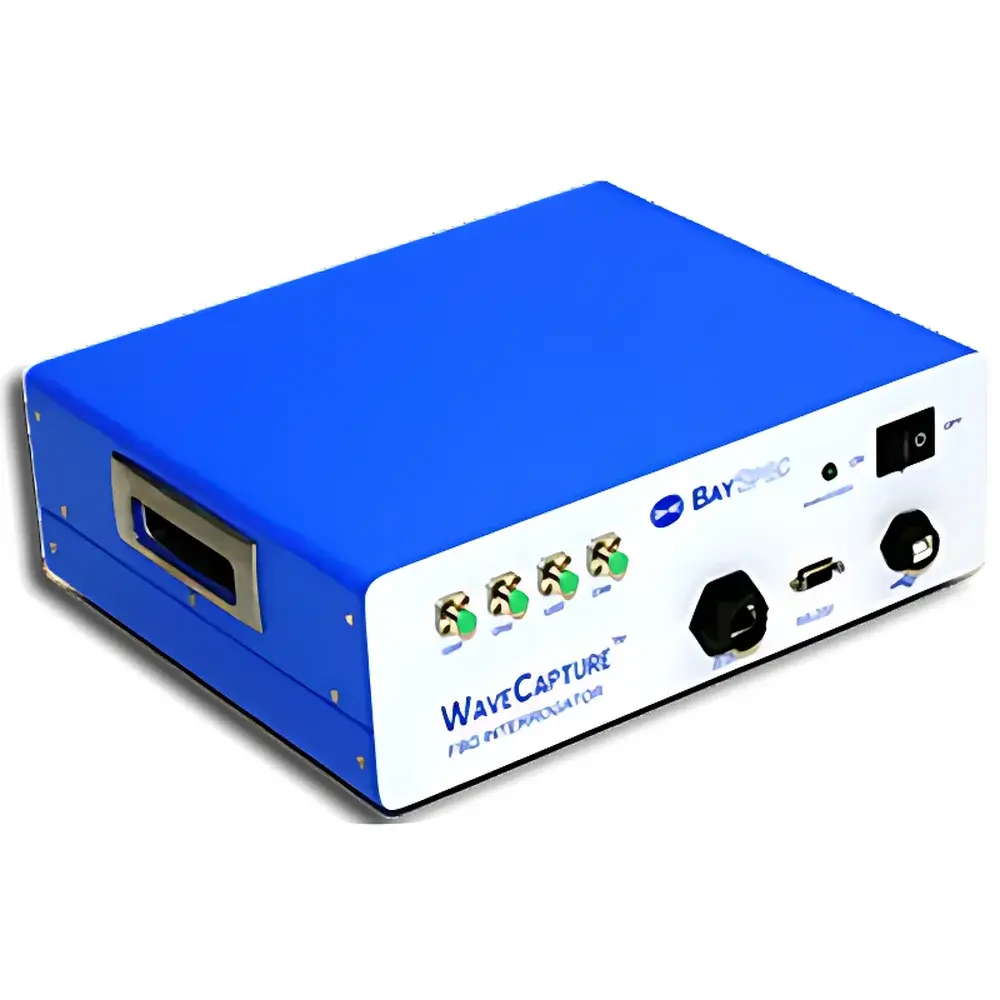
BaySpec WaveCapture FBGA Interferometric Fiber Bragg Grating Spectral Analyzer
| Brand | BaySpec |
|---|---|
| Origin | USA |
| Manufacturer | BaySpec, Inc. |
| Category | Imported |
| Model | WaveCapture FBGA |
| Interface | USB 2.0 / Ethernet / RS-232 |
| Wavelength Range | Broadband (C+L band typical) |
| Max Sampling Rate | 5 kHz |
| Channels | Up to 4 simultaneous FBG interrogation channels |
| Spectral Dispersion Element | Volume Phase Grating (VPG) |
| Detector | Thermoelectrically cooled InGaAs linear array |
| Resolution | High wavelength resolution (sub-pm typical) |
| Repeatability | Excellent wavelength repeatability |
| Environmental Compliance | Telcordia GR-63-CORE, GR-1209-CORE, GR-1221-CORE |
| Power | Low-power design, battery-operable |
| Mechanical Architecture | Solid-state, no moving parts |
Overview
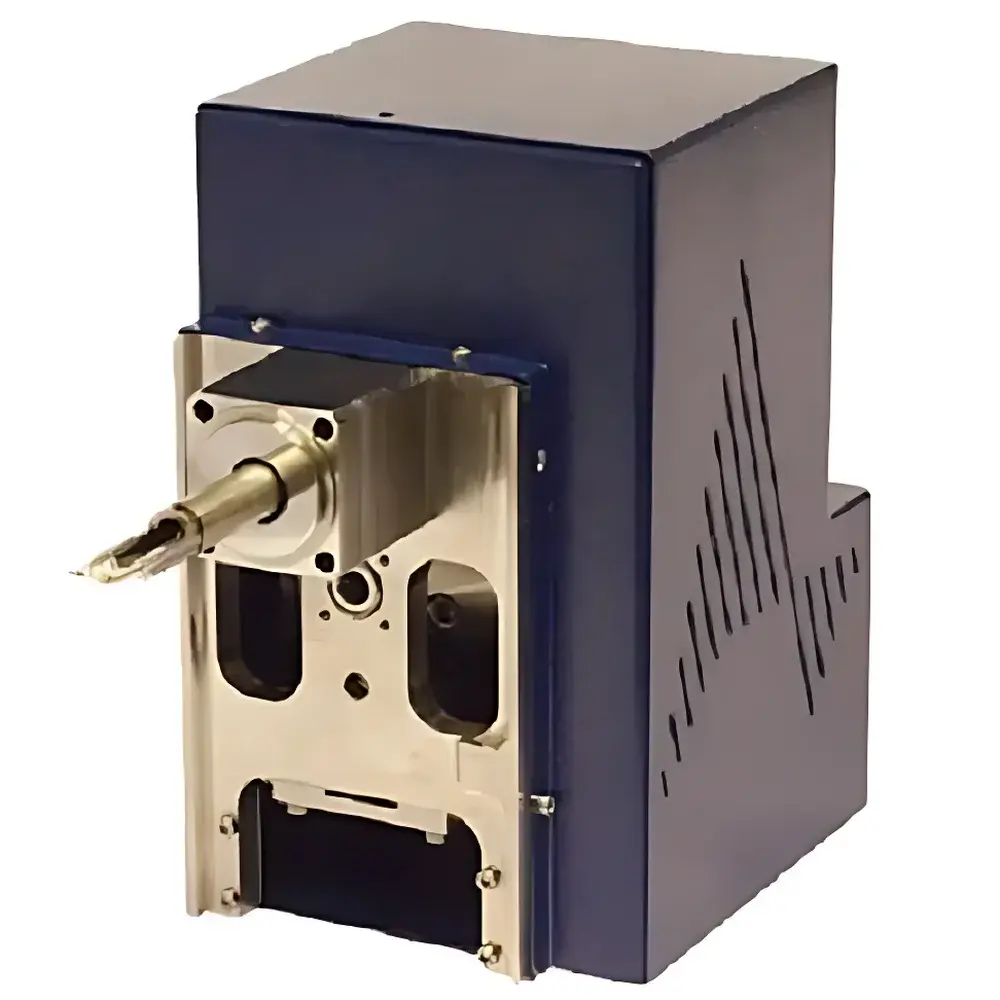
The BaySpec WaveCapture FBGA is a turnkey interferometric spectral analyzer engineered specifically for high-speed, high-precision interrogation of Fiber Bragg Grating (FBG) sensor arrays. Unlike conventional scanning or tunable-laser-based FBG interrogators, the WaveCapture FBGA employs a solid-state, parallel-spectrum acquisition architecture based on volume phase grating (VPG) dispersion and thermoelectrically cooled InGaAs photodetector arrays. This optical design enables true real-time spectral capture—without mechanical scanning elements—thereby eliminating drift, wear, and calibration dependency. The system operates on the principle of spatially resolving the reflected FBG spectrum across the detector array, where each pixel corresponds to a discrete wavelength bin. This Fourier-transform–adjacent methodology delivers sub-picometer-level wavelength resolution with microsecond-scale frame-to-frame latency, making it suitable for dynamic strain, temperature, and pressure monitoring in aerospace structural health monitoring (SHM), rotating machinery diagnostics, and high-frequency composite material testing.
Key Features
- Solid-state optical engine: No moving parts, compliant with MIL-STD-810F shock and vibration requirements for deployment in mobile or harsh-environment platforms.
- Up to 4 independent FBG interrogation channels, each capable of simultaneous full-spectrum acquisition at up to 5 kHz sampling rate.
- Volume Phase Grating (VPG) as core dispersive element—providing high diffraction efficiency (>90%), low polarization dependence, and thermal stability over –20 °C to +70 °C.
- Cooled InGaAs linear array detector with 512 or 1024 pixels, enabling high signal-to-noise ratio (SNR > 5000:1) and sub-pm wavelength resolution under typical C+L-band operation (1520–1620 nm).
- Low-power architecture: Operates from 12 V DC input; compatible with field-deployable battery packs for extended unattended operation.
- Multi-interface connectivity: Native support for USB 2.0 (high-speed bulk transfer), Gigabit Ethernet (TCP/IP stack with configurable IP addressing), and legacy RS-232 for integration into legacy SCADA or PLC environments.
Sample Compatibility & Compliance
The WaveCapture FBGA is optimized for standard telecom-grade single-mode fiber (SMF-28) and polarization-maintaining FBG sensors with reflectivity >5% and bandwidth <0.5 nm. It supports FBG arrays written with uniform, chirped, or tilted grating structures, provided spectral separation exceeds the system’s intrinsic resolution limit. All hardware and firmware comply with Telcordia GR-63-CORE (physical protection), GR-1209-CORE (environmental reliability), and GR-1221-CORE (network equipment safety). Mechanical ruggedization meets MIL-STD-810F Method 516.6 Shock (40 g, 11 ms half-sine) and Method 514.6 Vibration (10–2000 Hz, 8.1 g rms). No periodic recalibration is required per manufacturer specifications due to inherent optical stability and factory-traceable wavelength reference alignment.
Software & Data Management
The system ships with WaveCapture Studio—a cross-platform (Windows/Linux/macOS) application supporting real-time spectrum visualization, peak tracking, wavelength-to-strain/temperature conversion using user-defined calibration polynomials, and time-series export in CSV, HDF5, or MATLAB .mat formats. The SDK provides C/C++, Python, and LabVIEW APIs with thread-safe callback functions for OEM integration. Audit trails, user access control, and data integrity logging are available in compliance-ready configurations aligned with GLP/GMP documentation practices. Firmware updates are delivered via signed binary packages with SHA-256 verification; configuration files are digitally signed to prevent unauthorized modification.
Applications
- Aerospace SHM: Real-time strain mapping on wing skins, fuselage panels, and composite control surfaces during ground vibration tests or flight trials.
- Rotating Equipment Monitoring: Blade deflection tracking in gas turbines and wind turbine blades under operational centrifugal loads.
- High-Speed Manufacturing: In-line thermal expansion compensation during laser welding or additive manufacturing of metal components.
- Geotechnical Instrumentation: Distributed temperature and strain profiling in deep-borehole fiber-optic cables subjected to seismic transients.
- Defense Systems: Embedded sensing in guided munitions, UAV airframes, and naval hull structures requiring EMI-immune, lightweight metrology.
FAQ
What is the maximum number of FBGs that can be monitored per channel?
Typically up to 30–50 FBGs per channel depending on grating spacing and spectral width; multiplexing is limited by total usable bandwidth and minimum resolvable wavelength separation.
Does the system support absolute wavelength calibration traceable to NIST standards?
Yes—factory calibration uses stabilized HeNe and Hg/Ar lamp references; optional on-site recalibration kits with NIST-traceable FBG reference standards are available.
Can the WaveCapture FBGA operate in real time without host PC intervention?
Yes—the embedded ARM-based controller supports autonomous operation with onboard storage (microSD), scheduled acquisitions, and edge-triggered event logging.
Is the software compliant with FDA 21 CFR Part 11 for regulated pharmaceutical or medical device applications?
The audit trail, electronic signature, and role-based access modules meet core Part 11 requirements; full validation documentation (IQ/OQ/PQ protocols) is provided upon request.
What is the typical wavelength accuracy and long-term stability specification?
Initial accuracy: ±1 pm (over 24 h, constant ambient); 1-year stability: ±3 pm (with temperature stabilization enabled).