
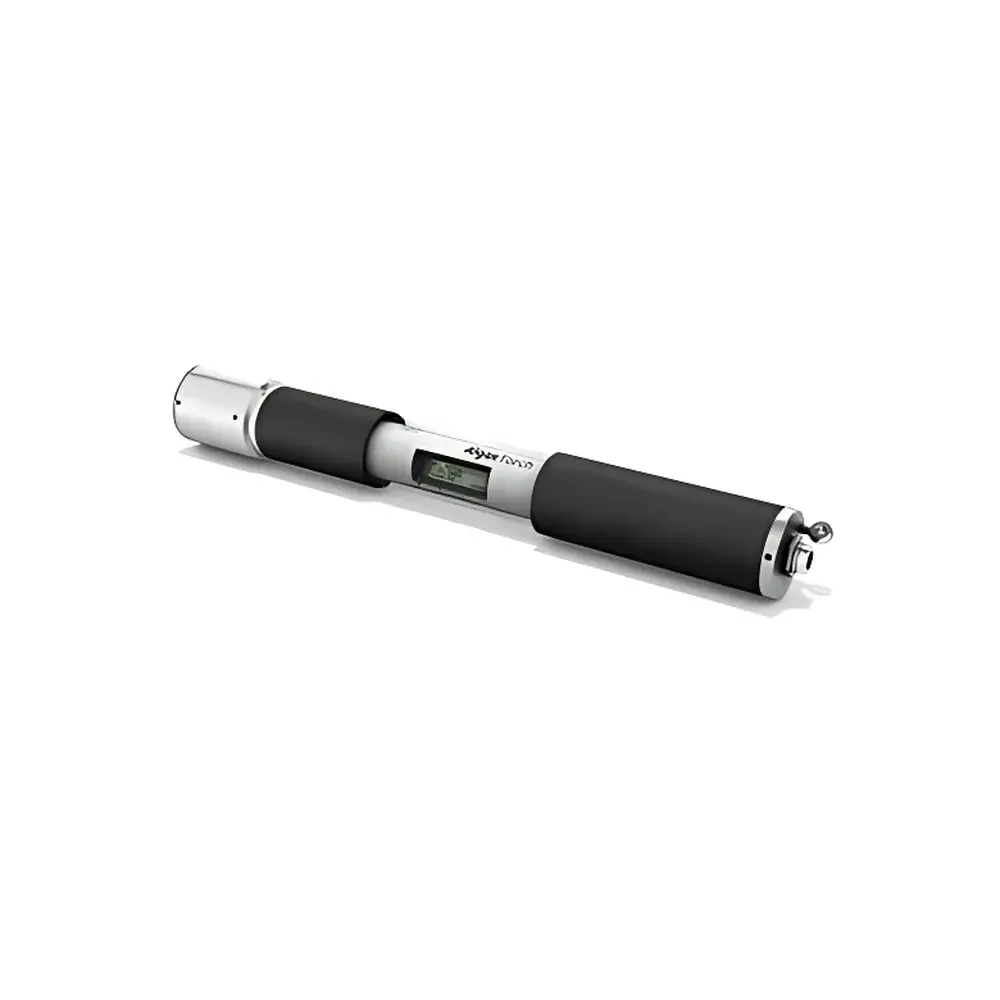
BBE AlgaeTorch Portable In-Situ Chlorophyll a and Phycocyanin Fluorometer
| Brand | BBE Moldaenke |
|---|---|
| Model | AlgaeTorch |
| Measurement Principle | In-situ algal pigment fluorescence detection (excitation at 470 nm, 525 nm, 610 nm) |
| Parameters | Total chlorophyll a / total algal density / cyanobacteria concentration |
| Range | 0–500 µg Chl-a/L |
| Response time | <20 s |
| Resolution | 0.1 ng Chl-a/L |
| Accuracy | ±0.015 ng Chl-a/L (total algae) |
| LOD | 0.1 µg Chl-a/L (single-species cyanobacteria) |
| Turbidity compensation | 0–200 FTU |
| Operating temperature | 0–35 °C |
| Depth rating | AlgaeTorch 10 (10 m), AlgaeTorch 100 (100 m) |
| Protection class | IP68 |
| Dimensions | 500 × 60 mm (H × Ø) |
| Weight | 1.3 kg |
| Power supply | 12 V DC (internal rechargeable battery) |
| Data interface | USB |
| Memory capacity | 2000 measurements |
| Software | bbe++ for Windows |
| Optional accessories | telescopic pole, shoulder strap, 10 m tether cable, probe performance kit |
| GPS module | integrated |
| Data output formats | ASCII, Excel (.xlsx), plain text |
Overview
The BBE AlgaeTorch is a field-deployable, in-situ fluorometer engineered for real-time, quantitative assessment of phytoplankton pigments—primarily chlorophyll a and phycocyanin—in natural water bodies. Unlike laboratory-based spectrophotometric or HPLC methods requiring filtration, extraction, and solvent handling, the AlgaeTorch leverages the intrinsic fluorescence properties of photosynthetic pigments under controlled excitation wavelengths (470 nm for chlorophyll a, 525 nm for cryptophytes, and 610 nm for phycocyanin-rich cyanobacteria). This optical approach enables direct, non-invasive measurement within the water column without sample collection or pretreatment. The instrument operates on the principle of pulse-modulated excitation and time-gated detection, minimizing interference from ambient light and scattering artifacts. Its design adheres to the physical basis of in vivo fluorescence yield, calibrated against reference standards traceable to NIST-maintained chlorophyll a solutions. The AlgaeTorch is not a proxy sensor—it delivers quantitative, species-group-resolved estimates aligned with ISO 10260:2022 (Water quality — Determination of chlorophyll a by fluorometric method) and supports compliance with EU WFD monitoring requirements for phytoplankton community status assessment.
Key Features
- True in-situ operation: Immersion-based measurement with no filtration, centrifugation, or reagent addition required.
- Multi-pigment discrimination: Simultaneous quantification of total chlorophyll a, cyanobacterial biomass (via phycocyanin), and cryptophyte contribution using three discrete excitation channels.
- Ruggedized submersible architecture: IP68-rated housing with pressure-compensated optics; available in two depth-rated variants (AlgaeTorch 10: 10 m; AlgaeTorch 100: 100 m).
- Integrated geospatial logging: Built-in GPS module records latitude, longitude, altitude, and timestamp for every measurement—enabling spatial interpolation and GIS integration.
- Real-time turbidity compensation: On-the-fly correction for light attenuation up to 200 FTU, ensuring robustness in eutrophic or sediment-laden waters.
- Onboard data management: Internal memory stores up to 2000 full-resolution datasets, including raw fluorescence intensities, calculated concentrations, GPS coordinates, and user annotations.
- Low-power, field-optimized operation: Rechargeable Li-ion battery supports >12 hours of continuous profiling; 12 V DC input compatible with portable power stations and vehicle sockets.
Sample Compatibility & Compliance
The AlgaeTorch is validated for use in freshwater, brackish, and low-salinity marine environments—including lakes, reservoirs, rivers, aquaculture ponds, and drinking water source intakes. It performs reliably across turbidity ranges from clear oligotrophic (0 FTU) to highly productive eutrophic systems (≤200 FTU), provided suspended solids do not exceed optical saturation thresholds. The device meets IEC 60529 (IP68) for dust and immersion resistance and conforms to electromagnetic compatibility standards per EN 61326-1:2013. Its measurement methodology aligns with ISO 10260:2022 and supports GLP-compliant data acquisition when used with bbe++ software’s audit trail and electronic signature functionality (21 CFR Part 11 ready via optional configuration). Calibration verification is performed using certified chlorophyll a standard solutions (e.g., Sigma-Aldrich C6144) and validated against interlaboratory round-robin studies conducted under COST Action ES1201.
Software & Data Management
The bbe++ desktop application (Windows 10/11, 64-bit) serves as the central hub for instrument control, calibration, visualization, and reporting. It provides synchronized display of concentration time-series, spatial heatmaps, and spectral response overlays. All datasets are stored in a structured SQLite database with immutable metadata (operator ID, instrument serial number, firmware version, GPS fix quality). Export options include ASCII tab-delimited files for statistical analysis in R or Python, Excel-compatible .xlsx reports with embedded charts, and KML exports for direct import into Google Earth Pro. Annotation fields support free-text notes per measurement—critical for documenting bloom morphology, surface scum presence, or concurrent weather conditions. Firmware updates and calibration coefficient uploads are managed through secure, signed packages verified via SHA-256 checksums.
Applications
- Early-warning monitoring of cyanobacterial harmful algal blooms (cyanoHABs) in drinking water reservoirs and recreational lakes.
- Long-term phytoplankton phenology studies in limnological and oceanographic research programs.
- Regulatory compliance sampling for national water framework directive (WFD) ecological status classification.
- Process control in wastewater stabilization ponds and constructed wetlands.
- Field validation of satellite-derived chlorophyll a products (e.g., Sentinel-3 OLCI, Landsat 9 OLI-2).
- Undergraduate and graduate teaching modules on aquatic ecology, biogeochemistry, and environmental instrumentation.
- Emergency response during algal toxin events—supporting rapid spatial mapping prior to targeted microcystin sampling.
FAQ
Does the AlgaeTorch require daily calibration?
No. Factory calibration is stable for ≥12 months under normal field use. A quick verification check using the supplied chlorophyll a reference standard is recommended before each deployment campaign.
Can it distinguish between Microcystis and Anabaena?
It does not identify species taxonomically. However, its phycocyanin-specific channel provides high selectivity for cyanobacteria containing this pigment—enabling functional grouping consistent with EPA Method 445.0.
Is the GPS signal accurate enough for small lake surveys?
Yes. With SBAS (WAAS/EGNOS) enabled, horizontal accuracy is typically ≤3 m RMS, sufficient for transect-based profiling and zonal mapping in water bodies ≥1 ha.
How is data integrity ensured during extended underwater deployments?
All measurements are timestamped, georeferenced, and written to non-volatile memory immediately upon acquisition. Power loss during immersion does not corrupt existing data.
Can the AlgaeTorch be integrated into automated buoy networks?
Yes. The USB-C interface supports CDC ACM serial emulation, enabling direct communication with industrial PLCs and telemetry gateways (e.g., Campbell Scientific CR1000X) via Modbus RTU or custom ASCII protocols.
Related Products







