
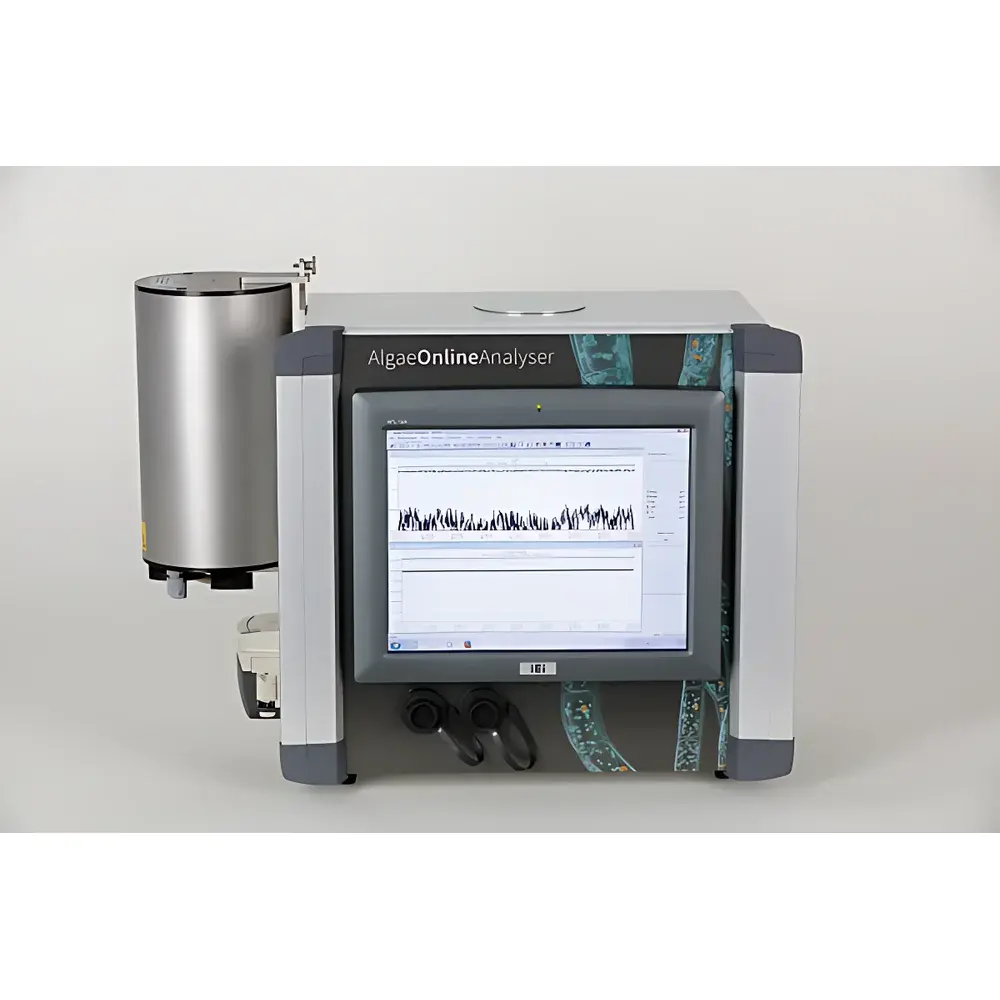
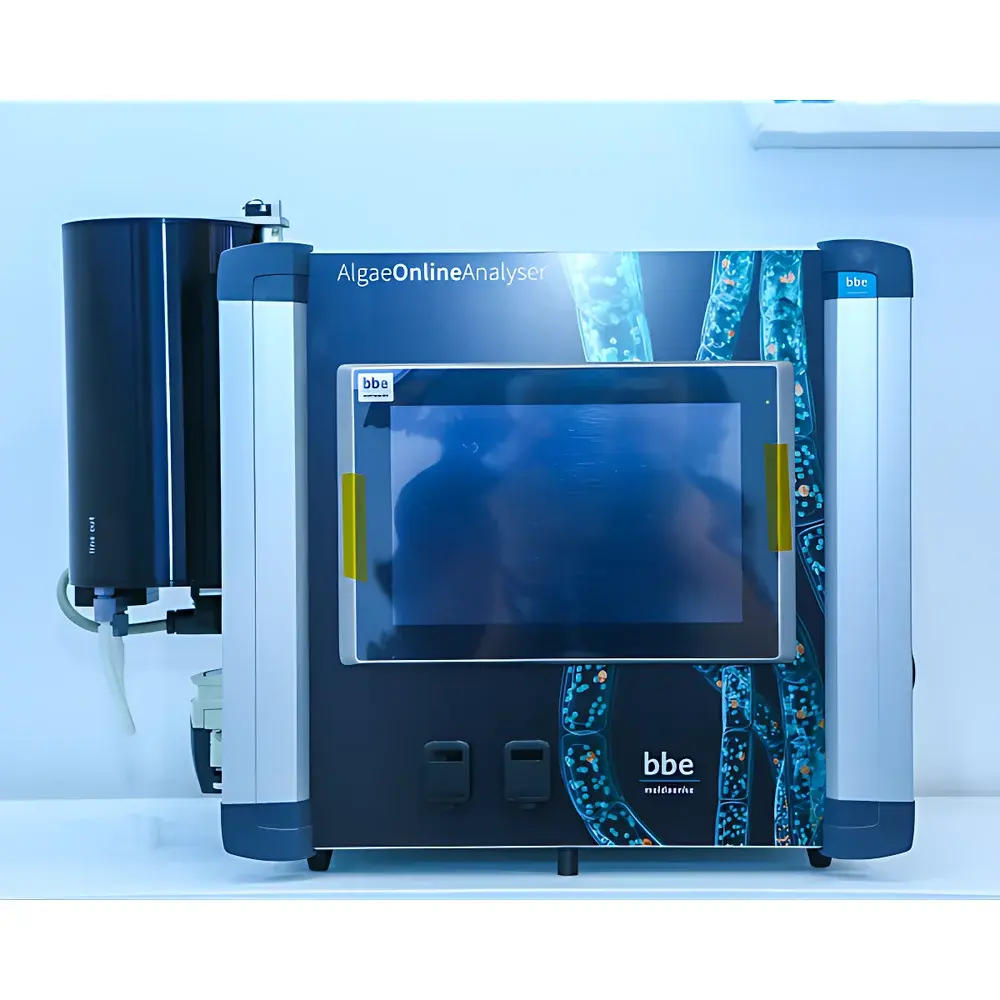
BBE AOA Online Algae Analyzer
| Brand | BBE / bbe Moldaenke |
|---|---|
| Origin | Germany |
| Manufacturer | Yes |
| Import Status | Imported |
| Model | AOA |
| Application | Real-time online chlorophyll a and phytoplankton group quantification |
Overview
The BBE AOA Online Algae Analyzer is an in-situ, fluorescence-based spectroscopic instrument engineered for continuous, real-time classification and quantitative analysis of phytoplankton communities in natural and engineered water systems. It operates on the principle of multi-wavelength excitation fluorometry: distinct algal taxonomic groups—chlorophytes (green algae), cyanobacteria (blue-green algae), diatoms/dinoflagellates, and cryptophytes—possess characteristic photosynthetic pigment compositions (e.g., chlorophylls a/b/c, phycobilins, fucoxanthin, alloxanthin), resulting in unique, reproducible fluorescence emission spectra upon excitation at six discrete wavelengths (370, 470, 525, 570, 590, and 610 nm). By deconvoluting these spectral “algae fingerprints” using proprietary multivariate calibration models, the AOA delivers simultaneous, interference-resistant quantification of total chlorophyll a, group-specific algal densities (cells/mL or relative biovolume), and functional parameters such as photosynthetic activity index. Unlike offline HPLC or microscopy-based methods—which require sample preservation, filtration, extraction, and expert taxonomic interpretation—the AOA performs fully automated analysis within 3 minutes per cycle, with no reagents, no sample pre-treatment, and minimal operator intervention. Its measurement correlation with reference HPLC-chl a analysis exceeds R² > 0.93 across diverse freshwater and brackish matrices, validating its use in regulatory monitoring and scientific research contexts.
Key Features
- Real-time, in-situ operation with automatic 3-minute measurement cycles
- No sample filtration, centrifugation, or chemical extraction required
- Simultaneous quantification of six biological parameters: total chlorophyll a, yellow substance (CDOM), and four phytoplankton groups (chlorophytes, cyanobacteria, diatoms/dinoflagellates, cryptophytes)
- Integrated temperature and light transmission (0–100%) sensing for environmental context correction
- High analytical sensitivity: detection limit of 0.05 µg/L chl-a, resolution of 0.01 µg/L
- Robust industrial design: IP54-rated enclosure, operating temperature range 0–35 °C, storage range 0–50 °C
- Modular expandability: optional active fluorescence quenching module for photosynthetic activity assessment; configurable valve manifold for multi-point sampling
Sample Compatibility & Compliance
The AOA is validated for direct analysis of raw surface water, reservoir outflows, drinking water treatment intakes, aquaculture ponds, and estuarine samples with turbidity up to 100 NTU and suspended solids ≤ 100 mg/L. It complies with core requirements of ISO 10260 (water quality — determination of chlorophyll a by spectrophotometry and fluorometry), ASTM D3731-18 (standard test method for chlorophyll a in water), and supports GLP/GMP-aligned data integrity through secure audit trails and user-access controls in its software environment. While not a standalone compliance device for regulatory reporting under EPA Method 445.0, its performance characteristics align with QA/QC benchmarks used in USGS, EU WFD (Water Framework Directive) monitoring programs, and ISO/IEC 17025-accredited laboratories for trend analysis and early-warning detection.
Software & Data Management
The dedicated bbe Software Suite provides full instrument control, calibration management, spectral visualization, and data export. All measurements are timestamped and stored locally with embedded metadata (temperature, transmission, excitation intensity). Graphical dashboards display time-series trends for each parameter; overlay plots enable cross-parameter correlation analysis (e.g., chl-a vs. cyanobacteria density during bloom onset). Data can be exported in native .bba format, CSV, Excel (.xlsx), or PDF reports compliant with internal documentation standards. Network integration is supported via Ethernet (TCP/IP), enabling remote access, centralized data aggregation in SCADA or LIMS environments, and compatibility with Modbus RTU/TCP and SDI-12 protocols (via optional converter). The software maintains full traceability: every calibration event, parameter change, or firmware update is logged with user ID and timestamp, satisfying FDA 21 CFR Part 11 requirements for electronic records and signatures when configured with role-based authentication.
Applications
- Early detection and tracking of cyanobacterial blooms in lakes, reservoirs, and rivers
- Operational support for drinking water utilities: intake monitoring, coagulation optimization, and disinfection by-product precursor assessment
- Long-term limnological and marine ecological studies requiring high-temporal-resolution phytoplankton dynamics
- Performance evaluation of constructed wetlands and tertiary treatment systems
- Research-grade validation of remote sensing algorithms (e.g., satellite-derived chl-a products)
- Educational deployment in university hydrology, environmental science, and aquatic ecology laboratories
FAQ
How frequently does the AOA require maintenance?
Routine maintenance—including optical window cleaning and verification of calibration stability—is recommended every ≥7 days under typical field conditions. Full service intervals are defined by operational hours and exposure history, with manufacturer-recommended annual verification.
Can the AOA distinguish toxic versus non-toxic cyanobacteria strains?
No. The AOA classifies based on pigment composition, not genetic or toxin profiles. It detects cyanobacteria as a functional group; strain-level identification or microcystin quantification requires complementary molecular or immunochemical methods.
Is the instrument suitable for seawater applications?
Yes—with appropriate antifouling accessories and salinity compensation enabled in software. Performance has been verified in brackish and coastal waters up to 20 PSU; extended deployment in full-strength seawater (>30 PSU) requires custom housing and flow-cell conditioning.
What data interfaces are available for integration into existing monitoring networks?
Standard interfaces include 1× RS232, 1× USB 3.0, 2× USB 2.0, and 1× Gigabit Ethernet. Optional modules add 4–20 mA analog output, dry-contact relay outputs, SDI-12 (with bbe converter), and Modbus TCP/RTU support.
Does the system support remote calibration or software updates?
Yes. Firmware and spectral calibration files can be uploaded remotely via Ethernet. Field calibration verification (e.g., using certified chl-a standard solutions) must be performed physically, but results are automatically synchronized to the central database.
Related Products







