
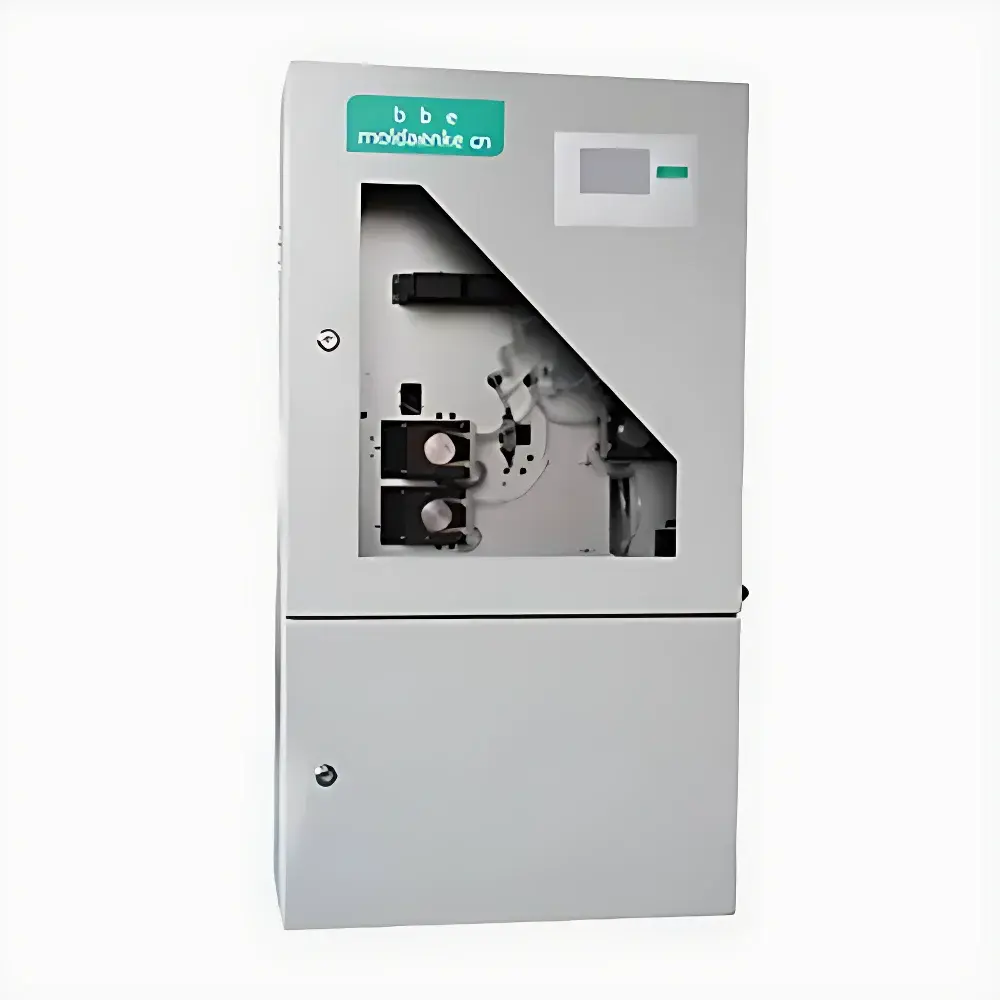
bbe Cn-PWR II Online Cyanide Analyzer
| Brand | BBE / bbe Moldaenke |
|---|---|
| Origin | Shanghai, China |
| Manufacturer Type | Original Equipment Manufacturer (OEM) |
| Product Category | Domestic (China-Made) |
| Model | bbe Cn-PWR II |
| Instrument Type | Online Analyzer |
| Communication Options | 4–20 mA analog output, RS232/RS485 serial interface, MODBUS RTU/TCP, TCP/IP (optional) |
Overview
The bbe Cn-PWR II Online Cyanide Analyzer is an industrial-grade, fully automated photometric system engineered for continuous, real-time monitoring of free and total cyanide concentrations in aqueous environmental matrices. It operates on the principle of ligand-specific colorimetric reaction—typically based on the pyridine-barbituric acid (PBA) or isonicotinic acid-barbituric acid (ISA-BA) method—where cyanide ions form a stable chromophore under controlled pH and oxidation conditions. The resulting absorbance is measured at a defined wavelength (typically 620–630 nm) using a high-stability LED light source and precision optical detection module. Designed for unattended operation in harsh field environments, the analyzer integrates sample conditioning, reagent dosing, reaction timing, optical measurement, and waste handling into a single compact platform. Its architecture complies with the fundamental operational requirements of ISO 10304-3 (water quality — determination of cyanide — part 3: continuous flow analysis methods) and supports alignment with EPA Method 335.4 and ASTM D7511–19 where applicable.
Key Features
- Fully automated analysis cycle including sampling, reagent addition, reaction incubation, photometric measurement, and automatic line cleaning—programmable cycle intervals from 15 minutes to 24 hours
- Integrated dual-point auto-calibration capability (zero and span), with optional manual calibration via front-panel interface or remote command
- Detection limit optimized to ≤0.5 µg/L CN⁻ (as free cyanide) under standard configuration, with signal-to-noise ratio >100:1 for low-concentration stability
- High-precision peristaltic pumping system featuring chemically resistant tubing and digitally regulated motor control—ensuring volumetric repeatability <±0.5% RSD over extended operation
- Modular hardware design enables field-replaceable reagent cartridges, optical cells, and fluidic manifolds; scalable range extension via dilution module or alternative reagent kits
- 7-inch capacitive touchscreen HMI with intuitive icon-based navigation, multilingual UI support (English, German, Spanish, Chinese), and embedded diagnostic logs
- Comprehensive fault management: real-time error logging, audible/visual alarms for low reagent, clogged lines, optical drift, power interruption, and automatic recovery upon power restoration
Sample Compatibility & Compliance
The bbe Cn-PWR II accepts raw or pre-filtered water samples with turbidity <100 NTU and suspended solids <50 mg/L. It is validated for use with surface water, drinking water distribution systems, municipal wastewater effluents, and industrial discharges containing complex matrices (e.g., electroplating rinse waters, mining leachates). Sample inlet pressure must be maintained between 0.1–0.3 bar; optional integrated pressure regulator and particulate filter are available. The analyzer meets CE marking requirements under the EU Environmental Monitoring Directive (2000/60/EC) and conforms to IEC 61326-1 for EMC immunity in industrial environments. Data integrity protocols align with GLP principles, and audit-trail functionality (when paired with optional data logger firmware) satisfies basic traceability needs for regulatory reporting.
Software & Data Management
Local device control and configuration are managed through the embedded web server interface (accessible via Ethernet), supporting HTTP/HTTPS and SNMPv3 for network integration. All measurement data—including raw absorbance values, calculated cyanide concentration (µg/L or mg/L), calibration history, maintenance timestamps, and alarm events—are timestamped and stored in non-volatile memory for ≥30 days. Standard communication interfaces include isolated 4–20 mA analog output (HART-compatible), RS485 Modbus RTU (slave mode), and optional TCP/IP Modbus TCP or MQTT protocol stacks for SCADA/DCS integration. Remote firmware updates and configuration backup/restore are supported via secure FTP or HTTPS upload. Optional cloud gateway modules enable encrypted TLS 1.2 transmission to centralized water quality dashboards compliant with ISO/IEC 27001 information security standards.
Applications
- Continuous compliance monitoring at wastewater treatment plant discharge points subject to local cyanide limits (e.g., EU Urban Wastewater Treatment Directive Annex I, US NPDES permits)
- Early-warning surveillance in surface water intakes upstream of drinking water facilities
- Process control in electroplating, metal finishing, and gold extraction operations where cyanide is used as a complexing agent
- Environmental impact assessment (EIA) monitoring at mine tailings storage facilities and heap leach pads
- Research-grade long-term trend analysis in riverine and estuarine ecosystems exposed to legacy contamination
FAQ
What cyanide species does the bbe Cn-PWR II measure?
It quantifies both free cyanide (CN⁻) and acid-dissociable cyanide (ADC) after distillation pretreatment, depending on configured method protocol and optional accessory modules.
Is sample filtration required prior to analysis?
Yes—samples with >20 mg/L suspended solids or visible particulates must be filtered (e.g., 5–10 µm nominal pore size) to prevent optical cell fouling and pump occlusion.
Can the analyzer operate in explosive atmospheres?
No—the standard unit is rated for general indoor/outdoor non-hazardous locations (IP65 enclosure); ATEX or IECEx-certified variants are not currently offered.
How often does the system require maintenance?
Routine maintenance includes monthly tubing replacement, quarterly optical cell inspection, and biannual reagent system validation; full service interval is recommended every 6 months under continuous operation.
Does the instrument support FDA 21 CFR Part 11 compliance?
Out-of-the-box, it provides electronic audit trails and user access levels; full Part 11 compliance requires integration with validated third-party LIMS or ELN platforms supporting digital signatures and role-based permissions.
Related Products







