
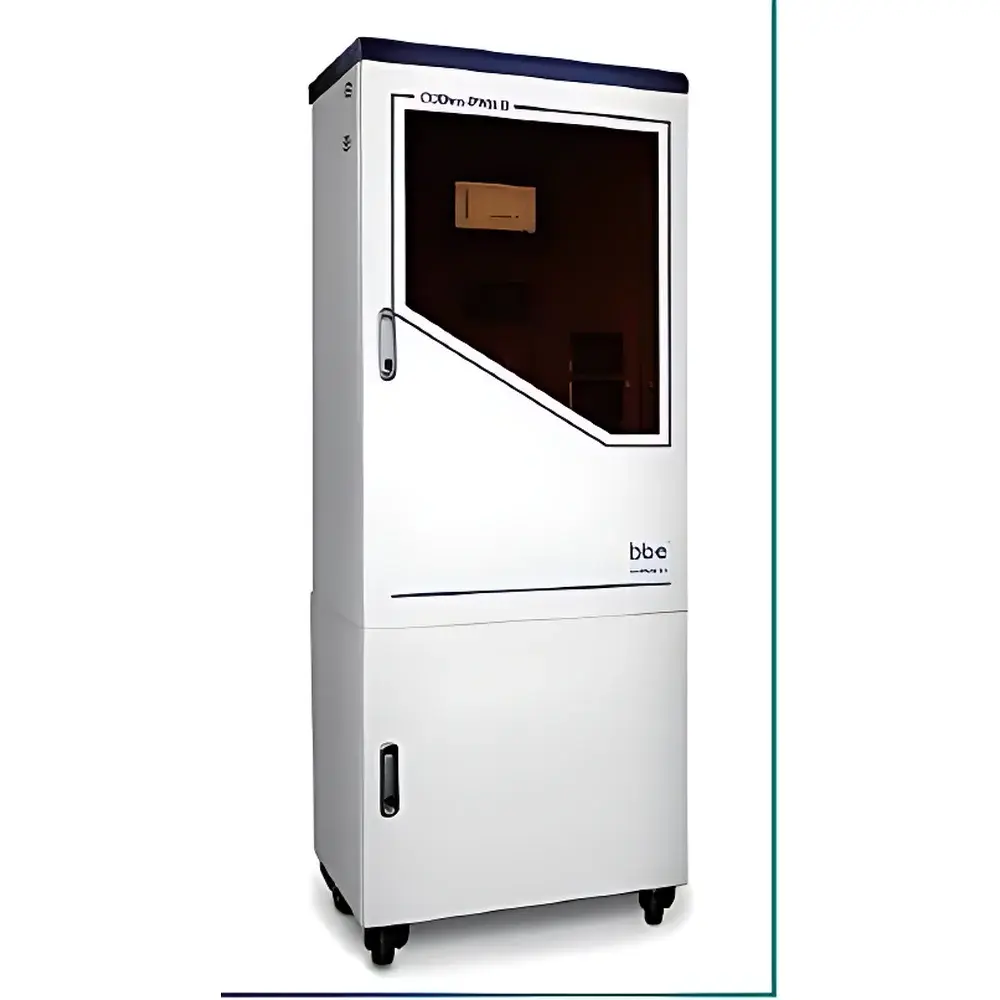
bbe CODcr-PWR II Online Chemical Oxygen Demand Analyzer
| Brand | BBE / bbe Moldaenke |
|---|---|
| Origin | Shanghai, China |
| Manufacturer Type | Direct Manufacturer |
| Instrument Type | Online Analyzer |
| Measurement Principle | Potassium Dichromate Digestion Method (Online) |
| Wavelength | 600 nm (standard for Cr(VI)/Cr(III) absorbance ratio) |
| Measurement Range | 10–500 mg/L, 10–1000 mg/L, or 10–1500 mg/L (user-selectable range switching) |
| Accuracy | ≤ ±10% of reading |
| Repeatability | ≤ ±5% RSD |
| Limit of Detection (LOD) | 10 mg/L COD |
| Cycle Time | 30 minutes per analysis |
| Sample Volume per Cycle | 1.5–3 L |
| Compliance | Designed to meet ISO 6060 and EPA Method 410.4 requirements for online COD monitoring |
Overview
The bbe CODcr-PWR II Online Chemical Oxygen Demand Analyzer is an industrial-grade, fully automated system engineered for continuous, unattended monitoring of chemical oxygen demand (COD) in aqueous matrices. It implements the standardized potassium dichromate digestion method—aligned with ISO 6060 and EPA Method 410.4—in a robust online configuration. Unlike laboratory-based batch analyzers, the CODcr-PWR II integrates sample aspiration, precise reagent dosing, high-temperature acid digestion (typically at 150–165 °C under reflux conditions), colorimetric detection via dual-wavelength photometry (600 nm primary, reference channel for turbidity compensation), and data reporting within a single compact enclosure. Its design targets long-term stability in municipal wastewater influent/effluent streams, industrial discharge points, and surface water monitoring stations where regulatory compliance, process control, and trend analysis demand reproducible, traceable, and auditable measurements.
Key Features
- High-stability optical detection module featuring a precision tungsten-halogen light source and thermally stabilized photodiode array, ensuring linear absorbance response across the full dynamic range (10–1500 mg/L COD).
- Peristaltic pumping system with calibrated, chemically resistant tubing and pressure-sensing feedback loops to guarantee volumetric accuracy of both sample and reagent delivery (±1.5% volume tolerance).
- Dedicated digestion unit with PID-controlled heating, sealed reaction chamber, and integrated cooling phase—optimized to achieve complete oxidation of organic compounds while minimizing chloride interference through mercury sulfate masking.
- Programmable logic controller (PLC)-based automation core supporting scheduled analysis cycles, automatic range switching, fault diagnostics (e.g., low flow, digestion timeout, photometric drift), and configurable alarm outputs (relay & Modbus TCP).
- Industrial-grade 7-inch capacitive touchscreen HMI with intuitive menu navigation, multilingual support (English default), real-time trend graphs, and local data logging (≥30 days at 15-minute intervals).
- Modular architecture enabling field-replaceable consumables (digestion coils, cuvettes, pump tubing) and tool-free access to critical service points—reducing mean time to repair (MTTR) to under 20 minutes.
Sample Compatibility & Compliance
The CODcr-PWR II accepts raw, filtered, or clarified liquid samples with suspended solids ≤ 50 mg/L and chloride concentrations up to 2000 mg/L (with standard HgSO₄ masking). It is validated for use with municipal wastewater, treated effluent, river and lake water, potable water pre-treatment streams, and select industrial discharges (e.g., food processing, textile, and pulp & paper). All measurement protocols adhere to ISO 6060:1989 (Water quality — Determination of chemical oxygen demand) and are compatible with routine verification against certified reference materials (CRMs) traceable to NIST SRM 2639. The instrument’s firmware supports audit-trail-enabled operation compliant with GLP principles; optional 21 CFR Part 11 functionality (electronic signatures, user role management, immutable logs) is available upon configuration.
Software & Data Management
Data acquisition and system supervision are managed via embedded Linux-based firmware with OPC UA and Modbus TCP server capabilities. Raw absorbance values, calculated COD concentrations, diagnostic flags, and calibration history are timestamped and exported in CSV or XML format via Ethernet or optional 4G LTE module. Remote access is supported through secure HTTPS interface with TLS 1.2 encryption. The onboard database retains full cycle metadata—including digestion temperature profiles, reagent lot numbers, and QC check results—for regulatory reporting. Integration with SCADA, DCS, or cloud-based platforms (e.g., Microsoft Azure IoT Hub, Siemens MindSphere) is achieved without proprietary middleware.
Applications
- Real-time COD trending at wastewater treatment plant (WWTP) influent channels to optimize biological loading and aeration control.
- Compliance monitoring at NPDES or EU Urban Wastewater Treatment Directive (UWWTD) discharge points.
- Early-warning detection of industrial slug loads entering municipal sewer networks.
- Performance verification of tertiary treatment units (e.g., ozonation, activated carbon filtration).
- Long-term water quality assessment in regulated surface water bodies under national monitoring programs (e.g., USGS NWIS, EU WISE).
FAQ
What digestion temperature and duration does the CODcr-PWR II employ?
The system maintains a controlled digestion temperature of 155 °C for 120 minutes under acidic reflux conditions—consistent with ISO 6060 Annex A protocols.
Can the analyzer handle high-chloride wastewater without manual intervention?
Yes; it automatically doses mercury sulfate solution in proportion to measured chloride concentration (via integrated ion-selective electrode option), suppressing interference up to 2000 mg/L Cl⁻.
Is routine calibration required, and how is it performed?
Calibration is semi-automated using two-point standard addition (10 mg/L and 500 mg/L KHP standards); the system validates linearity before each analytical cycle and logs all calibration events with operator ID and timestamp.
What maintenance intervals are recommended for uninterrupted operation?
Pump tubing replacement every 3 months, digestion coil inspection every 6 months, and annual photometric validation using NIST-traceable neutral density filters.
Does the instrument support remote firmware updates and diagnostic telemetry?
Yes; over-the-air (OTA) firmware updates and encrypted diagnostic telemetry are enabled via authenticated SSH or secure web portal—subject to customer-defined network security policies.
Related Products







