
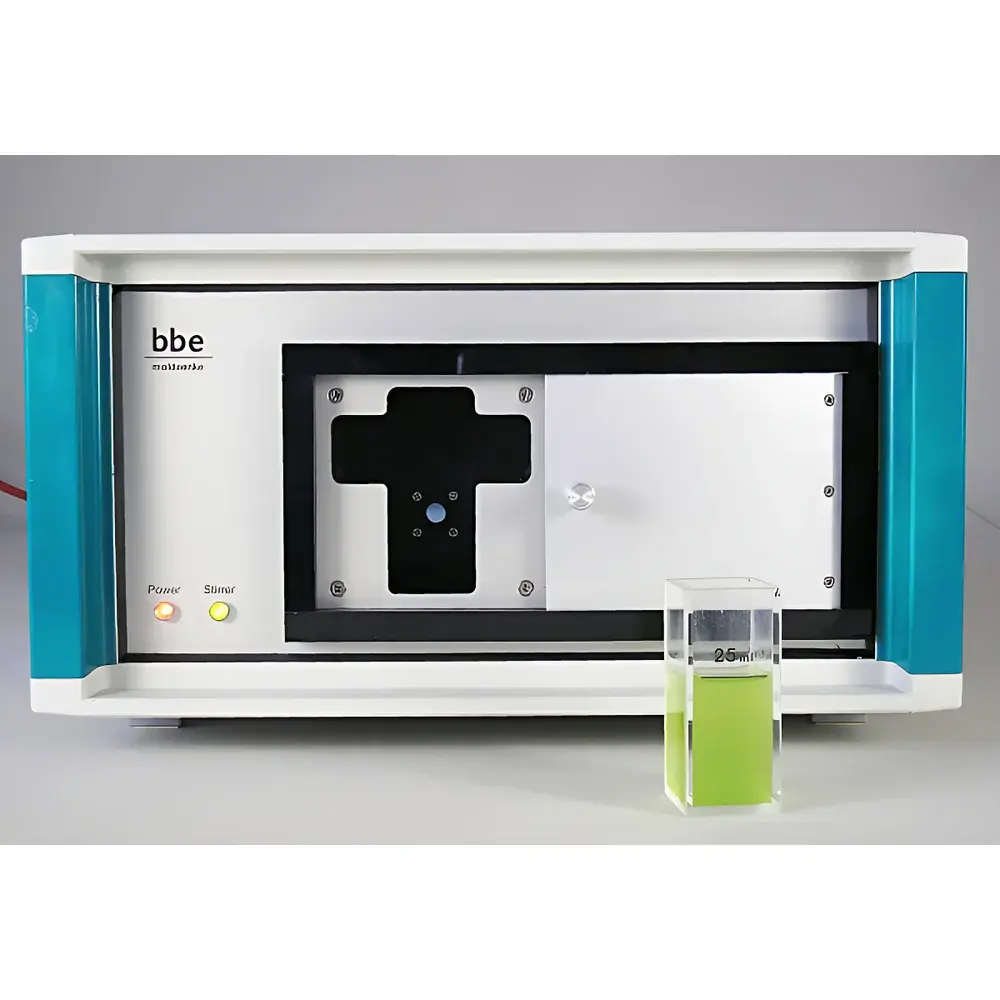
BBE Moldaenke BG00430000 Laboratory Algae Analyzer
| Brand | BBE Moldaenke |
|---|---|
| Origin | Germany |
| Manufacturer | Yes |
| Import Status | Imported |
| Model | BG00430000 |
| Measurement Parameters | Total chlorophyll a / total algal density |
| Measurement Range | 0–500 µg chl-a/L |
| Resolution | 0.01 µg chl-a/L |
| Detection Limit | 0.05 µg chl-a/L |
| Light Transmission Range | 0–100% |
| Excitation Wavelengths | 370, 470, 525, 570, 590, 610 nm |
| Measurement Time | ≤3 min per sample |
| Sample Volume | 25 mL |
| Operating Temperature | 0–35 °C |
| Storage Temperature | 0–50 °C |
| Dimensions (H×W×D) | 185 × 330 × 350 mm |
| Weight | 7.5 kg |
| Power Supply | 110/240 V AC, 50/60 Hz or 12 V DC |
| Power Consumption | 10 W |
| Protection Rating | IP54 |
| Data Interface | RS232 |
| Software | bbe++ (Windows-based database software) |
| Optional Accessories | Photosynthetic activity module |
Overview
The BBE Moldaenke BG00430000 Laboratory Algae Analyzer is a dedicated in vitro fluorometric instrument engineered for rapid, reagent-free identification and quantification of phytoplankton functional groups in freshwater and marine samples. It operates on the principle of multi-wavelength pulse-modulated excitation fluorescence spectroscopy, leveraging the distinct in vivo pigment fluorescence signatures of major algal classes—including Chlorophyta (green algae), Cyanobacteria, Bacillariophyta/Dinophyta (diatoms and dinoflagellates), and Cryptophyta. Unlike conventional microscopy or culture-based methods, this analyzer requires no sample pre-filtration, centrifugation, or chemical extraction. Its optical architecture enables simultaneous detection of total chlorophyll a, accessory pigments (e.g., phycocyanin, fucoxanthin, alloxanthin), and colored dissolved organic matter (CDOM), providing a comprehensive biochemical profile correlated with photosynthetic activity. The system delivers quantitative results—expressed as cell density equivalents and chlorophyll a concentration—in under three minutes per 25 mL sample, with analytical reproducibility validated against reference HPLC methods (R² > 0.93).
Key Features
- Multi-parametric fluorescence profiling using six precisely calibrated excitation wavelengths (370, 470, 525, 570, 590, and 610 nm) to resolve spectral contributions from key photosynthetic and photoprotective pigments.
- Integrated transmission sensor enabling concurrent measurement of light attenuation (0–100%), supporting turbidity correction and optical depth estimation.
- High-resolution quantification down to 0.01 µg chl-a/L, with a method detection limit of 0.05 µg chl-a/L—suitable for oligotrophic and eutrophic water monitoring.
- Compact benchtop design (185 × 330 × 350 mm; 7.5 kg) featuring IP54-rated enclosure for controlled laboratory environments.
- Flexible power operation: compatible with standard AC mains (110/240 V, 50/60 Hz) or external 12 V DC supply—enabling deployment in mobile labs or field-deployable setups when paired with optional rechargeable battery.
- Optimized thermal management ensuring stable performance across 0–35 °C ambient operating range.
Sample Compatibility & Compliance
The BG00430000 accepts unfiltered, unpreserved aqueous samples (25 mL volume) from lakes, reservoirs, rivers, drinking water intakes, wastewater effluents, and mesocosm experiments. It complies with standard practices for phytoplankton assessment outlined in ISO 10260 (water quality — determination of chlorophyll a), ASTM D3731 (standard test method for chlorophyll a in water by fluorometric measurement), and EU Water Framework Directive (WFD) Annex V requirements for phytoplankton community analysis. While not a GLP-certified instrument per se, its digital audit trail, timestamped data export, and bbe++ software metadata logging support traceability in regulated research environments. The absence of consumables or reagents eliminates batch-to-batch variability and aligns with green analytical chemistry principles.
Software & Data Management
Data acquisition, calibration, and reporting are managed via bbe++—a Windows-native application with embedded relational database architecture. The software supports user-defined calibration curves, multi-sample batch processing, automatic outlier flagging, and export of raw fluorescence spectra, quantified class densities, chlorophyll a concentrations, and transmission values in CSV, Excel, and PDF formats. All measurements include embedded instrument ID, operator ID, date/time stamp, and environmental metadata (e.g., sample ID, temperature). Audit logs record parameter changes, calibration events, and software updates—facilitating internal QA/QC reviews and alignment with FDA 21 CFR Part 11 expectations where electronic records are subject to regulatory scrutiny.
Applications
- Trophic state assessment and early-warning monitoring of cyanobacterial blooms in reservoirs and recreational waters.
- Long-term limnological studies requiring high-frequency phytoplankton community profiling without taxonomic expertise.
- Validation and cross-calibration of remote sensing algorithms using in situ ground-truth data.
- Drinking water source protection programs evaluating seasonal shifts in algal composition at intake points.
- Ecotoxicological testing where rapid, non-destructive assessment of photosynthetic inhibition serves as a sublethal endpoint.
- University teaching laboratories demonstrating functional group ecology, photophysiology, and instrumental environmental analysis.
FAQ
Does the BG00430000 require sample filtration or pigment extraction prior to analysis?
No. The instrument analyzes native, unprocessed water samples directly—eliminating filtration artifacts and preserving physiological integrity.
Can the system distinguish between viable and non-viable algal cells?
Yes—when equipped with the optional photosynthetic activity module, it measures variable chlorophyll a fluorescence (Fv/Fm) to assess quantum yield and physiological status.
Is the bbe++ software compatible with modern Windows OS versions?
Yes—bbe++ supports Windows 10 and Windows 11 (64-bit), with regular updates provided through BBE Moldaenke’s customer portal.
What maintenance is required for long-term operational reliability?
Annual optical path verification and LED intensity calibration are recommended; no routine consumables or lamp replacements are needed due to solid-state excitation sources.
How is data security ensured during transfer from instrument to PC?
All RS232 communications are ASCII-based and unencrypted by default; users may implement local network-level encryption or air-gapped transfer protocols per institutional IT policy.
Related Products







