
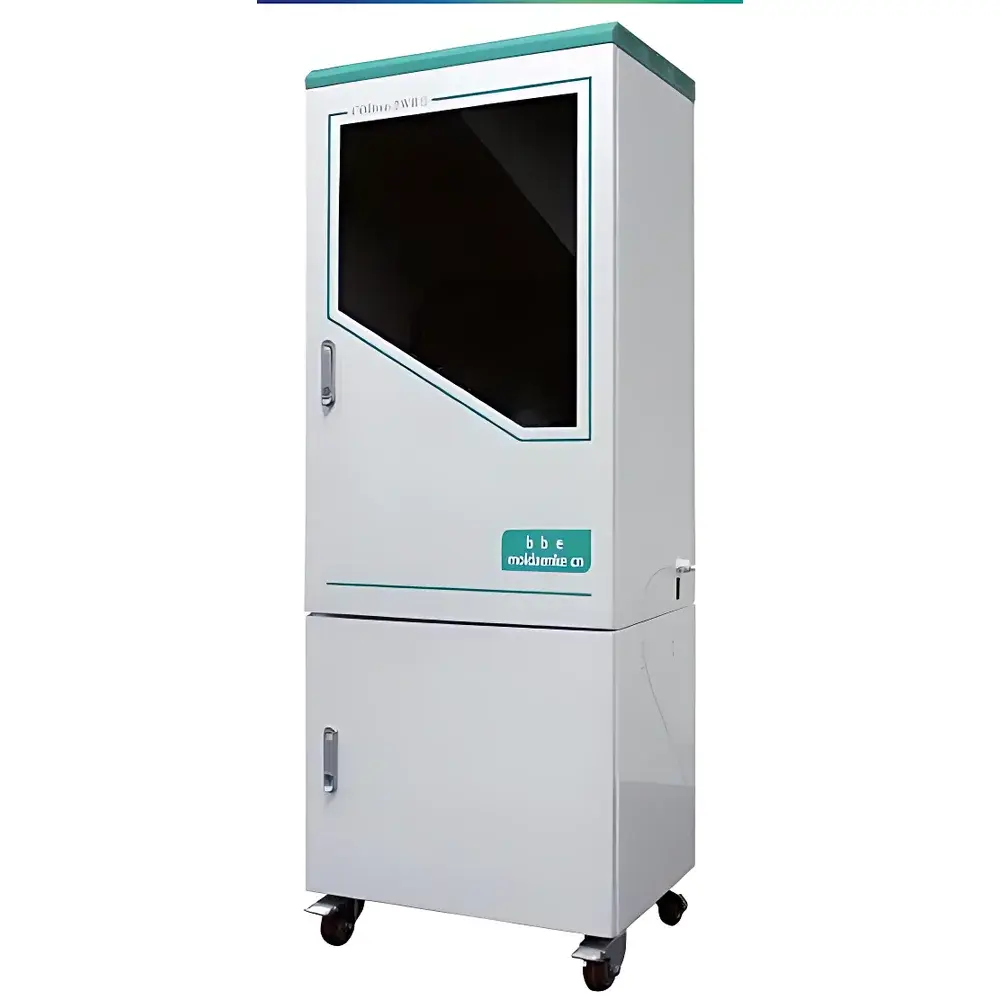
BBE Moldaenke BG00750004 Automated Permanganate Index Analyzer
| Brand | BBE Moldaenke |
|---|---|
| Origin | Shanghai, China |
| Manufacturer Type | Original Equipment Manufacturer (OEM) |
| Instrument Type | Online Analyzer |
| Measurement Principle | Potassium Permanganate Oxidation with ORP Endpoint Detection |
| Range | 0–8 mg/L and 0–20 mg/L (dual-range auto-switching) |
| Repeatability | ±3% of Full Scale (FS) |
| Accuracy | ≤±3% FS |
| Limit of Detection (LOD) | 0.4 mg/L |
| Resolution | 0.01 mg/L |
| Analysis Cycle Time | 60 minutes per sample |
Overview
The BBE Moldaenke BG00750004 Automated Permanganate Index Analyzer is an online, fully automated analytical system engineered for continuous or scheduled determination of the permanganate index (CODMn) in aqueous environmental samples. It operates on the standardized chemical oxidation principle defined in ISO 8467:1993 and equivalent national methods (e.g., HJ 1002–2018 in China), wherein potassium permanganate (KMnO4) serves as the oxidant under acidic, heated conditions. Endpoint detection is achieved via precise potentiometric monitoring of the oxidation-reduction potential (ORP) shift — a robust, reagent-stoichiometry-based method that eliminates subjective visual endpoint interpretation and enhances long-term measurement stability. Designed for unattended operation in municipal waterworks, wastewater treatment plants, and surface water monitoring stations, the analyzer delivers traceable, GLP-compliant data without manual intervention.
Key Features
- Fully automated analysis cycle including sample aspiration, reagent dosing, thermal digestion, ORP endpoint titration, and integrated high-efficiency tubing cleaning — all controlled by an embedded programmable logic unit.
- Dual-range measurement capability (0–8 mg/L and 0–20 mg/L) with automatic range switching based on preliminary screening or user-defined thresholds.
- High-stability peristaltic pump system with individually dedicated channels for KMnO4, sulfuric acid, sodium oxalate, and rinse solutions — eliminating cross-contamination between reagents and ensuring volumetric accuracy within ±1.5%.
- Optimized digestion module maintaining precise temperature control (97 ± 1 °C) and consistent heating duration to ensure complete oxidation of low-molecular-weight organic compounds while minimizing over-oxidation of chloride interference.
- Low-noise, high-sensitivity photodiode-based ORP sensor with temperature compensation and automatic calibration verification prior to each analysis cycle.
- Industrial-grade 7-inch capacitive touchscreen interface with intuitive menu navigation, multilingual support (English default), and local storage of up to 5,000 timestamped result records with full audit trail metadata (sample ID, operator, error logs, maintenance timestamps).
Sample Compatibility & Compliance
The BG00750004 is validated for use with raw and treated surface water, drinking water, municipal wastewater effluents, and industrial discharges with turbidity ≤ 100 NTU and suspended solids < 50 mg/L. It complies with key regulatory frameworks including ISO 8467, EPA Method 4500-PERM, and Chinese standard HJ 1002–2018. All firmware and data handling routines support audit-ready operation under GLP and GMP environments: time-stamped event logging, user-access levels (admin/operator/guest), password-protected configuration changes, and non-volatile memory retention during power interruption. Optional RS-232/RS-485 serial interfaces enable MODBUS RTU integration into SCADA or LIMS platforms, satisfying requirements for centralized data aggregation and regulatory reporting.
Software & Data Management
Embedded firmware implements deterministic real-time scheduling for sequential analysis, self-diagnostic routines, and configurable pre-analytical tube priming and post-cycle purging. Data export is supported via USB mass storage or serial protocol, generating CSV files compliant with ISO/IEC 17025 documentation standards. The system records full process parameters per measurement — including ORP curve slope, digestion temperature profile, reagent consumption, and endpoint stability window — enabling retrospective method validation. Remote diagnostics are accessible via optional Ethernet module (not included), supporting SNMP-based network monitoring and secure HTTPS-based configuration updates. All data entries include ISO 8601 timestamps and are protected against unauthorized deletion through write-once archival mode.
Applications
- Real-time compliance monitoring of intake and effluent streams at municipal water treatment facilities.
- Trend analysis of organic load variation in rivers, lakes, and reservoirs for early pollution event detection.
- Process optimization in activated sludge and biological nutrient removal systems via correlation with BOD5 and TOC.
- Quality assurance in bottled water and beverage production where low-level organic contamination must be verified.
- Regulatory reporting for discharge permits requiring periodic CODMn submission under national environmental statutes.
FAQ
What sample pretreatment is required prior to analysis?
No filtration or centrifugation is needed for samples with turbidity ≤ 100 NTU and particle size 300 mg/L Cl−) may require method-specific correction factors per ISO 8467 Annex B.
Can the instrument operate unattended for extended periods?
Yes — with scheduled cleaning cycles, remote alarm notification via dry-contact outputs, and auto-resume functionality after power recovery, it supports >30 days of continuous operation without manual servicing.
Is the system compatible with third-party data acquisition software?
Yes — MODBUS RTU over RS-485 enables seamless integration with Siemens Desigo, Schneider EcoStruxure, or custom Python/Node-RED middleware using standard function codes 03 (read holding registers) and 06 (preset single register).
How is calibration verified during routine operation?
Daily automated verification uses certified potassium hydrogen phthalate (KHP) standard solution; drift tolerance is set to ±2% FS — exceeding which triggers maintenance alert and halts further analysis until recalibration.
What maintenance intervals are recommended for optimal performance?
Peristaltic pump tubing replacement every 3 months (or 1,500 cycles), ORP electrode refurbishment every 6 months, and full system performance verification annually per ISO/IEC 17025 Clause 6.4.3.
Related Products







