
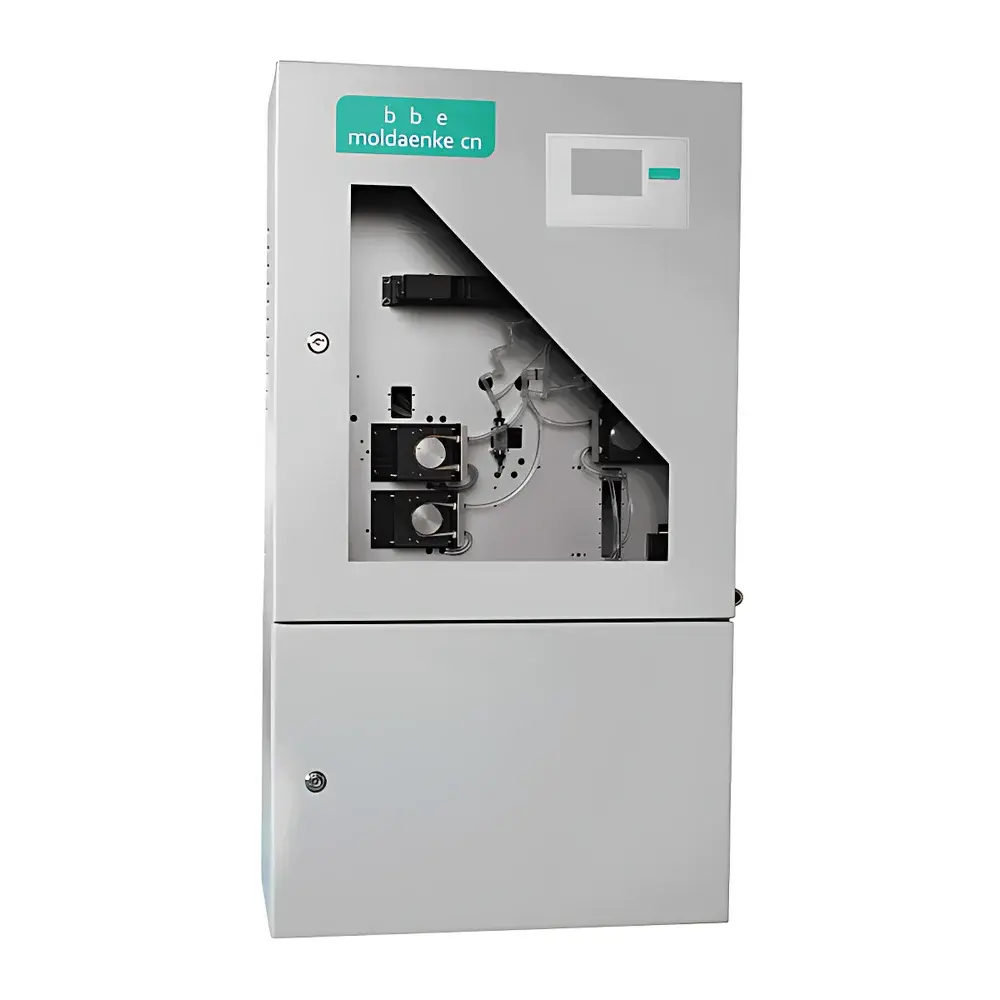
bbe NH4—PWR II Online Ammonia-N (NH₃-N) Water Quality Analyzer
| Brand | BBE / bbe Moldaenke |
|---|---|
| Origin | Shanghai, China |
| Manufacturer Type | Direct Manufacturer |
| Instrument Category | Domestic (China-Made) |
| Model | bbe NH4—PWR II |
| Instrument Type | Online Water Quality Analyzer |
| Measured Parameter | Ammonia-Nitrogen (NH₃-N) |
| Measurement Principle | Salicylate Spectrophotometry |
| Detection Range | 0–0.5 / 2 / 4 / 20 / 100 mg/L NH₃-N (selectable) |
| Accuracy | ≤ ±3% FS or 0.0014 mg/L (whichever is greater) |
| Repeatability | ≤2% |
| Limit of Detection (LOD) | 0.0027 mg/L (at 0–0.5 mg/L range) |
| Zero Drift | ≤1% FS/24 h |
| Span Drift | ≤2% FS/24 h |
| Measurement Cycle Time | 500 s |
| Resolution | 0.0001 mg/L (at 0–0.5 mg/L range) |
| Dimensions (H×L×W) | 1100 × 600 × 310 mm |
| Weight | ~45 kg |
| Sample Requirements | Oil-free, low-suspended solids |
| Temp | 2–40 °C |
| Pressure | 0.0–0.1 bar |
| Flow Rate | 1.5–3.0 L/min |
| Output Interfaces | 4–20 mA analog, RS232/RS485 serial |
| Communication Protocols | MODBUS RTU/TCP (optional), TCP/IP (optional) |
| Calibration | Automatic & manual |
| Maintenance | Modular design with tool-free access |
| Display | Integrated touchscreen HMI |
| Data Integrity Features | Built-in QC check verification, remote status monitoring (optional) |
| Environmental Compliance | Designed for continuous operation in Class I, Division 2 hazardous locations per IEC 60079-0 (general requirements) |
Overview
The bbe NH4—PWR II Online Ammonia-N (NH₃-N) Water Quality Analyzer is an industrial-grade, fully automated photometric analyzer engineered for continuous, unattended monitoring of ammonia nitrogen concentration in surface water, drinking water distribution systems, municipal wastewater treatment plants, and industrial effluent streams. It implements the standardized salicylate spectrophotometric method (ISO 11732:2005, ASTM D1426–15, and EPA Method 350.1), which offers high selectivity for ammonium ions (NH₄⁺) under alkaline conditions via catalyzed reaction with hypochlorite and salicylate to form a stable indophenol blue complex. Absorbance is measured at 655 nm using a dual-beam optical system with temperature-stabilized LED light source and solid-state detector, minimizing drift and ensuring long-term baseline stability. The analyzer operates in a true online configuration — requiring no sample pre-treatment beyond filtration — and is validated for compliance with regulatory data quality objectives (DQOs) applicable to continuous emission monitoring systems (CEMS) and environmental compliance reporting.
Key Features
- Fully automated measurement cycle including reagent dosing, mixing, reaction incubation, photometric detection, and system flushing — configurable cycle time from 500 seconds per analysis
- High-precision peristaltic pumping system with calibrated flow control, delivering reproducible liquid handling across all operational ranges (CV ≤ 1.2% over 24 h)
- Modular architecture with hot-swappable reagent cartridges, optical cell, and waste management unit — enabling field maintenance without system shutdown
- Integrated 7-inch capacitive touchscreen HMI with intuitive navigation, multilingual interface (English, German, Spanish, Chinese), and real-time diagnostic dashboard
- Comprehensive fault diagnostics including clog detection, low reagent alerts, optical path contamination warnings, and power-loss recovery with auto-resume functionality
- Configurable calibration routines: scheduled automatic zero/span calibration, manual point calibration, and multi-point verification using certified reference standards
- Robust enclosure rated IP65, suitable for indoor and sheltered outdoor installation in ambient temperatures from 5–40 °C and relative humidity up to 90% non-condensing
Sample Compatibility & Compliance
The bbe NH4—PWR II is designed for direct integration into process water lines with minimal pretreatment. It accepts raw influent samples meeting the following physical specifications: turbidity < 5 NTU, total suspended solids (TSS) 100 µm. Sample temperature must remain within 2–40 °C, and inlet pressure must be maintained between 0.0 and 0.1 bar (gauge) with a stable flow rate of 1.5–3.0 L/min. The analyzer complies with electromagnetic compatibility requirements per EN 61326-1 for industrial environments and conforms to general safety principles outlined in IEC 61010-1. While not intrinsically safe, its construction satisfies mechanical and thermal safety criteria for non-hazardous area deployment. For regulated applications, the instrument supports audit-trail-capable data logging (optional firmware extension) aligned with GLP/GMP traceability expectations and can be configured to meet 21 CFR Part 11 electronic record requirements when paired with validated server-side software.
Software & Data Management
Data output is supported via isolated 4–20 mA analog outputs (two channels, configurable for NH₃-N concentration and status flag), plus dual serial interfaces (RS232 and RS485) supporting MODBUS RTU protocol as standard. Optional Ethernet connectivity enables MODBUS TCP and native TCP/IP socket communication for seamless integration into SCADA, DCS, or cloud-based asset management platforms. Internal memory stores ≥30 days of 5-minute interval measurement records, QC checks, calibration logs, and event timestamps. All stored data are timestamped with UTC synchronization capability via NTP client (when network-enabled). Remote access is available through secure HTTP(S) web interface or OPC UA server (firmware option), allowing real-time parameter adjustment, historical trend visualization, and alarm acknowledgment without local physical interaction.
Applications
- Real-time ammonia monitoring at drinking water treatment plant intake and finished water points to ensure compliance with WHO and national drinking water guidelines (e.g., ≤0.5 mg/L NH₃-N)
- Process control in activated sludge bioreactors — tracking nitrification/denitrification efficiency and optimizing aeration energy use
- Effluent compliance monitoring for industrial dischargers subject to NPDES permits or ISO 14001 environmental management systems
- Early warning detection in watershed protection networks where elevated ammonia signals potential agricultural runoff or sewage leakage
- Research-grade longitudinal studies requiring high-resolution temporal profiling of nitrogen speciation in mesocosm or pilot-scale treatment systems
FAQ
What measurement principle does the bbe NH4—PWR II employ?
It uses the salicylate spectrophotometric method (ISO 11732), generating a colorimetric indophenol complex proportional to NH₄⁺ concentration, measured at 655 nm.
Is the analyzer suitable for seawater or high-salinity samples?
No — chloride interference above 500 mg/L may suppress color development; desalination or dilution pretreatment is required for brackish or marine applications.
Can the instrument be integrated into an existing PLC-based control system?
Yes — via MODBUS RTU over RS485 or MODBUS TCP over Ethernet, with register mapping documentation provided upon request.
What reagents are consumed during operation, and what is their shelf life?
Sodium salicylate, sodium nitroprusside, and sodium hypochlorite solutions — supplied in sealed, light-protected cartridges with 6-month unopened shelf life at 4–25 °C.
Does the system support remote calibration verification using standard reference materials?
Yes — optional QC verification module allows automated introduction of certified NH₄⁺ standards at user-defined intervals, with pass/fail reporting logged to internal memory.
Related Products







