
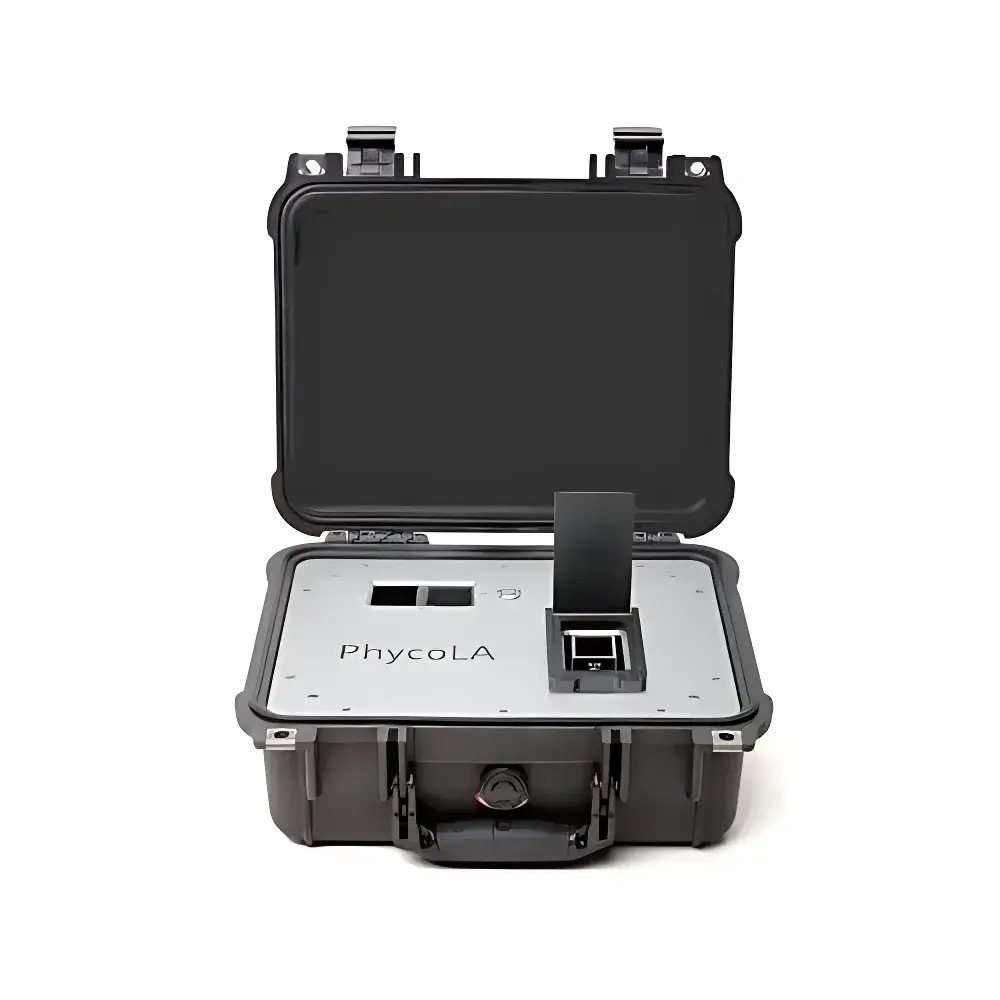
BBE PhycoLA Algal Toxin Early-Warning Analyzer with Automated Algal Classification
| Brand | BBE Moldaenke |
|---|---|
| Origin | Germany |
| Manufacturer | BBE Moldaenke GmbH |
| Type | Laboratory Instrument |
| Model | PhycoLA |
| Operating Temperature | 0–40 °C |
| Reagent Storage Temperature | 0–40 °C |
| Sample Volume per Batch | 25 mL |
| Biological Target | Cyanobacteria and Algal Taxa |
| Application Domain | Freshwater and Brackish Water Quality Monitoring |
Overview
The BBE PhycoLA is a laboratory-grade, fluorescence-based algal toxin early-warning analyzer engineered for rapid, multi-parametric assessment of cyanobacterial risk in freshwater systems. It operates on the principle of excitation-emission matrix (EEM) fluorescence spectroscopy combined with proprietary spectral deconvolution algorithms to simultaneously quantify free phycocyanin (PC), chlorophyll a (Chl a), photosynthetic activity (Fv/Fm), and optical properties of dissolved yellow substances (Y-SUB). Free phycocyanin serves as a robust proxy for microcystin-producing cyanobacterial biomass and associated off-flavor compounds (e.g., geosmin and 2-methylisoborneol), enabling proactive toxicity screening without reliance on time-consuming immunoassays or LC-MS/MS. Unlike endpoint ELISA kits or culture-based methods, the PhycoLA delivers quantitative results within minutes from unprocessed water samples—making it suitable for routine surveillance in drinking water treatment plants, reservoir management programs, and ecological research laboratories.
Key Features
- Simultaneous quantification of free phycocyanin concentration (µg/L), chlorophyll a (µg/L), and effective quantum yield of PSII (Fv/Fm) in a single 25 mL sample run
- Automated algal classification at the functional group level (e.g., Microcystis, Anabaena, Planktothrix, Aphanizomenon, diatoms, green algae) using multivariate fluorescence pattern recognition
- Integrated correction for interference from colored dissolved organic matter (CDOM) via parallel measurement of yellow substance absorbance at 440 nm
- Temperature-stable optical path calibrated for operation across 0–40 °C ambient and reagent storage conditions
- Pre-configured assay protocols compliant with DIN 38412-37 (algal growth inhibition tests) and aligned with ISO 14442:2022 (fluorescence-based phytoplankton analysis)
- Modular design supporting GLP-compliant data integrity: audit trail logging, user access levels, electronic signatures, and 21 CFR Part 11–ready software architecture
Sample Compatibility & Compliance
The PhycoLA accepts raw, unfiltered freshwater samples—including raw intake water, finished drinking water, reservoir effluents, and mesocosm incubations—with minimal pretreatment (optional 0.45 µm filtration for turbid samples). It is validated for use with surface waters ranging from oligotrophic lakes (Chl a < 1 µg/L) to eutrophic reservoirs (>100 µg/L). The system meets key regulatory expectations for environmental monitoring instrumentation: calibration traceability to NIST-traceable fluorescence standards; compliance with EN ISO/IEC 17025:2017 for testing laboratories; and alignment with WHO Guidelines for Drinking-water Quality (4th ed., Annex 2) regarding cyanotoxin risk indicators. All firmware and method files are version-controlled and exportable for external QA/QC review or third-party verification.
Software & Data Management
The instrument is operated via BBE’s PhycoSoft v5.2, a Windows-based application supporting automated report generation (PDF/CSV), trend visualization (7-/30-/90-day rolling averages), and integration with LIMS via ODBC or HL7 interfaces. Raw fluorescence spectra (300–750 nm excitation × 400–850 nm emission) are stored with full metadata (operator ID, timestamp, temperature, sample ID, instrument status flags). Data export includes uncertainty estimates derived from internal reference standard repeatability (n ≥ 6 per batch) and conforms to FAIR principles (Findable, Accessible, Interoperable, Reusable). Audit logs record all parameter changes, result modifications, and user logins—ensuring full traceability for GLP, GMP, or EPA Method 1623.2-aligned workflows.
Applications
- Risk-informed decision support during cyanobacterial bloom events in rivers, lakes, and drinking water reservoirs
- Process control at conventional and advanced water treatment facilities—particularly for optimizing coagulation, ozonation, and activated carbon dosing
- Long-term limnological studies tracking seasonal shifts in phytoplankton community structure and physiological stress
- Regulatory compliance monitoring under EU Bathing Water Directive (2006/7/EC) and US EPA Cyanobacteria and Toxins Standard Development Framework
- Research applications in aquaculture health management, marine biogeochemistry, and climate-driven phytoplankton phenology studies
- Educational use in university-level environmental science, aquatic toxicology, and instrumental analysis courses
FAQ
Does the PhycoLA detect microcystins directly?
No—it measures free phycocyanin as a highly correlated surrogate biomarker for microcystin-producing cyanobacteria. Quantitative toxin confirmation requires orthogonal techniques such as LC-MS/MS or ELISA.
Can it distinguish between intracellular and extracellular phycocyanin?
Yes—the assay protocol includes optional centrifugation and filtration steps to differentiate particulate-bound versus dissolved phycocyanin fractions.
Is method validation documentation available?
Yes—BBE provides a complete validation package including precision (RSD ≤ 4.2% for Chl a at 5 µg/L), linearity (R² ≥ 0.998 over 0.2–200 µg/L PC), limit of quantification (LOQ = 0.12 µg/L PC), and inter-laboratory reproducibility data per ISO 5725-2.
What maintenance is required?
Quarterly optical path cleaning, annual lamp intensity calibration, and biannual verification against BBE-certified reference standards (Cat. No. PC-REF-01 and CHLA-REF-02).
Is remote monitoring supported?
Yes—via optional PhycoLink Ethernet module enabling real-time status telemetry, alarm notifications (SMTP/SNMP), and secure web-based dashboard access.







