
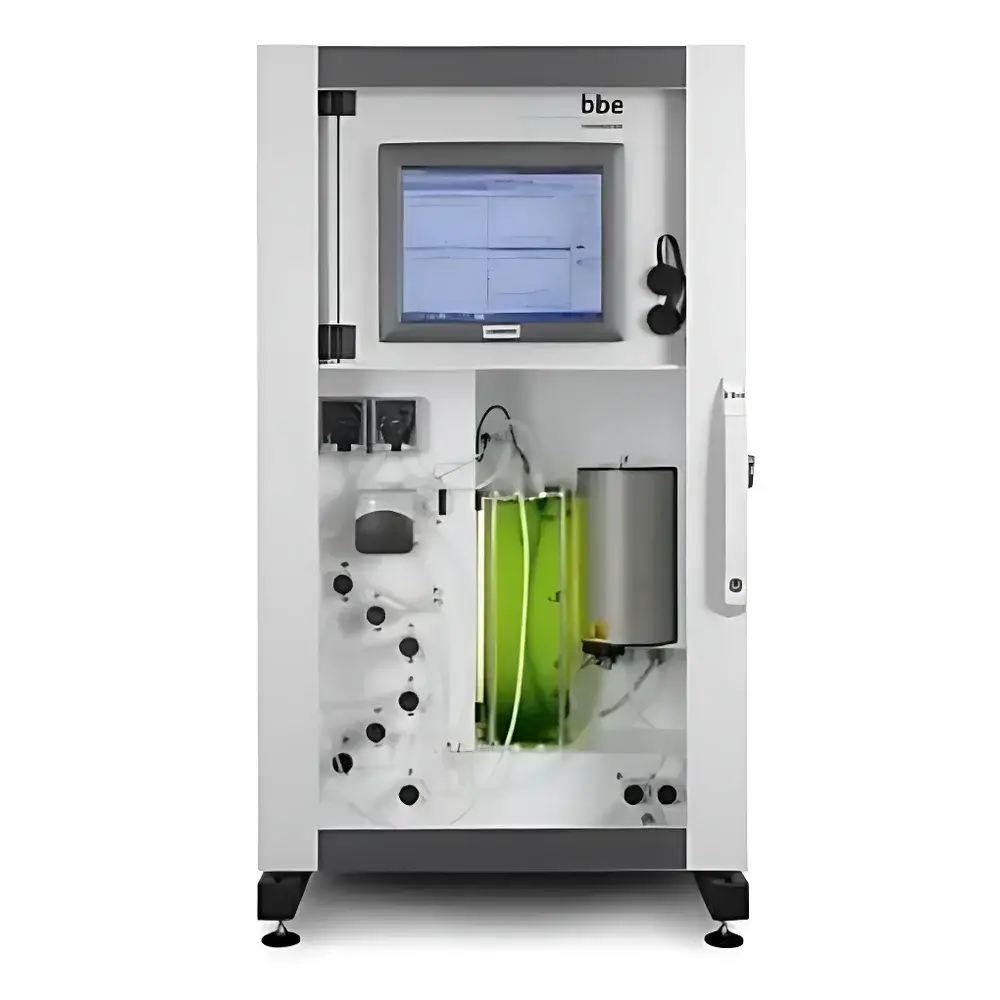
BBE A-ToxII Algal Toxicity Analyzer
| Brand | BBE/bbe Moldaenke |
|---|---|
| Origin | Germany |
| Manufacturer Type | Original Equipment Manufacturer (OEM) |
| Origin Category | Imported |
| Model | A-ToxII |
| Instrument Type | Online |
| Test Organism | Algae (Chlorella vulgaris, ISO 8692:2012 compliant) |
| Operating Temperature | 0–35 °C |
| Reagent Storage Temperature | 0–30 °C |
Overview
The BBE A-ToxII Algal Toxicity Analyzer is an online, real-time biosensor system engineered for continuous assessment of acute aquatic toxicity in surface water, raw drinking water sources, and process influents. It operates on the well-established physiological principle of photosynthetic inhibition in microalgae—specifically measuring the reduction in chlorophyll-a fluorescence yield following exposure to toxicants. This photobiological endpoint serves as a highly sensitive, integrative indicator of bioavailable toxicity across diverse chemical classes. Unlike endpoint-specific chemical assays, the A-ToxII delivers a holistic, functionally relevant toxicity signal reflective of actual biological impact on primary producers—a critical trophic level in aquatic ecosystems. The instrument integrates an onboard, temperature-controlled algal cultivation module, enabling autonomous propagation of axenic Chlorella vulgaris cultures validated per ISO 8692:2012, ensuring standardized biological responsiveness and long-term assay reproducibility.
Key Features
- Integrated, self-sustaining algal bioreactor with automated light/dark cycle control and nutrient replenishment, eliminating dependency on external culture maintenance.
- Real-time, continuous monitoring capability via peristaltic sampling pump—compatible with unattended operation for up to 7 days without manual intervention.
- Dual-channel fluorometric detection system with excitation at 450 nm and emission capture at 680 nm and 740 nm, enabling ratiometric quantification of PSII quantum yield inhibition.
- Dynamic alarm thresholds configurable by user (e.g., ≥15% inhibition over 30 min), supporting adaptive early-warning protocols aligned with local regulatory trigger levels.
- Robust architecture designed for field deployment: IP65-rated enclosure, wide operating temperature range (0–35 °C), and corrosion-resistant fluidic pathways compatible with natural freshwater matrices.
- Pre-calibrated response sensitivity to reference toxicants including atrazine (detection limit: 0.5 µg/L), Cu²⁺, Cd²⁺, phenol, aniline, and common herbicides—validated against OECD 201 and ISO 8692 test guidelines.
Sample Compatibility & Compliance
The A-ToxII is optimized for low-turbidity freshwater samples (turbidity < 20 NTU; DOC < 15 mg/L), making it especially suitable for reservoirs, lakes, rivers, and drinking water intakes. It complies with key international frameworks governing ecotoxicological monitoring: ISO 8692:2012 (standardized algal growth inhibition testing), OECD Guideline 201 (freshwater alga and cyanobacteria growth inhibition test), and supports data traceability requirements under GLP and ISO/IEC 17025. While not a direct replacement for regulatory compliance testing, its output provides actionable, near-real-time toxicity intelligence that informs risk-based sampling strategies and incident response workflows—particularly valuable in source water protection programs governed by the EU Water Framework Directive (WFD) and U.S. EPA’s Drinking Water Protection Program.
Software & Data Management
The embedded firmware includes time-series logging of inhibition kinetics (0–100%), baseline drift compensation, and automatic outlier rejection based on statistical variance thresholds. Data export is supported via Modbus TCP/IP, RS-485, or optional 4–20 mA analog output for integration into SCADA or LIMS platforms. The optional A-Tox Control Center software enables remote configuration, historical trend analysis, alarm event annotation, and audit-trail generation compliant with FDA 21 CFR Part 11 requirements—including electronic signatures, user access controls, and immutable log retention. All measurement metadata—including sample ID, incubation duration, temperature, and fluorescence ratios—is embedded in CSV and XML exports to support traceable QA/QC documentation.
Applications
- Early-warning monitoring of raw water intakes for municipal drinking water utilities, detecting accidental or intentional contamination events before conventional chemical analysis.
- Process safety assurance in food and beverage manufacturing facilities, where untreated intake water may contact product-contact surfaces.
- Research-grade toxicity screening in academic and governmental laboratories, supporting mechanistic studies on mixture effects, bioavailability modulation, and seasonal sensitivity shifts in algal communities.
- Ecosystem health assessment in lake and reservoir management programs, correlating toxicity signals with nutrient loading, cyanobacterial bloom dynamics, and land-use patterns.
- Validation and calibration support for passive sampling devices and effect-directed analysis (EDA) workflows targeting unknown toxicants in complex environmental matrices.
FAQ
What algal species does the A-ToxII use by default, and can it be substituted?
The system is factory-configured with Chlorella vulgaris (strain SAG 211-11b), certified per ISO 8692:2012. Alternate strains—including Scenedesmus obliquus or Pseudokirchneriella subcapitata—can be introduced following method validation per OECD 201 protocols.
Does the instrument require daily maintenance or reagent replenishment?
No consumables are required during standard operation. The integrated bioreactor sustains algal viability for ≥7 days; routine tasks include weekly optical window cleaning and monthly nutrient media replacement.
How does the A-ToxII differentiate between abiotic interference (e.g., turbidity, UV quenching) and true toxic inhibition?
It employs dual-wavelength ratiometric fluorescence detection and real-time baseline normalization using pre-exposure dark-adapted measurements—effectively suppressing non-toxic optical artifacts while preserving biological response fidelity.
Is the system suitable for wastewater or high-DOC water matrices?
Not recommended for untreated wastewater or waters with DOC > 15 mg/L or turbidity > 20 NTU due to potential interference with fluorescence signal integrity and algal viability; pretreatment (e.g., filtration, dilution) is advised for such applications.
Can inhibition data be correlated to specific chemical concentrations?
The A-ToxII provides a functional toxicity index—not a quantitative chemical assay. Correlation to nominal concentrations requires matrix-specific calibration curves generated using reference toxicants under controlled laboratory conditions.







