
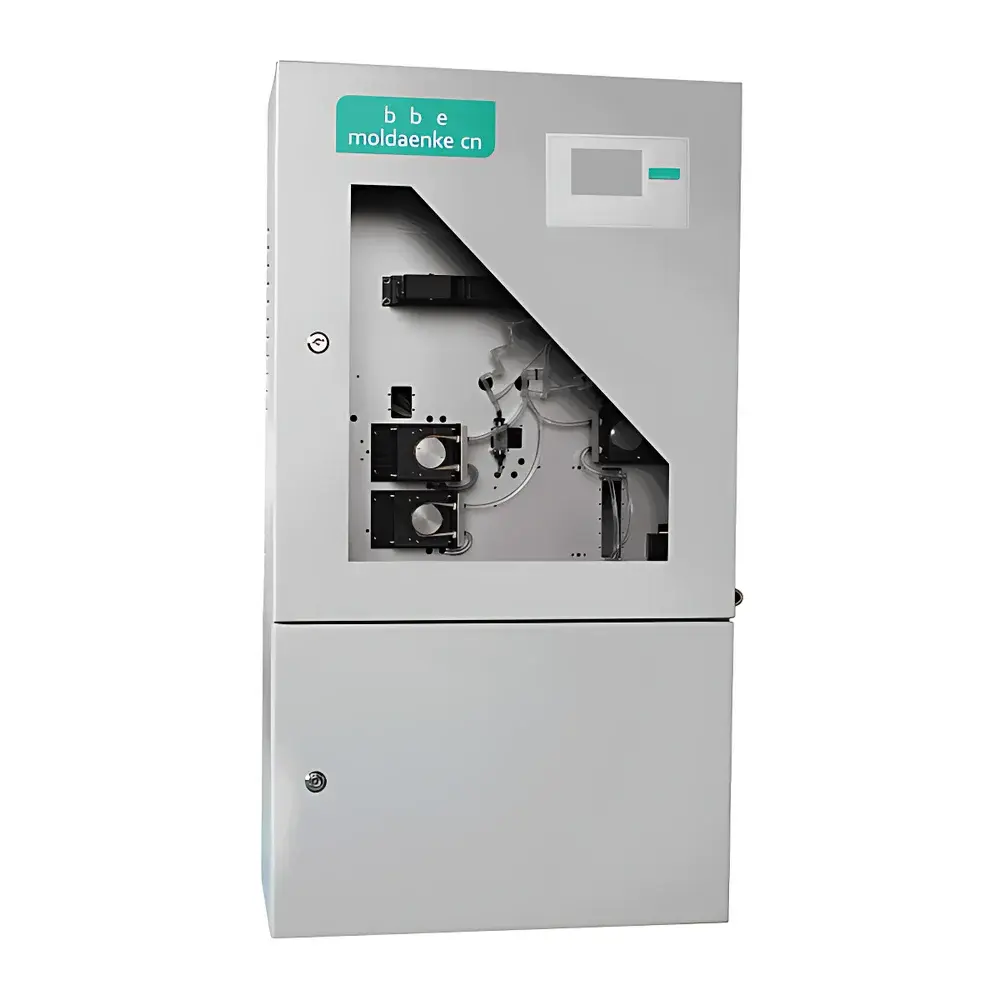
bbe TP—PWR II Online Total Phosphorus Water Quality Analyzer
| Brand | BBE / bbe Moldaenke |
|---|---|
| Origin | Shanghai, China |
| Manufacturer Type | Manufacturer |
| Product Category | Domestic |
| Model | bbe TP—PWR II |
| Instrument Type | Online Water Quality Analyzer |
| Analyte | Total Phosphorus |
| Measurement Principle | Acidic Peroxysulfate Digestion + Ammonium Molybdate Spectrophotometry (λ = 880 nm) |
| Detection Limit | 0.0035 mg/L (at 0–0.5 mg/L range) |
| Accuracy | ≤ ±3% FS or ±0.003 mg/L (whichever is greater) |
| Repeatability | ≤1% |
| Zero Drift | ≤1% FS/24h |
| Span Drift | ≤2% FS/24h |
| Measurement Cycle | 30 minutes |
| Resolution | 0.0001 mg/L (0–0.5 mg/L range) |
| Dimensions (H×L×W) | 1100 × 600 × 310 mm |
| Weight | ~45 kg |
| Sample Requirements | Oil-free, low-suspended solids |
| Temp. | 2–40 °C |
| Pressure | 0.0–0.1 bar |
| Flow Rate | 1.5–3.0 L/min |
| Output Interfaces | 4–20 mA analog, RS232/RS485 serial |
| Communication Protocols | MODBUS RTU/TCP (optional), TCP/IP (optional) |
| UV-Assisted Digestion | Integrated |
| QC Verification & Remote Monitoring | Optional |
Overview
The bbe TP—PWR II Online Total Phosphorus Water Quality Analyzer is an industrial-grade, fully automated analyzer engineered for continuous, unattended monitoring of total phosphorus (TP) in surface water, drinking water, municipal wastewater, and industrial effluents. It implements the standardized acidic potassium persulfate digestion method followed by ammonium molybdate spectrophotometric detection at 880 nm — a technique aligned with ISO 15681-1:2003 and EPA Method 365.3 for total phosphorus determination. The system integrates UV-assisted digestion to enhance oxidation efficiency for refractory organic phosphorus species, ensuring comprehensive conversion of all phosphorus forms (orthophosphate, condensed phosphates, and organically bound phosphorus) into measurable orthophosphate prior to colorimetric quantification. Designed for deployment in demanding environmental monitoring stations, wastewater treatment plants (WWTPs), and industrial discharge points, the TP—PWR II delivers laboratory-grade data integrity under field conditions through rigorous thermal and optical stability control, precision fluid handling, and embedded quality assurance protocols.
Key Features
- Fully automated operation with programmable measurement cycles (adjustable from 30 min to 24 h), including auto-digestion, reagent addition, mixing, color development, photometric reading, and system flushing.
- Integrated UV-enhanced digestion module improves oxidation completeness for complex phosphorus compounds, reducing interference from humic substances and particulate-bound phosphorus.
- High-precision peristaltic pumping system with calibrated flow control ensures volumetric reproducibility better than ±1%, critical for maintaining measurement repeatability across extended deployments.
- Modular architecture enables rapid component replacement (e.g., digestion cell, cuvette holder, reagent manifold) without recalibration — minimizing downtime and service dependency.
- 7-inch capacitive touchscreen HMI with multilingual interface (English, German, Spanish, Chinese) supports intuitive navigation, real-time status visualization, and context-sensitive diagnostics.
- Comprehensive fault management: automatic error logging, audible/visual alarms for low reagent level, clogged tubing, abnormal absorbance, temperature deviation, and power interruption recovery with seamless resumption post-reboot.
- Configurable analog (4–20 mA) and digital outputs (RS232/RS485) support integration into SCADA, DCS, or PLC-based infrastructure; optional MODBUS RTU/TCP and TCP/IP protocols enable secure remote configuration and data polling.
Sample Compatibility & Compliance
The TP—PWR II is validated for use with clarified, oil-free aqueous samples exhibiting turbidity < 5 NTU and suspended solids < 10 mg/L. It operates reliably within a sample temperature range of 2–40 °C and inlet pressure of 0.0–0.1 bar, accommodating standard gravity-fed or low-pressure pumped sampling lines. To ensure analytical validity, samples must be pre-filtered (e.g., 5–10 µm cartridge filter) and degassed if dissolved air interferes with fluidic stability. The analyzer conforms to IEC 61326-1:2013 (EMC for measurement equipment) and IEC 61000-6-2/6-4 for industrial environments. Its methodology satisfies regulatory requirements referenced in EU Directive 2000/60/EC (Water Framework Directive), US EPA Clean Water Act reporting criteria, and China’s HJ 535–2009 and HJ 636–2012 standards for total phosphorus monitoring. Optional QC verification functionality supports GLP-compliant audit trails, including spike recovery checks, blank validation, and multi-point calibration logs.
Software & Data Management
Embedded firmware provides local data storage (≥30 days of 15-minute interval records) with timestamped metadata (sample ID, reagent lot, digestion temperature, optical path integrity). All measurements are traceable to NIST-traceable phosphate standards via onboard calibration routines. The analyzer supports dual-mode calibration: automatic scheduled calibration using certified standard solutions or manual calibration initiated via HMI. Optional remote monitoring software enables centralized fleet management across multiple units, delivering real-time health metrics (pump cycles, lamp intensity decay, digestion efficiency index), predictive maintenance alerts (e.g., reagent depletion forecast, tubing wear estimation), and export of CSV/Excel-compatible reports compliant with ISO/IEC 17025 documentation requirements. Audit trail functionality meets FDA 21 CFR Part 11 readiness when paired with user authentication and electronic signature modules.
Applications
- Continuous compliance monitoring at municipal wastewater treatment plant final effluent discharge points per national phosphorus limits (e.g., <0.5 mg/L TP).
- Source water protection programs for lakes and reservoirs, detecting early eutrophication signals via sub-0.01 mg/L detection capability.
- Industrial pretreatment verification for phosphorus-containing process streams (e.g., metal finishing, food processing, detergent manufacturing).
- Research-grade longitudinal studies requiring high temporal resolution (e.g., diurnal phosphorus flux in riverine systems).
- Integration into smart water networks where TP data feeds predictive models for nutrient load forecasting and adaptive dosing of coagulants in treatment processes.
FAQ
What digestion method does the TP—PWR II employ, and how does UV assistance improve performance?
It uses acidic potassium persulfate digestion at elevated temperature (120–130 °C), enhanced by integrated UV irradiation to accelerate breakdown of recalcitrant organic phosphorus compounds — increasing total conversion efficiency by up to 12% compared to thermal digestion alone.
Is the analyzer suitable for raw wastewater with high suspended solids?
No. It requires pre-filtration to remove particles >10 µm and oil droplets; untreated raw sewage may cause clogging and optical interference. A dedicated sample conditioning unit (SCU) with automatic backwash filtration is recommended upstream.
Can measurement range be changed in-field without hardware modification?
Yes. Range switching (e.g., 0–0.5 mg/L ↔ 0–100 mg/L) is performed via software configuration and validated using corresponding calibration standards; no physical component swap is required.
How is data integrity ensured during power outages or network interruptions?
Internal non-volatile memory retains all measurement data and system logs. Upon power restoration, the analyzer resumes operation from its last known state and synchronizes buffered data to the host system once connectivity is reestablished.
Does the system support remote calibration verification?
Yes — optional remote QC mode allows operators to initiate automated spike recovery tests or blank checks from a central server, with full audit trail generation and pass/fail evaluation against predefined acceptance criteria (e.g., recovery 85–115%).







