
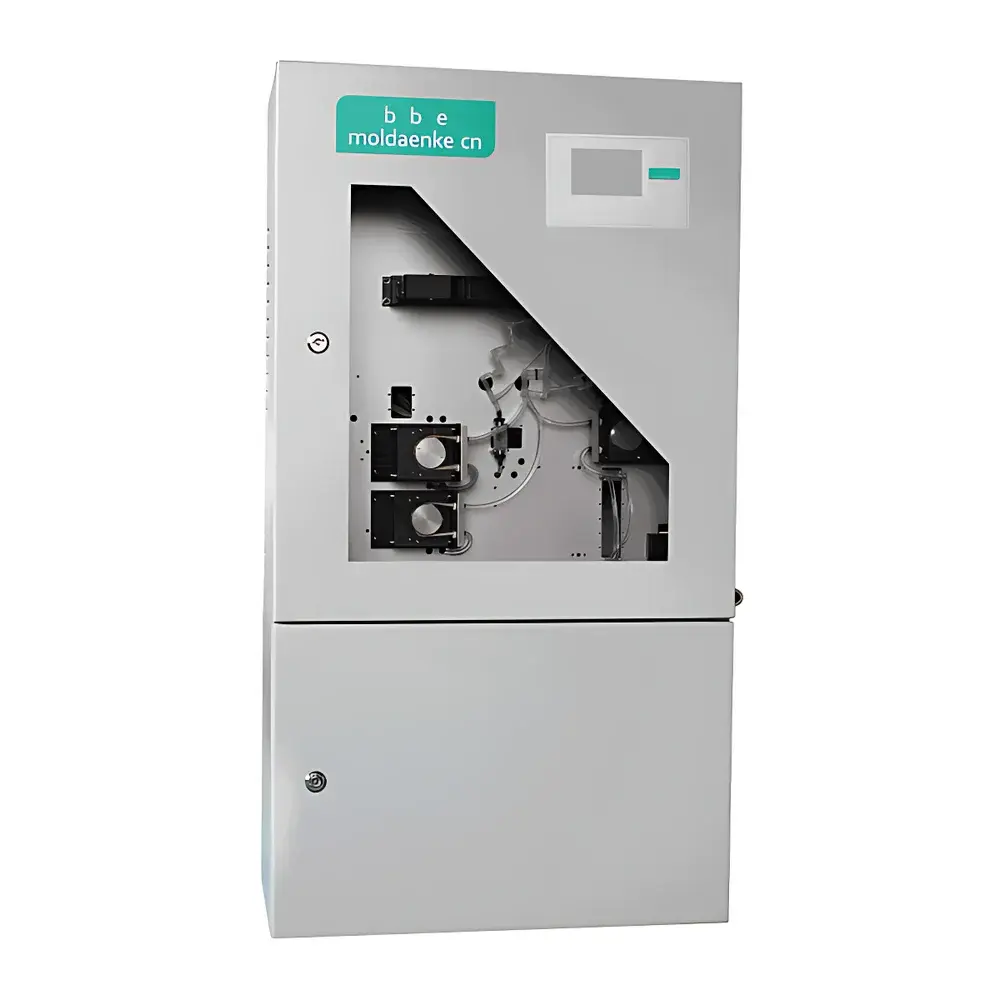
bbe TP+TN—PWR II Online Total Phosphorus and Total Nitrogen Analyzer
| Brand | BBE / bbe Moldaenke |
|---|---|
| Origin | Shanghai, China |
| Manufacturer Type | Original Equipment Manufacturer (OEM) |
| Product Category | Domestic |
| Instrument Type | Online Water Quality Analyzer |
| Measured Parameters | Total Nitrogen (TN), Total Phosphorus (TP) |
| Measurement Principle (TN) | Alkaline Potassium Persulfate Digestion + UV-Vis Spectrophotometry |
| Measurement Principle (TP) | Acidic Potassium Persulfate Digestion + Ammonium Molybdate Spectrophotometry |
| Detection Range (TN) | 0–2.5 / 10 / 50 / 350 mg/L |
| Detection Range (TP) | 0–2 / 5 / 10 / 100 mg/L |
| Accuracy (TN) | ≤ ±3% FS or 0.05 mg/L (whichever is greater) |
| Accuracy (TP) | ≤ ±3% FS |
| Repeatability | ≤2% for both TN and TP |
| LOD (TN) | 0.05 mg/L |
| LOD (TP) | 0.0035 mg/L |
| Zero Drift (TN) | ≤3% FS/24h |
| Zero Drift (TP) | ≤1% FS/24h |
| Span Drift (TN) | ≤3% FS/24h |
| Span Drift (TP) | ≤2% FS/24h |
| Measurement Cycle (TN) | 21 min |
| Measurement Cycle (TP) | 30 min |
| Resolution | 0.01 mg/L (at minimum range) |
| Dimensions (H×L×W) | 1190 × 600 × 310 mm |
| Weight | ~45 kg |
| Sample Requirements | Oil-free, low-suspended solids |
| Temp. | 2–40 °C |
| Pressure | 0.0–0.1 bar |
| Flow Rate | 1.5–3.0 L/min |
| Output Interfaces | 4–20 mA analog, RS232/RS485 serial |
| Communication Protocols | MODBUS RTU/TCP (optional), TCP/IP (optional) |
| Key Hardware | Diode Array Spectrometer (UV–Vis, 190–800 nm), Integrated UV-Assisted Digestion Module |
| Calibration | Automatic & Manual |
| Maintenance | Modular Design with Tool-Free Access |
| Display | Touchscreen HMI (Human-Machine Interface) |
| Data Integrity Features | Audit Trail Ready, QC Check & Verification Logging (optional), Remote Status Monitoring (optional) |
Overview
The bbe TP+TN—PWR II is an industrial-grade online water quality analyzer engineered for continuous, simultaneous quantification of total nitrogen (TN) and total phosphorus (TP) in diverse aqueous matrices—including surface water, drinking water distribution systems, municipal wastewater effluents, and industrial process discharges. It implements two standardized wet-chemical digestion protocols compliant with ISO 11908 (for TN) and ISO 6878 (for TP): alkaline potassium persulfate digestion under UV-assisted conditions for complete nitrogenous compound oxidation, followed by dual-wavelength UV-Vis spectrophotometric detection; and acidic persulfate digestion coupled with ammonium molybdate colorimetry for orthophosphate release and subsequent phosphomolybdate complex formation. The system integrates a diode array spectrometer covering 190–800 nm, enabling full-spectrum acquisition to support robust turbidity correction algorithms and multi-peak spectral deconvolution—critical for maintaining accuracy in variable-turbidity environments without filtration.
Key Features
- True dual-parameter operation: Independent, programmable measurement cycles for TN (21 min) and TP (30 min), with user-defined sequencing and interval scheduling
- UV-enhanced digestion module ensures >95% oxidation efficiency for refractory organic nitrogen species (e.g., amino acids, urea) and particulate-bound phosphorus
- Real-time turbidity interference compensation using reference wavelengths and baseline drift modeling—validated per EN ISO 7027 for suspended solids up to 100 NTU
- Modular fluidic architecture with quick-release valves, self-cleaning peristaltic pumps, and chemically resistant PFA/PEEK tubing—designed for >12 months mean time between maintenance (MTBM)
- Embedded touchscreen HMI with intuitive wizard-guided calibration, diagnostic logs, and event history (including power failure recovery and auto-restart)
- Dual calibration modes: fully automated standard addition with onboard reagent reservoirs, plus manual single-point or multi-point verification
- Comprehensive fault handling: real-time sensor diagnostics, reagent level monitoring, pressure/flow validation, and alarm-triggered data flagging per ISO/IEC 17025 clause 7.7
Sample Compatibility & Compliance
The bbe TP+TN—PWR II accepts raw, unfiltered samples meeting defined physical constraints: temperature 2–40 °C, pressure 0.0–0.1 bar (gauge), and flow rate 1.5–3.0 L/min. It is certified for use in ambient outdoor enclosures (IP55-rated cabinet optional) and compatible with common pretreatment units (e.g., automatic samplers, coarse filters, air-gap degassers). Analytical performance conforms to EPA Method 353.2 (TN) and EPA Method 365.2 (TP) equivalency requirements. Data integrity architecture supports audit-ready operation under GLP and GMP frameworks, including configurable electronic signatures, 180-day onboard event logging, and timestamped QC check records. Optional remote monitoring enables integration into SCADA or cloud-based environmental data management platforms compliant with ISO 14001 Annex A.3.3.
Software & Data Management
Firmware v4.2+ includes embedded data handling compliant with FDA 21 CFR Part 11 requirements when configured with user authentication, role-based access control, and electronic audit trail activation. All measurements are tagged with instrument ID, sample ID, digestion timestamp, calibration status, and environmental metadata (temperature, pressure, flow). Raw spectral scans (ASCII-exportable) and processed results are stored locally on industrial-grade SD card (≥32 GB) and transmitted via dual-channel 4–20 mA analog output or RS485 serial interface. MODBUS TCP and native TCP/IP protocols (optional) allow direct ingestion into PI System, Ignition SCADA, or custom LIMS via RESTful API endpoints. Firmware updates are performed securely over HTTPS with SHA-256 signature verification.
Applications
- Regulatory compliance monitoring at wastewater treatment plant (WWTP) final effluent discharge points per EU Urban Wastewater Treatment Directive (91/271/EEC) and US Clean Water Act NPDES permits
- Source water quality trending in reservoirs and rivers to support early-warning systems for eutrophication risk assessment
- Process control in tertiary denitrification and phosphorus removal units—enabling dynamic dosing of carbon sources or metal salts
- Industrial pretreatment verification for food processing, pharmaceutical, and chemical manufacturing facilities subject to local POTW limits
- Long-term nutrient load estimation in watershed-scale monitoring networks requiring low-maintenance, high-durability instrumentation
FAQ
What digestion methods does the bbe TP+TN—PWR II use for TN and TP analysis?
It applies alkaline potassium persulfate digestion with UV assistance for TN, and acidic potassium persulfate digestion followed by ammonium molybdate colorimetry for TP—both aligned with internationally recognized standard methods.
Can the analyzer operate without external sample filtration?
Yes, provided influent meets specified turbidity and suspended solids limits (<100 NTU, oil-free); its integrated turbidity correction algorithm maintains accuracy across variable clarity conditions.
Is the system suitable for unattended operation in remote locations?
Absolutely—the unit features battery-backed real-time clock, auto-power-resume after outage, internal data buffering, and optional cellular/GSM telemetry for alarm notification and remote firmware updates.
How is measurement traceability ensured?
Each analysis includes embedded calibration certificate references, NIST-traceable standard lot numbers (when used), and full spectral raw data archiving—supporting ISO/IEC 17025 accreditation requirements.
What maintenance intervals are recommended for routine operation?
Preventive maintenance is scheduled every 3 months for reagent replacement and optical path inspection; full module refurbishment is recommended annually or after 5,000 measurement cycles, whichever occurs first.







