
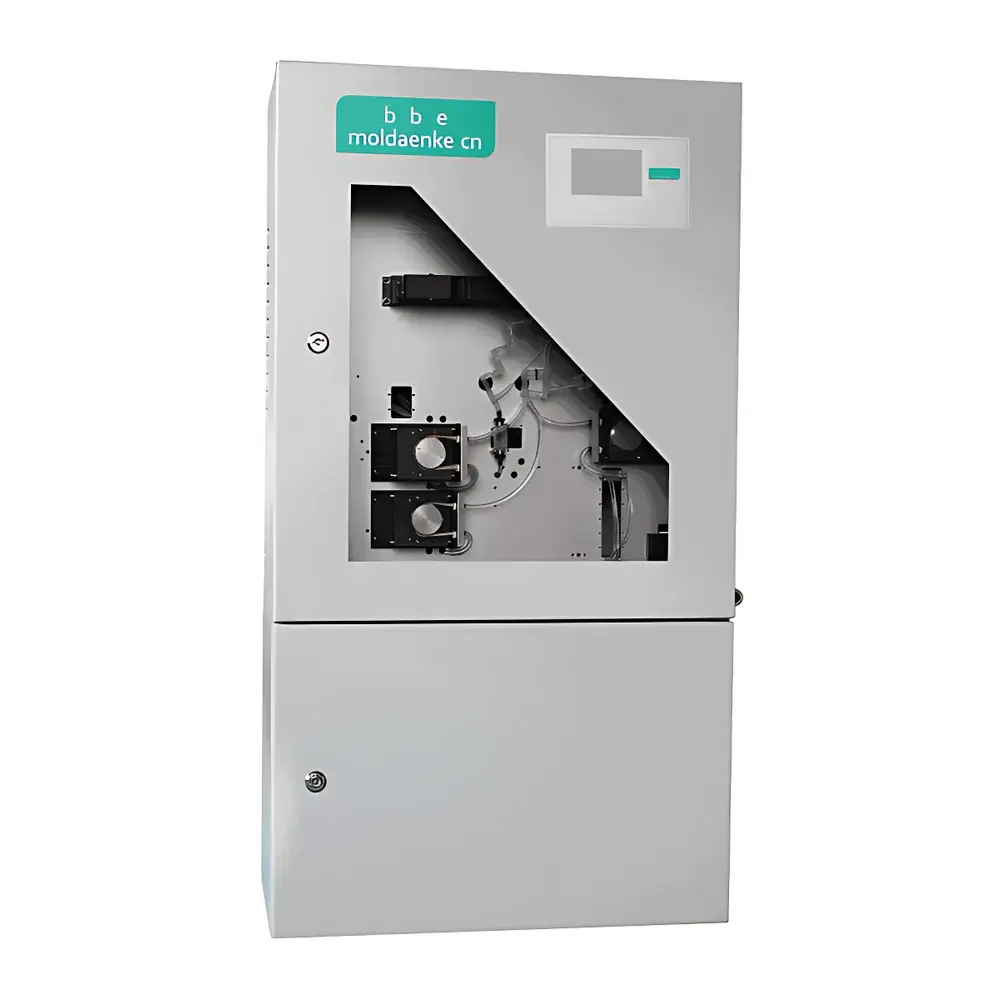
bbe TP+TN+NH4—PWR II Online Tri-Parameter Water Quality Analyzer for Total Phosphorus, Total Nitrogen and Ammonia-Nitrogen
| Brand | bbe Moldaenke |
|---|---|
| Origin | Shanghai, China |
| Manufacturer Type | Original Equipment Manufacturer (OEM) |
| Product Category | Domestic |
| Model | bbe TP+TN+NH4—PWR II |
| Instrument Type | Online Water Quality Analyzer |
| Measured Parameters | Total Phosphorus (TP), Total Nitrogen (TN), Ammonia-Nitrogen (NH₄–N) |
| Measurement Principles | TN – Alkaline Potassium Persulfate Digestion + UV Spectrophotometry |
| Measurement Ranges | TN: 0–2.5 / 10 / 50 / 350 mg/L |
| TP | 0–2 / 5 / 10 / 100 mg/L |
| NH₄–N | 0–0.5 / 2 / 4 / 20 / 100 mg/L |
| Accuracy | TN: ≤ ±3% FS or 0.05 mg/L (whichever greater) |
| TP | ≤ ±3% FS |
| NH₄–N | ≤ ±3% FS or 0.015 mg/L (whichever greater) |
| Repeatability | ≤2% for all parameters |
| Detection Limits | TN: 0.05 mg/L |
| TP | 0.0035 mg/L |
| NH₄–N | 0.0027 mg/L |
| Zero Drift | TN: ≤3% FS/24h |
| TP & NH₄–N | ≤1% FS/24h |
| Span Drift | TN: ≤3% FS/24h |
| TP & NH₄–N | ≤2% FS/24h |
| Measurement Cycle Time | TN: 21 min |
| TP | 30 min |
| NH₄–N | 8.4 min |
| Resolution | TN: 0.01 mg/L (min range) |
| TP | 0.001 mg/L (min range) |
| NH₄–N | 0.0001 mg/L (min range) |
| Dimensions (H×L×W) | 1190 × 600 × 310 mm |
| Weight | ~45 kg |
| Sample Requirements | Oil-free, low-suspended solids |
| Temp | 2–40 °C |
| Pressure | 0.0–0.1 bar |
| Flow Rate | 1.5–3.0 L/min |
| Key Technologies | Diode Array Full-Spectrum Detection (UV–Vis), Turbidity Interference Compensation, UV-Assisted Digestion, Modular Architecture, Touchscreen HMI, Remote Status Monitoring (optional), QC Check & Audit Trail Support (optional), Communication: 4–20 mA, RS232/RS485, MODBUS TCP/IP (optional) |
Overview
The bbe TP+TN+NH4–PWR II is an integrated online tri-parameter water quality analyzer engineered for continuous, unattended monitoring of total phosphorus (TP), total nitrogen (TN), and ammonia-nitrogen (NH4–N) in diverse aqueous matrices—including surface water, drinking water distribution systems, municipal wastewater effluents, and industrial process streams. Its analytical architecture is grounded in standardized wet-chemical digestion coupled with high-fidelity spectrophotometric detection. TN quantification employs alkaline potassium persulfate digestion followed by UV absorbance measurement at characteristic wavelengths (typically 220 nm and 275 nm), enabling correction for nitrate interference. TP determination utilizes acidic potassium persulfate oxidation to convert all phosphorus species to orthophosphate, followed by molybdate blue complex formation and visible-range absorbance detection. NH4–N is measured via the salicylate-hypochlorite reaction, yielding a stable indophenol blue chromophore with high selectivity and sensitivity in the visible spectrum. All three methods comply with internationally recognized reference protocols, including ISO 11908 (TN), ISO 15681-1 (TP), and ISO 7150-1 (NH4–N), ensuring data traceability and regulatory acceptability in environmental compliance reporting.
Key Features
- True tri-parameter capability with independent, programmable measurement sequences and customizable cycle intervals—enabling optimized temporal resolution per parameter without cross-interference.
- Diode array spectrophotometer covering full UV–visible range (190–800 nm), supporting multi-wavelength calibration, spectral deconvolution, and real-time baseline correction.
- Proprietary turbidity compensation algorithm that dynamically corrects absorbance signals using dual-wavelength referencing, minimizing matrix effects from suspended solids up to 100 NTU.
- UV-assisted digestion module enhancing oxidation efficiency for refractory nitrogen and phosphorus compounds, particularly beneficial in wastewater and industrial influent applications.
- Fully modular fluidic and optical design: reagent cartridges, digestion cells, and flow cells are field-replaceable without system recalibration, reducing mean time to repair (MTTR) to under 30 minutes.
- Industrial-grade 10.1-inch capacitive touchscreen HMI with intuitive wizard-based configuration, multilingual UI (English, German, Spanish, Chinese), and embedded diagnostics log.
- Comprehensive self-diagnostics: automatic zero/span verification, air bubble detection, reagent level monitoring, temperature-stabilized cuvette heating, and pressure-controlled sample aspiration.
- Robust enclosure rated IP65, designed for installation in pump stations, control rooms, or outdoor kiosks with ambient operating temperature range of 5–40 °C.
Sample Compatibility & Compliance
The bbe TP+TN+NH4–PWR II is validated for use with low-turbidity, oil-free aqueous samples meeting defined physical constraints: temperature 2–40 °C, pressure head 0.0–0.1 bar (gauge), and volumetric flow rate 1.5–3.0 L/min. It is not intended for raw sewage with high particulate load or emulsified hydrocarbons without upstream filtration or centrifugation. The analyzer meets electromagnetic compatibility (EMC) requirements per IEC 61326-1 and safety standards per IEC 61010-1. Data integrity features—including configurable audit trails, electronic signatures, and event logging—support alignment with GLP, GMP, and EPA Method 365.3/365.4 validation frameworks. Optional MODBUS TCP/IP and 4–20 mA outputs enable seamless integration into SCADA, DCS, or cloud-based environmental data management platforms compliant with ISO 50001 and EU WFD reporting structures.
Software & Data Management
Embedded firmware supports local data storage (≥30 days of 1-min averaged values per parameter) with cyclic overwrite protection. All measurements include timestamp, method ID, digestion status flag, and QC pass/fail annotation. Remote access is enabled via secure HTTPS interface or optional LTE/WiFi gateway, allowing real-time viewing of chromatograms, calibration curves, and diagnostic events. The system supports scheduled automatic calibration using certified standard solutions and includes built-in recovery protocols for power interruption (auto-resume post-blackout with state-consistent restart). For regulated environments, optional 21 CFR Part 11-compliant software modules provide role-based user authentication, electronic signature capture, and immutable audit trail export in CSV or PDF format. Data export formats include ASCII, JSON, and OPC UA—facilitating interoperability with third-party LIMS and enterprise analytics tools.
Applications
- Real-time nutrient load monitoring at wastewater treatment plant (WWTP) influent, bioreactor zones, and final effluent discharge points for compliance with national discharge permits (e.g., US EPA NPDES, EU Urban Wastewater Treatment Directive).
- Early-warning detection of phosphorus breakthrough in drinking water reservoirs or distribution networks, supporting proactive coagulant dosing control.
- Process optimization in denitrification and nitrification basins through synchronized TN/NH4–N trending and stoichiometric ratio analysis.
- Industrial pretreatment verification for facilities discharging to municipal sewers—ensuring adherence to local POTW limits on TP and TN.
- Long-term trend analysis for watershed management programs, including eutrophication risk assessment and TMDL (Total Maximum Daily Load) modeling support.
- Research-grade nutrient flux studies in mesocosms, constructed wetlands, and aquaculture recirculation systems requiring high temporal resolution and method transparency.
FAQ
What sample pretreatment is required prior to analysis?
Pre-filtration to ≤80 µm is recommended for samples containing suspended solids >50 mg/L. Oil and grease must be removed via phase separation or activated carbon filtration to prevent optical window fouling and reagent interference.
Can the instrument operate unattended for extended periods?
Yes. With standard reagent packs (7-day capacity), scheduled cleaning cycles, and remote diagnostics, the system supports ≥30 days of continuous operation without manual intervention under typical municipal water conditions.
Is method validation documentation available?
Yes. bbe provides method validation reports per ISO/IEC 17025, including precision, accuracy, LOD/LOQ, linearity (R² ≥0.999), and inter-laboratory comparison data upon request.
How is calibration traceability maintained?
All factory calibrations are traceable to NIST-certified reference materials (SRM 2192 for NH4–N, SRM 2193 for NO3–N, SRM 2194 for PO4–P), and end-user calibration standards must be prepared following ISO 6497 guidelines.
What maintenance tasks require certified technician involvement?
Only optical alignment verification and digestion cell replacement after 10,000 cycles require factory-trained personnel. All other routine maintenance—including tubing replacement, filter changes, and reagent loading—is operator-performed using guided on-screen instructions.







