
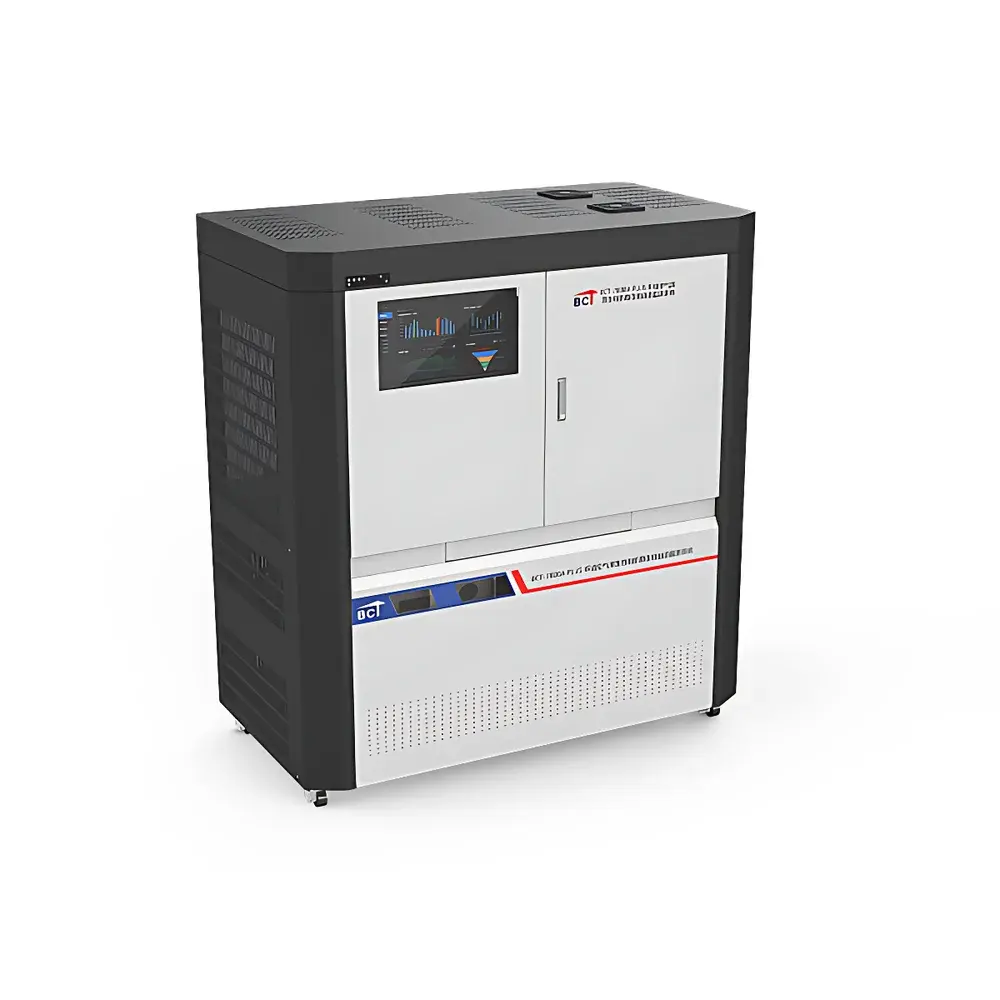
BCT-7800A PLUS Environmental Air VOCs Online Automated Monitoring System
| Brand | BCT |
|---|---|
| Origin | Beijing, China |
| Manufacturer Type | Original Equipment Manufacturer (OEM) |
| Product Category | Domestic Instrumentation |
| Model | 7800A PLUS |
| Pricing | Upon Request |
Overview
The BCT-7800A PLUS Environmental Air VOCs Online Automated Monitoring System is a fully integrated, laboratory-grade continuous emission monitoring system engineered for real-time, unattended quantification of volatile organic compounds (VOCs) in ambient air. It employs cryogen-free, electronically cooled multi-stage trap preconcentration coupled with dual-detector gas chromatography—comprising flame ionization detection (GC-FID) and optional mass spectrometry (GC-MS)—to deliver regulatory-compliant, high-fidelity data at sensitive locations including urban background sites, industrial fence-line perimeters, traffic intersections, and regional monitoring networks. The system operates on the principle of automated thermal desorption followed by capillary GC separation and selective detection, enabling trace-level analysis across C2–C12 hydrocarbons, oxygenated VOCs (e.g., aldehydes and ketones), and aromatic compounds in accordance with HJ 1010–2018—the Chinese national standard specifying performance requirements, verification protocols, and operational validation criteria for continuous VOCs monitoring systems.
Key Features
- Triple-stage electronic cooling trap architecture with independent focusing trap for enhanced desorption efficiency—critical for accurate quantification of high-boiling-point VOCs (e.g., C9–C12 aromatics and semi-volatiles)
- Single-path inlet configuration dedicated to C2–C4 light hydrocarbons, eliminating matrix interference and improving FID response reproducibility for ethane, ethene, propane, and propene
- Segmented temperature-controlled moisture removal system achieving >99.99% water removal efficiency without condensation-induced blockage—ensuring stability for polar, water-soluble carbonyls (e.g., formaldehyde, acetaldehyde, acetone)
- Valve-based sample isolation technology with CNC-controlled multi-position valve manifold—minimizing carryover, eliminating split losses, and supporting automated calibration (internal standard, certified gas standards, blank air)
- Inertized flow path from sampling inlet through trap to detector—reducing surface adsorption, memory effects, and baseline drift over extended run times
- No liquid nitrogen or mechanical cryo-coolers required—reducing failure points, power dependency, and lifecycle maintenance overhead
Sample Compatibility & Compliance
The BCT-7800A PLUS is validated for direct analysis of ambient air matrices without pre-filtration beyond standard particulate removal (e.g., 2.5 µm cyclonic or membrane filter). It supports two standardized analytical configurations: (1) 116-species EPA TO-15/TO-17-aligned VOC panel covering aliphatics, olefins, alkylbenzenes, and halogenated compounds; and (2) 57-species PAMs (Photochemical Assessment Monitoring Stations) target list aligned with U.S. EPA and EU Air Quality Directive frameworks. All hardware and software functions comply with HJ 1010–2018 technical specifications—including minimum detection limits (<0.1 ppbv for most C2–C6 species), precision (<5% RSD), and 72-hour unattended operation requirement. System logs, audit trails, and calibration records are structured to support GLP/GMP-aligned data integrity practices and are compatible with 21 CFR Part 11–ready LIMS integration when deployed with optional secure authentication modules.
Software & Data Management
The embedded control software provides ISO/IEC 17025–informed instrument supervision: real-time chromatogram visualization, automated peak integration using retention time locking and spectral deconvolution (for GC-MS option), and configurable alarm thresholds for rapid anomaly detection. Raw data files adhere to ASTM E1947-compliant formats (e.g., .CDF, .D), while processed reports export to CSV, PDF, and XML for ingestion into national air quality databases (e.g., CNEMC platform) or third-party environmental modeling tools. Audit trail functionality records all user actions, method changes, calibration events, and system errors with timestamp, operator ID, and IP address—meeting traceability requirements for regulatory submissions and internal QA/QC reviews.
Applications
- Real-time source attribution and plume tracking at industrial boundaries and landfill perimeter zones
- Long-term trend analysis of photochemical precursor concentrations (e.g., isoprene, terpenes, xylenes) in regional background monitoring networks
- Mobile lab deployment for hotspot screening near transportation corridors and logistics hubs
- Supporting health risk assessment studies requiring speciated VOC exposure profiles at residential proximity sites
- Validation and performance verification of low-cost sensor networks via reference-grade co-location measurements
FAQ
Does the system meet international equivalency standards such as EPA TO-15 or EN 14662?
Yes—the 116-species method is fully aligned with EPA Method TO-15 compound coverage and retention indexing; full EN 14662 compliance requires optional GC-MS configuration and certified calibration gases traceable to NIST SRMs.
What is the typical system uptime and mean time between failures (MTBF)?
Field deployments report >95% scheduled data capture rate over 12-month intervals; MTBF exceeds 8,000 hours under standard ambient conditions (10–35°C, <80% RH).
Can the system be integrated into existing SCADA or EMS platforms?
Yes—Modbus TCP and OPC UA interfaces are available as factory options; RESTful API support enables custom middleware integration for centralized telemetry aggregation.
Is remote diagnostics and firmware update capability supported?
Yes—secure SSH and TLS-encrypted web interface allow authenticated remote troubleshooting, method updates, and log retrieval without on-site technician dispatch.
What routine maintenance is required, and what is the recommended service interval?
Primary consumables include traps (12–18 months), GC columns (24+ months), and FID jet/nozzle (annually); full preventive maintenance is recommended every 6 months by BCT-certified field engineers.
Related Products







