
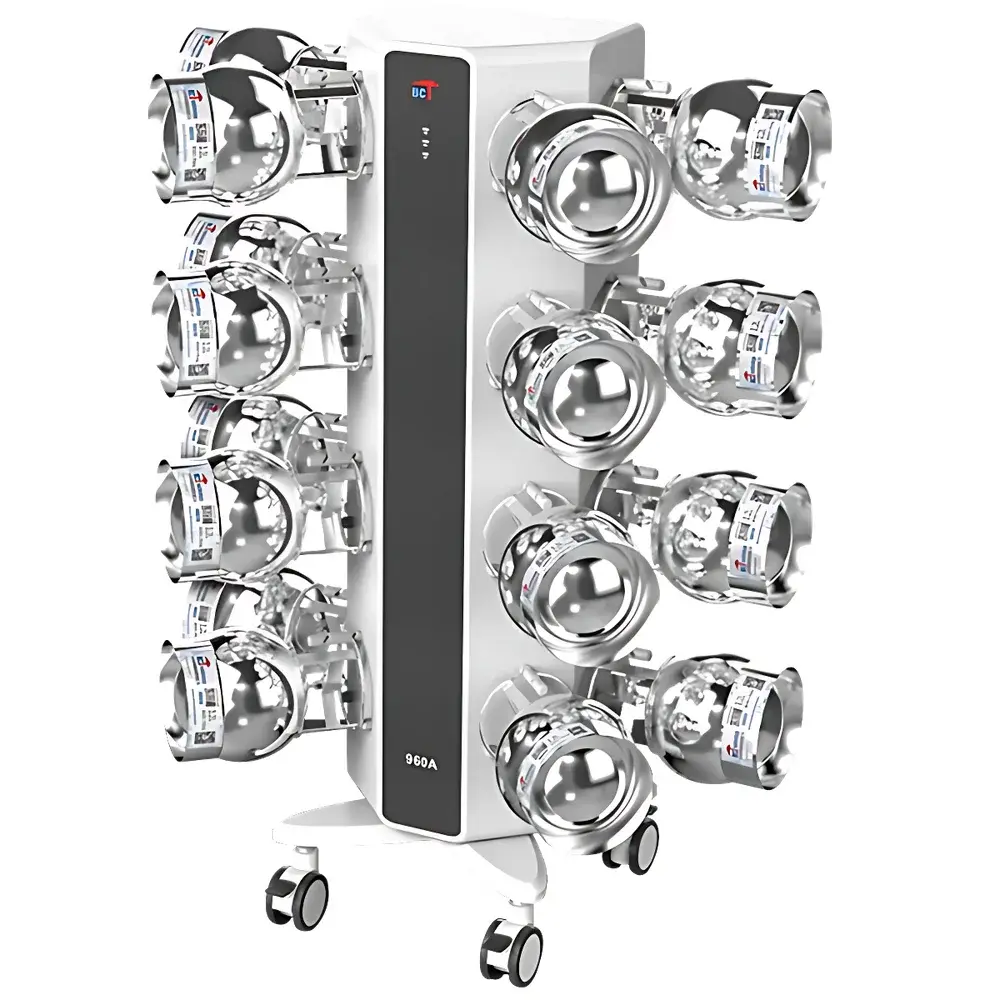
BCT 960A Multifunctional Autosampler for Gas Chromatography
| Brand | BCT |
|---|---|
| Origin | Beijing, China |
| Manufacturer Type | Direct Manufacturer |
| Product Category | Domestic Instrument |
| Model | 960A |
| Instrument Type | Multifunctional Autosampler |
| Sample Introduction Ports | 16-position |
| Compatible Sample Containers | Vacuum Sampling Canisters & Tedlar® Bags |
| Entire Gas Path Heating | Yes (Uniform Temperature Control) |
| Gas Path Surface Treatment | Fused Silica Inert Coating (Verified via Inertness Testing) |
| Multi-Position Injection Valve | Bidirectional Rotational Actuation |
| Flow Path Optimization | Minimized Contact Time Between Sample and Valve Core |
Overview
The BCT 960A Multifunctional Autosampler is an engineered solution for unattended, high-integrity sample introduction in gas chromatography (GC) and GC–mass spectrometry (GC–MS) workflows. Designed specifically for volatile organic compound (VOC) and semi-volatile organic compound (SVOC) analysis, it employs a fully heated, inert gas path architecture to preserve sample integrity from container to injector. Unlike conventional ambient-temperature or partially heated autosamplers, the 960A maintains uniform thermal control across all critical components—including transfer lines, switching valves, and internal manifolds—eliminating cold spots that promote condensation, adsorption, or recombination of reactive analytes. Its operational principle relies on precise pneumatic actuation and bidirectional rotational valve sequencing, enabling deterministic positioning and minimal dwell time between sample aspiration and injection. This architecture directly supports trace-level quantification in environmental monitoring, industrial hygiene, and regulatory compliance testing where recovery accuracy and carryover control are non-negotiable.
Key Features
- Fully heated gas path (up to 200 °C configurable), with independent temperature monitoring at multiple nodes to ensure thermal homogeneity and prevent analyte loss through condensation.
- 16-position sample introduction interface compatible with standard 6-L and 1-L evacuated stainless-steel canisters as well as 1–10 L Tedlar® bags—enabling direct headspace or pressurized transfer without intermediate dilution or transfer steps.
- Fused silica inert coating applied uniformly across all wetted surfaces (valve stators, rotor seals, capillary transfer lines), validated per EPA Method TO-15 inertness criteria using surrogate recovery tests (e.g., C₂–C₁₀ aldehydes, chlorinated benzenes, and sulfur compounds).
- Bidirectional multi-position injection valve with micro-stepped rotation ensures repeatable alignment to target ports within ±0.1° angular tolerance, reducing mechanical hysteresis and minimizing dead volume in the flow path.
- Integrated pressure regulation and leak-check routines compliant with ASTM D5504 and ISO 16000-6 protocols, supporting automated system integrity verification prior to each sequence.
- Modular design allows field-upgradable firmware and hardware options including electronic pressure control (EPC) integration and optional internal calibration gas manifold.
Sample Compatibility & Compliance
The 960A accommodates a defined range of standardized environmental sampling media: EPA-compliant SUMMA®-electropolished canisters (with certified passivation), certified Tedlar® film bags meeting ASTM D6196 specifications, and custom-fabricated fluoropolymer-lined containers. It operates within the analytical constraints of U.S. EPA Methods TO-14A, TO-15, and ASTM D6196 for ambient air VOC analysis, and supports method adaptation for ISO 16000-6 (indoor air) and EN 13670-1 (workplace air). All fluidic components meet USP Class VI biocompatibility requirements and are documented under a full material traceability system. The instrument’s control logic includes audit-trail-enabling event logging aligned with FDA 21 CFR Part 11 Annex 11 expectations for electronic records in regulated laboratories.
Software & Data Management
Controlled via BCT’s GC-Link™ software suite (v3.2+), the 960A supports both standalone operation and deep integration with major GC platforms (Agilent, Thermo Fisher, Shimadzu). Sequence definition includes customizable hold times, purge cycles, pressure ramp profiles, and multi-step injection protocols (e.g., splitless bake-out after each injection). Raw instrument logs—including valve actuation timestamps, heater setpoint deviations (>±2 °C), and pressure transducer readings—are exported in CSV/ASCII format with ISO 8601 timestamping. Software architecture incorporates role-based access control (RBAC), electronic signature capability, and automatic backup to network-attached storage (NAS) or cloud-synced repositories. All data handling conforms to GLP/GMP-aligned metadata tagging standards.
Applications
- Unattended analysis of ambient, indoor, and workplace air samples collected in canisters or Tedlar® bags for regulatory reporting (e.g., NAAQS, REACH, OSHA PELs).
- Method validation studies requiring low carryover (<0.05% for benzene, toluene, ethylbenzene, xylenes) and high recovery reproducibility (RSD <3% across 10 replicate injections).
- Multi-lab intercomparison programs where instrumental consistency—particularly in thermal management and surface inertness—is critical to interlaboratory agreement.
- Research applications involving thermally labile or highly polar VOCs (e.g., formaldehyde, acetaldehyde, hydrogen sulfide) where cold-zone artifacts must be eliminated.
- Automated calibration curve generation using dynamic spiking of primary standards into canister matrices, supported by programmable syringe-based dilution modules (optional).
FAQ
Does the 960A support quantitative analysis of reactive sulfur compounds such as H₂S and mercaptans?
Yes—its fused silica inert coating and zero-cold-spot thermal design have been verified for >95% recovery of H₂S, methanethiol, and dimethyl sulfide at sub-ppbv levels using TO-15-style canister sampling.
Can the 960A be integrated into an existing GC–MS system with third-party vendor software?
It provides native drivers for Agilent OpenLab CDS, Thermo Chromeleon, and Shimadzu GCMSsolution, and supports ASCII-based command protocol for custom integrations.
What maintenance intervals are recommended for the inert-coated valve and transfer lines?
Under typical environmental lab usage (≤40 samples/day), valve rotor seals require replacement every 12 months; fused silica lines are rated for ≥5 years of continuous operation when operated within specified temperature and pressure limits.
Is remote monitoring and diagnostic capability available?
Yes—via embedded Ethernet port with SNMP v3 support, enabling real-time status polling, predictive fault alerts, and secure firmware updates through enterprise IT infrastructure.






