
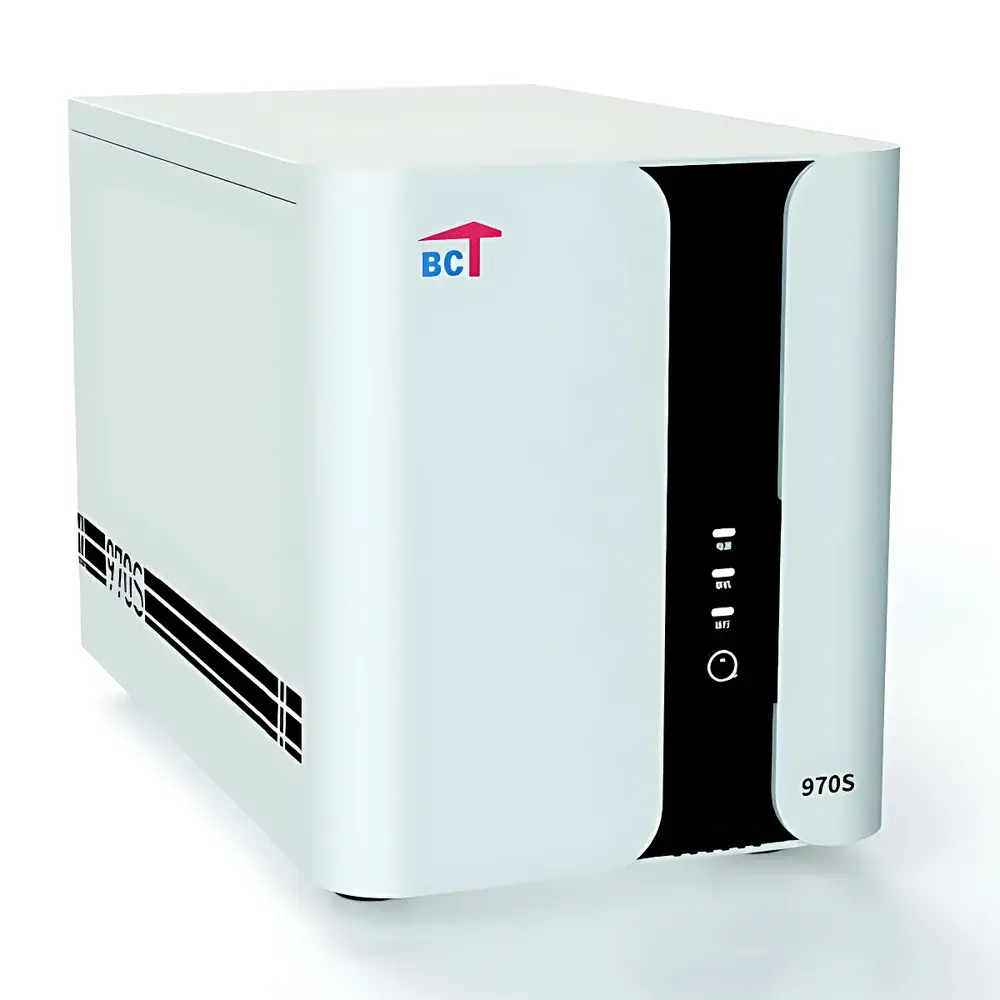
BCT 970S High-Precision Static Gas Dilution System
| Brand | BCT |
|---|---|
| Origin | Beijing, China |
| Manufacturer Type | Direct Manufacturer |
| Region Category | Domestic (China) |
| Model | 970S |
| Pricing | Available Upon Request |
Overview
The BCT 970S is a high-precision static gas dilution system engineered for trace-level calibration gas preparation in environmental air monitoring laboratories. Unlike dynamic dilution systems that rely on mass flow controllers (MFCs), the 970S employs a pressure-based static dilution methodology: certified reference gases, internal standards, and diluent gases (e.g., zero air or nitrogen) are sequentially introduced into electropolished, fused-silica-coated SUMMA®-type canisters under controlled pressure conditions. The final dilution ratio is calculated using the ideal gas law (P₁V₁ = P₂V₂), where absolute pressure measurements—performed with high-stability, temperature-compensated piezoresistive sensors—are used to determine molar concentration without dependence on gas composition or viscosity. This principle ensures metrological traceability, eliminates matrix-dependent errors common in MFC-based systems, and supports compliance with HJ 759–2023 (“Determination of 65 Volatile Organic Compounds in Ambient Air — Canister Sampling/GC-MS Method”) and ISO 6145-5:2017 (“Gas analysis — Preparation of calibration gas mixtures — Part 5: Dynamic volumetric methods”).
Key Features
- Fused-silica inert surface coating: Entire gas pathway—including valves, manifolds, mixing chambers, and canister interfaces—is uniformly coated with fused silica via chemical vapor deposition, minimizing adsorption/desorption hysteresis for reactive VOCs (e.g., aldehydes, sulfur compounds, halocarbons).
- 8 independent, dedicated dilution channels: Pre-configured for routine environmental standards including EPA TO-14/TO-15, PAMS, HJ 759–2023, HJ 1223–2021, ODS compounds, and multi-component internal standards (e.g., 4-component benzene/toluene/ethylbenzene/xylene blends), preventing cross-contamination between calibration matrices.
- Minimized internal volume design: Mixing chamber volume 60% versus conventional static dilutors, limiting analyte residence time and wall interaction.
- Full-path heated operation: All gas lines, valves, and canister interfaces maintain uniform temperature control (40–120 °C, ±0.5 °C) to prevent condensation and reduce memory effects from semi-volatile organics.
- Integrated reverse-purge capability: Programmable backflush sequence applies positive-pressure diluent gas in reverse flow direction across all channels, removing residual analytes prior to next calibration cycle—validated per ASTM D6196-22 Annex A3.
- Multi-stage dilution architecture: Supports sequential two-step dilution (e.g., primary dilution from cylinder to intermediate canister, secondary dilution to final working standard), extending dynamic range from parts-per-trillion (pptv) to parts-per-million (ppmv) without recalibration.
Sample Compatibility & Compliance
The 970S is validated for use with stainless-steel SUMMA® canisters (0.5–6 L), SilcoCan® variants, and custom-fused-silica-lined sampling vessels. It accommodates non-reactive and moderately reactive VOCs (C₂–C₁₂ aliphatics, aromatics, chlorinated solvents, oxygenates) and select inorganic gases (H₂S, SO₂, NH₃) when operated within specified temperature and humidity limits. System performance meets requirements for GLP-compliant calibration gas preparation under CNAS-CL01:2018 and supports audit readiness for ISO/IEC 17025:2017 accreditation. Pressure sensor calibration is NIST-traceable, and full system validation reports—including blank testing, repeatability (RSD 0.9999 over 10⁴ dilution range)—are provided with each unit.
Software & Data Management
The embedded control interface (Windows-based, touchscreen-compatible) enables method-driven operation with password-protected user roles, electronic logbook generation, and automatic metadata tagging (canister ID, pressure timestamps, ambient T/P, operator ID). Audit trails comply with FDA 21 CFR Part 11 requirements, including electronic signatures, immutable records, and change history. Export formats include CSV, PDF analytical reports, and XML for LIMS integration. Optional API support allows bidirectional communication with laboratory information management systems (LIMS) for automated worklist dispatch and result ingestion.
Applications
- Preparation of certified calibration standards for GC-MS, GC-FID, and PTR-TOF-MS analysis of ambient air VOCs
- Generation of tiered calibration curves per HJ 759–2023 and US EPA Method TO-15A
- Internal standard spiking for quantitative accuracy in canister-based field sampling programs
- Reference material verification and inter-laboratory comparison studies
- Method development and validation for emerging contaminants (e.g., fluorotelomer alcohols, unsaturated halocarbons)
FAQ
What pressure sensors are used, and what is their uncertainty specification?
The system integrates dual redundant absolute pressure transducers (0–200 psi range) with NIST-traceable calibration certificates; typical expanded uncertainty (k=2) is ±0.05% FS at 23 °C.
Can the 970S be integrated with existing LIMS or chromatography data systems?
Yes—via OPC UA or RESTful API, supporting automated method transfer, run logging, and calibration certificate export.
Is validation documentation included with shipment?
Each unit ships with Factory Acceptance Test (FAT) report, pressure sensor calibration certificates, inert surface coating verification (XPS data), and a full IQ/OQ protocol template aligned with ISO/IEC 17025.
Does the system support unattended overnight operation?
Yes—programmable scheduler enables batch processing of up to 24 canisters with auto-shutdown, leak-check sequencing, and real-time pressure drift monitoring.
What maintenance intervals are recommended for long-term accuracy?
Annual recalibration of pressure sensors and biannual inspection of fused-silica coating integrity (via helium leak test and blank analysis) are recommended per manufacturer guidelines.
Related Products







