
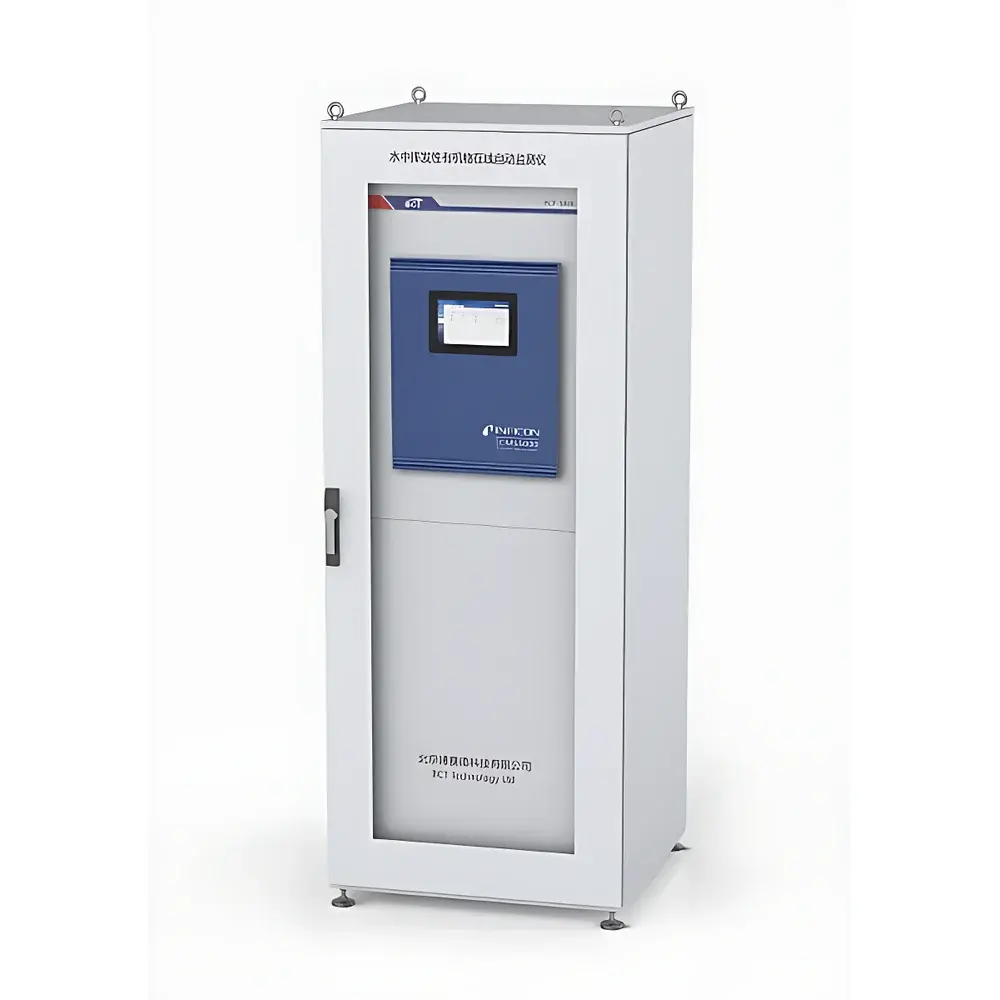
BCT BCT-5800 Online Automated Volatile Organic Compounds (VOCs) Monitor for Water
| Brand | BCT |
|---|---|
| Origin | Beijing, China |
| Manufacturer Type | Original Equipment Manufacturer (OEM) |
| Product Category | Domestic |
| Model | BCT-5800 |
| Pricing | Upon Request |
Overview
The BCT BCT-5800 Online Automated Volatile Organic Compounds (VOCs) Monitor for Water is a fully integrated, continuous water quality monitoring system engineered for real-time detection and quantification of volatile organic compounds in aqueous matrices. It operates on the principle of purge-and-trap gas chromatography coupled with a high-sensitivity Micro-Arc Ionization Detector (MAID), enabling trace-level analysis without offline sample preparation. The system autonomously manages sample introduction via a dedicated purge vessel, carrier gas delivery (helium or nitrogen), thermal desorption, capillary GC separation, and compound-specific detection. Designed for unattended operation in remote or semi-permanent installations—including drinking water intakes, wastewater discharge points, groundwater wells, and riverine monitoring stations—the BCT-5800 delivers regulatory-grade data continuity while meeting the functional requirements of long-term environmental surveillance programs.
Key Features
- Micro-Arc Ionization Detector (MAID): Offers sub-ppt (parts-per-quadrillion) detection limits for chlorinated hydrocarbons, BTEX (benzene, toluene, ethylbenzene, xylenes), trihalomethanes, and other priority VOCs per EPA Method 524.2 and ISO 10301.
- Automated Internal Standard Calibration: Integrated standard addition module performs periodic recalibration using deuterated surrogates (e.g., benzene-d6), ensuring measurement traceability and compliance with QA/QC protocols required under ISO/IEC 17025 and US EPA 40 CFR Part 136.
- Zero-Prep Sample Introduction: Direct aqueous injection eliminates filtration, preservation, or solvent extraction—reducing analytical bias and operator exposure risk.
- Multi-Trigger Operational Modes: Supports time-based, event-driven (e.g., flow rate or turbidity threshold), and remote command activation, enabling adaptive sampling strategies aligned with dynamic hydrological conditions.
- Embedded GC Method Library: Preloaded analytical methods compliant with ASTM D5795, ISO 15681-2, and China’s HJ 639–2012; user-editable retention time windows and integration parameters via secure web interface.
- Gas-Safe Architecture: Uses inert carrier gases only—no hydrogen or acetylene—eliminating explosion hazards in unmanned monitoring shelters or confined utility vaults.
- Low-Maintenance Mechanical Design: Solid-state valves, corrosion-resistant wetted materials (PFA, electropolished 316L SS), and sealed detector chamber minimize downtime and field service frequency.
Sample Compatibility & Compliance
The BCT-5800 accepts raw surface water, groundwater, treated effluent, and potable water without pretreatment. It maintains accuracy across pH 5–9, turbidity ≤ 100 NTU, and suspended solids ≤ 50 mg/L. System validation adheres to ISO 5667-3 for sampling representativeness and ISO 8466-1 for calibration linearity assessment. Data integrity conforms to FDA 21 CFR Part 11 requirements through electronic audit trails, role-based access control, and immutable result archiving. All firmware and software updates are version-controlled and documented per GLP principles.
Software & Data Management
The embedded Linux-based controller runs BCT Analytical Suite v4.x—a CE-marked, IEC 62443-compliant application supporting method scheduling, chromatogram review, peak identification (NIST MS library integration optional), and automated report generation (PDF/CSV). Raw data and metadata are timestamped, digitally signed, and transmitted via TLS 1.2-encrypted MQTT or Modbus TCP to central SCADA platforms or cloud-based LIMS. Remote diagnostics, firmware OTA updates, and alarm notifications (SMS/email) are configurable. Audit logs record all user actions, method changes, calibration events, and instrument status transitions for regulatory inspection readiness.
Applications
- Drinking water source protection: Early warning detection of fuel spills, industrial solvent leaks, or landfill leachate intrusion.
- Wastewater compliance verification: Continuous verification of VOC removal efficiency at municipal and industrial treatment plants.
- Groundwater plume tracking: Long-term trend analysis at remediation sites to assess natural attenuation or treatment performance.
- Transboundary water governance: Harmonized data collection across administrative boundaries to support joint water quality agreements and dispute resolution frameworks.
- Regulatory enforcement: Supporting national monitoring networks (e.g., China’s National Surface Water Quality Monitoring Network) and EU WFD Article 8 reporting obligations.
FAQ
What VOCs can the BCT-5800 reliably quantify at sub-ppt levels?
Benzene, chloroform, carbon tetrachloride, vinyl chloride, 1,2-dichloroethane, trichloroethylene, tetrachloroethylene, and other C2–C10 halogenated and aromatic compounds per EPA Method 524.2 validation criteria.
Does the system require daily manual intervention?
No—fully autonomous operation is supported for ≥30 days between maintenance cycles, including auto-zeroing, internal standard injection, and GC column bake-out routines.
Can historical chromatograms be retrieved and reprocessed?
Yes—raw detector signals and full GC method configurations are stored locally for ≥180 days and accessible via secure SFTP or HTTPS for retrospective analysis.
Is the BCT-5800 compatible with third-party SCADA systems?
Yes—Modbus TCP, OPC UA, and RESTful API interfaces enable bidirectional integration with Siemens Desigo, Honeywell Experion, or custom industrial IoT platforms.
How is calibration traceability maintained?
Through NIST-traceable certified reference materials (CRMs), documented calibration curves, and electronic records of every internal standard response factor update, satisfying ISO/IEC 17025 Clause 7.7 requirements.
Related Products







