
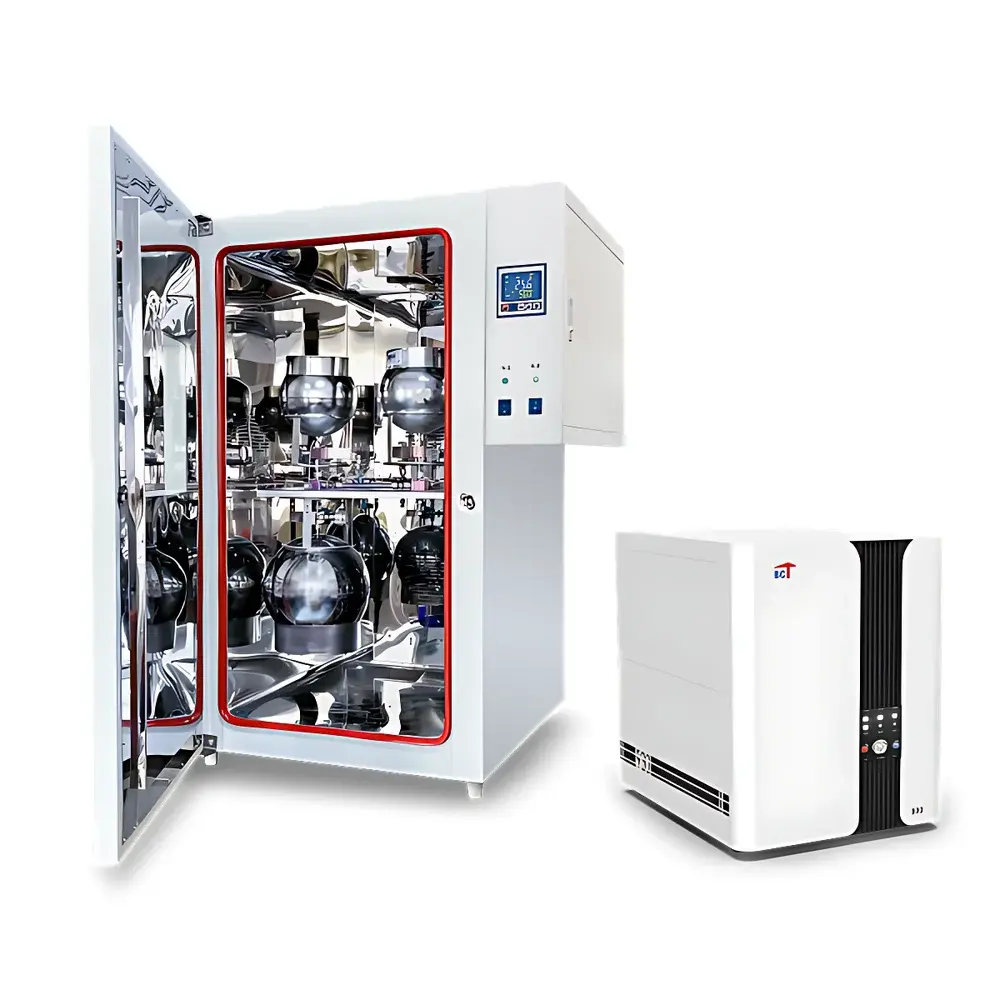
BCT BCT-930 Atmospheric Canister Cleaning System
| Brand | BCT |
|---|---|
| Origin | Beijing, China |
| Manufacturer Type | Original Equipment Manufacturer (OEM) |
| Country of Origin | China |
| Model | BCT-930 |
| Pricing | Available upon Request |
Overview
The BCT BCT-930 Atmospheric Canister Cleaning System is an engineered solution for the rigorous decontamination of electropolished stainless-steel sampling canisters—primarily SUMMA®-treated canisters—used in ambient air, indoor air, and emission source monitoring applications. Designed in accordance with EPA Method TO-14A, TO-15, and ASTM D6196, the system employs a high-fidelity vacuum-purge-refill protocol under precisely controlled thermal and humidity conditions to remove residual volatile organic compounds (VOCs), semi-volatile organic compounds (SVOCs), and reactive trace gases adsorbed on canister walls or trapped in dead volumes. Its core operational principle relies on repeated cycles of deep vacuum evacuation (down to ≤1 × 10⁻² mtorr), followed by inert gas (ultra-high-purity nitrogen or zero air) backfilling at regulated dew point and temperature, ensuring quantitative removal of analytes without introducing new contaminants.
Key Features
- Ultra-High Vacuum Performance: Achieves ultimate base pressure ≤1 × 10⁻² mtorr via a dual-stage vacuum architecture—comprising two externally mounted diaphragm pumps (for rough pumping and moisture trapping) and a high-speed turbomolecular pump (≥65,000 rpm) for rapid high-vacuum generation and sustained low-pressure stability.
- Thermally Uniform Heating: Integrated full-canister furnace provides homogeneous heating up to 120 °C (user-selectable), eliminating cold spots and minimizing condensation-induced re-adsorption during purge cycles.
- Dedicated Gas Pathways: Independent inlet and exhaust manifolds prevent cross-contamination between purge gas supply and effluent venting—critical for maintaining analytical integrity across sequential cleaning batches.
- Controlled Humidification: On-demand water vapor injection (dew point adjustable from −40 °C to +20 °C) enhances desorption efficiency for polar and water-soluble compounds (e.g., aldehydes, organic acids, ammonia), supporting method validation per EPA TO-15A Annex A.
- Modular Canister Interface: Quick-connect flange design (6 mm or 1/4″ VCR-compatible) enables tool-free attachment of standard 6-L, 3-L, and 1-L SUMMA canisters; accommodates both threaded and bayonet-style fittings.
- Embedded Safety Logic: Real-time pressure monitoring, overtemperature cutoff, leak detection alarm, and interlocked door safety switch comply with IEC 61010-1 requirements for laboratory electrical equipment.
Sample Compatibility & Compliance
The BCT-930 supports cleaning of all electropolished, silonized, or SUMMA-coated stainless-steel canisters used in EPA-compliant ambient air monitoring programs. It is validated for use with canisters meeting ASTM D5466 specifications and compatible with certified reference standards traceable to NIST SRMs. The system’s cleaning cycle parameters—including vacuum dwell time, purge gas flow rate (0–5 L/min), number of cycles (1–12), and temperature ramp profiles—are programmable and auditable, fulfilling documentation requirements for GLP and ISO/IEC 17025-accredited laboratories. All firmware logs—including timestamps, pressure curves, temperature setpoints, and operator ID—are exportable in CSV format for regulatory review.
Software & Data Management
The instrument is operated via a dedicated embedded touchscreen HMI running deterministic real-time firmware. Cycle configuration, execution history, and diagnostic data are stored locally with non-volatile memory retention (>10 years). Optional Ethernet or RS-232 connectivity enables integration into centralized lab information management systems (LIMS) and supports remote monitoring via Modbus TCP. Audit trail functionality records all parameter changes, user logins, and system events in compliance with FDA 21 CFR Part 11 requirements when paired with optional electronic signature modules and role-based access control.
Applications
- Pre-analysis conditioning of SUMMA canisters prior to VOC/TO-15 sampling campaigns
- Reconditioning of field-deployed canisters returning from multi-day ambient monitoring networks
- Validation of canister blank performance in method development and QA/QC protocols
- Supporting EPA Method TO-14A/TO-15 compliance audits and third-party accreditation assessments
- Research applications involving trace-level sulfur compound, carbonyl, or oxygenated VOC recovery studies
FAQ
What vacuum level does the BCT-930 achieve, and how is it verified?
The system achieves ≤1 × 10⁻² mtorr under clean, dry conditions using its integrated turbomolecular pump and calibrated capacitance manometer. Verification is performed via built-in sensor calibration routines traceable to NIST-certified reference standards.
Can the BCT-930 clean canisters used for sulfur-containing compounds like H₂S or mercaptans?
Yes—when operated with humidified nitrogen purge and elevated temperature (≥90 °C), the system demonstrates >95% recovery for reactive sulfur species, as confirmed by GC-PFPD and GC-SCD validation studies conducted per EPA Draft Method TO-11A.
Is the humidification system compatible with zero air as a purge medium?
Yes—both ultra-high-purity nitrogen and certified zero air (hydrocarbon-free, <0.1 ppb THC) may be humidified inline; dew point control remains stable across both gas types.
Does the BCT-930 support automated unattended operation?
Yes—up to 8 canisters may be processed sequentially using programmable batch mode; each cycle includes automatic pressure equalization, valve sequencing, and end-of-cycle notification via email or relay output.
What maintenance intervals are recommended for the vacuum system?
Diaphragm pump oil replacement every 6 months (or 2000 hours); turbomolecular pump bearing inspection every 24 months; inlet filter replacement every 3 months—documented in the included Preventive Maintenance Logbook.
Related Products



