
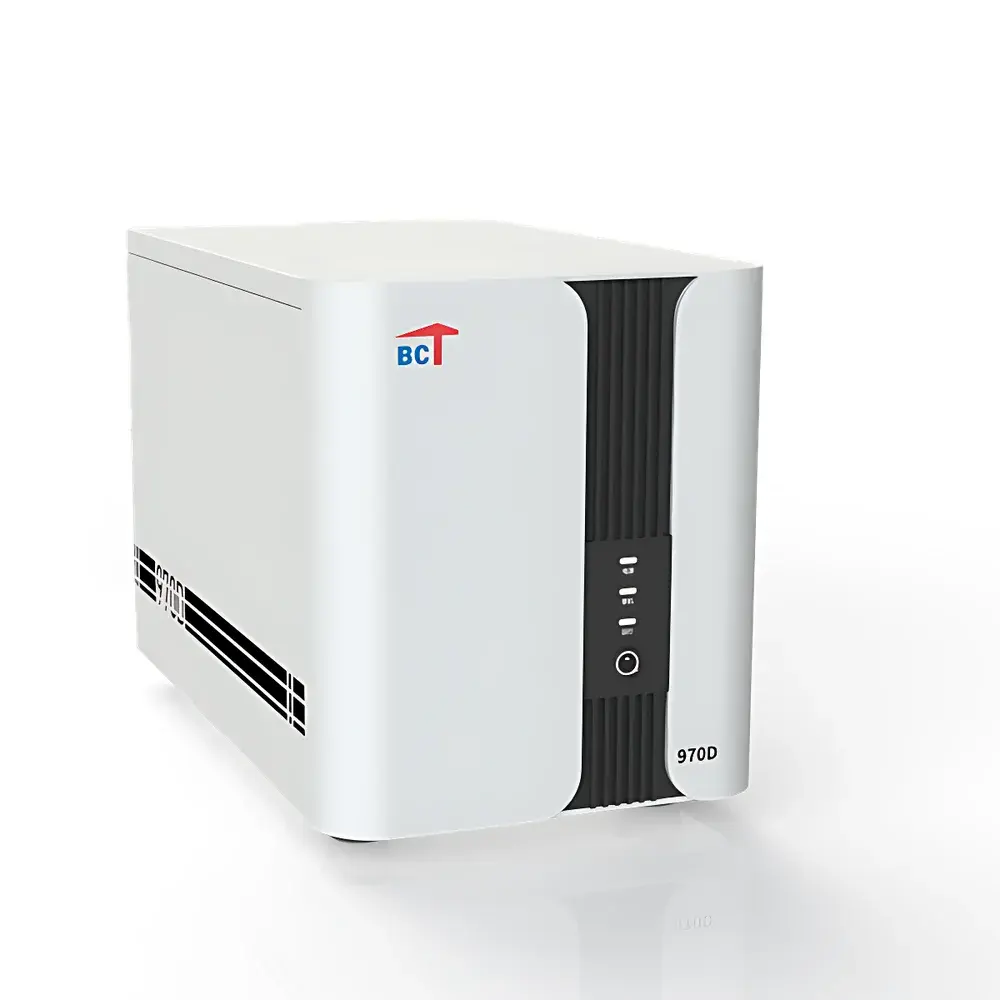
BCT BCT-970D Dynamic Gas Dilution System
| Brand | BCT |
|---|---|
| Origin | Beijing, China |
| Manufacturer Type | Original Equipment Manufacturer (OEM) |
| Product Origin | Domestic (China) |
| Model | BCT-970D |
| Pricing | Upon Request |
Overview
The BCT BCT-970D Dynamic Gas Dilution System is an engineered solution for high-accuracy, real-time dilution of calibration gases, reference standards, and complex gas samples—designed specifically for laboratories requiring trace-level stability, minimal adsorption artifacts, and regulatory-compliant operation. Unlike conventional static or mass-flow-based dilutors, the BCT-970D employs a true dynamic dilution principle grounded in critical flow (sonic nozzle) technology coupled with ultra-high-precision pressure sensing. This architecture eliminates reliance on thermal mass flow controllers (MFCs), which are inherently susceptible to surface adsorption, drift, and material incompatibility with reactive or polar analytes—including H₂S, COS, CH₃SH, CH₃SCH₃, CO, CO₂, and CH₄. By removing MFCs and storage vessels entirely, the system avoids stagnation-related memory effects and long equilibration delays associated with permeation tubes or pressurized cylinders. The entire gas pathway—from inlet to outlet—is constructed and internally coated with fused silica, providing exceptional chemical inertness and minimizing analyte retention across the full operational range.
Key Features
- Fused-silica inertized flow path: All wetted surfaces—including valves, manifolds, nozzles, and transfer lines—are fully fused-silica coated, ensuring ultra-low adsorption for sulfur-containing compounds, aldehydes, halogenated organics, and other reactive species.
- Sonic nozzle–based flow control: Utilizes calibrated critical-flow orifices operating under choked-flow conditions, delivering stable, temperature- and pressure-independent volumetric flow rates traceable to NIST standards.
- High-resolution pressure metrology: Integrated piezoresistive pressure transducers (±0.02% FS accuracy) enable real-time feedback control of dilution ratios without MFC recalibration or zero-drift compensation.
- Rapid dynamic equilibrium: Achieves stable output concentration within 5–30 minutes after initiation—significantly faster than diffusion-based or permeation-tube systems requiring hours or days to stabilize.
- Wide dilution range: Standard configuration supports continuous dilution factors from 2× to 5,000×, adjustable via software-controlled valve sequencing and pressure setpoint modulation.
- Zero storage requirement: Operates in true “gas-through” mode—no intermediate cylinders, bags, or canisters—reducing contamination risk, cylinder logistics, and residual gas disposal burden.
Sample Compatibility & Compliance
The BCT-970D is validated for use with both permanent gases and highly reactive trace analytes, including but not limited to hydrogen sulfide (H₂S), carbonyl sulfide (COS), methyl mercaptan (CH₃SH), dimethyl sulfide (CH₃SCH₃), carbon monoxide (CO), carbon dioxide (CO₂), methane (CH₄), formaldehyde (HCHO), and volatile organic halides. Its fused-silica architecture meets material compatibility requirements outlined in ISO 16000-6, ASTM D6196, and USP for inert gas handling systems. The instrument supports compliance workflows aligned with GB/T 44243–2024 (Determination of sulfur compounds, formaldehyde, and organic halides in hydrogen for PEM fuel cell vehicles by gas chromatography), as well as EPA Method TO-15 and ISO 16017–1 for VOC analysis. Full audit trail logging, user access control, and electronic signature support are available when integrated with compliant LIMS or chromatography data systems (CDS) meeting FDA 21 CFR Part 11 and EU Annex 11 requirements.
Software & Data Management
The BCT-970D is operated via a dedicated Windows-based control interface supporting intuitive dilution ratio setup, real-time pressure/flow monitoring, method storage, and automated sequence execution. All operational parameters—including inlet pressure, dilution stage pressures, valve status, and elapsed stabilization time—are timestamped and logged at configurable intervals (1 Hz default). Raw data exports to CSV or XML formats for integration into ELN platforms or statistical process control (SPC) tools. Optional OPC UA server module enables seamless connectivity to SCADA, MES, or centralized laboratory informatics infrastructure. Firmware updates maintain alignment with evolving metrological best practices and cybersecurity standards (IEC 62443 Level 1).
Applications
The system serves as a primary dilution standard in environmental air quality monitoring labs performing ambient VOC and odorant profiling; in fuel cell R&D facilities calibrating hydrogen purity analyzers per ISO 14687 and SAE J2719; in semiconductor fab QC labs generating ppq-level dopant standards; in national metrology institutes establishing primary gas mixtures for SI-traceable calibration; and in pharmaceutical stability testing labs preparing low-concentration challenge gases for residual solvent validation (ICH Q5C). It is also deployed in food safety labs analyzing off-flavor compounds (e.g., methanethiol in dairy), fragrance development labs quantifying threshold odorants, and third-party testing organizations accredited to ISO/IEC 17025 conducting proficiency testing for gas analysis.
FAQ
Does the BCT-970D require periodic recalibration of its pressure sensors?
Yes—pressure transducers are certified to ISO/IEC 17025-accredited calibration intervals of 12 months; field verification using deadweight testers or NIST-traceable pressure standards is recommended quarterly.
Can the system be integrated with GC or GC-MS autosamplers?
Yes—via digital I/O or Modbus TCP, enabling synchronized start/stop triggers and concentration metadata injection into CDS acquisition logs.
Is fused-silica coating applied to all internal components, including solenoid valves?
Valve bodies are stainless steel with fused-silica-lined internal passages; seat materials are PTFE-encapsulated perfluoroelastomer (FFKM) for broad chemical resistance.
What is the maximum allowable inlet pressure for the BCT-970D?
Standard configuration accepts up to 1.0 MPa (10 bar) absolute inlet pressure; high-pressure variants (up to 20 MPa) are available upon request.
Does the system support GLP/GMP audit trails out of the box?
Audit trail functionality—including user login history, parameter change logs, and electronic signatures—is enabled via optional GxP compliance firmware package compliant with 21 CFR Part 11 Subpart B.







