
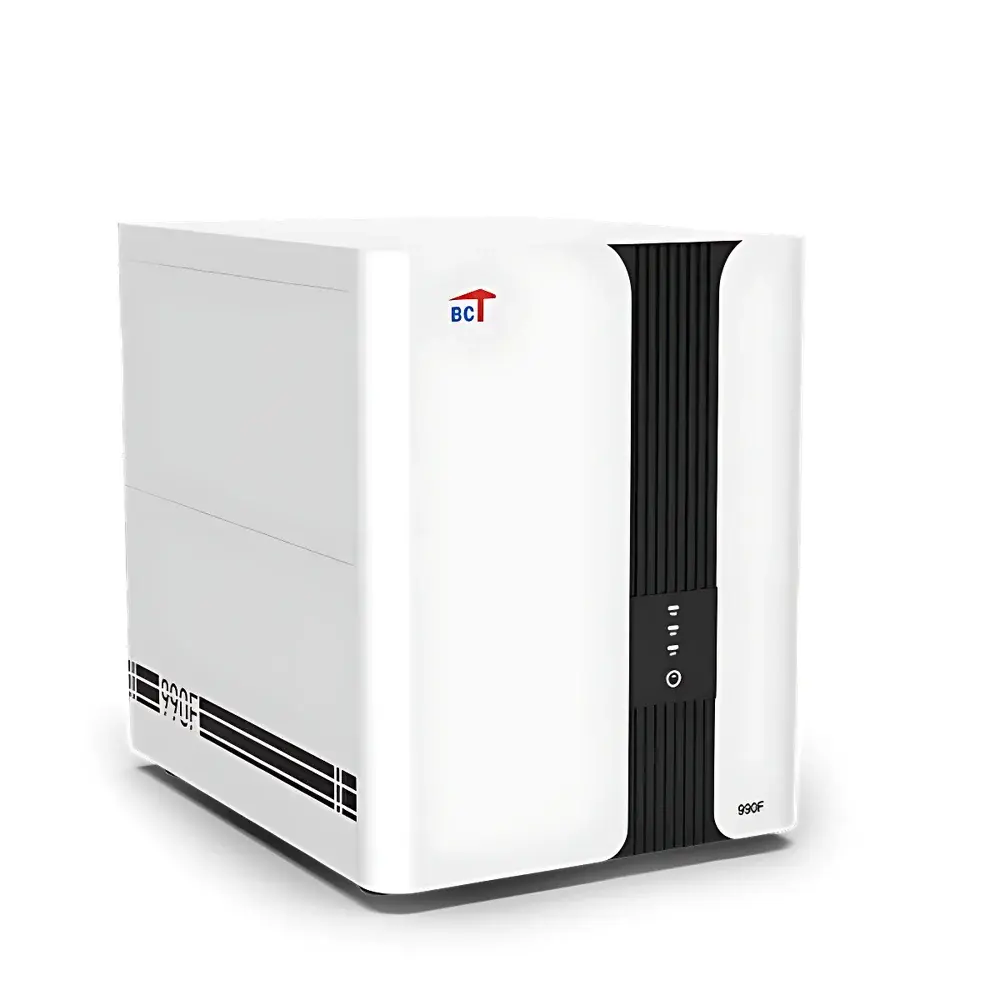
BCT BCT-990F High-Precision Fluorinated Greenhouse Gas Pre-concentrator
| Brand | BCT |
|---|---|
| Origin | Beijing, China |
| Manufacturer Type | Original Equipment Manufacturer (OEM) |
| Product Category | Domestic |
| Model | BCT-990F |
| Pricing | Available Upon Request |
Overview
The BCT BCT-990F High-Precision Fluorinated Greenhouse Gas Pre-concentrator is a cryogen-free, laboratory-grade atmospheric pre-concentration system engineered specifically for the quantitative analysis of fluorinated greenhouse gases (F-GHGs) and ozone-depleting substances (ODS). It operates on the principle of multi-stage cryogenic trapping and thermal desorption, enabling selective enrichment of trace-level analytes from large-volume air samples prior to gas chromatographic separation and detection (e.g., GC-ECD, GC-MS/MS). Designed in full alignment with the Chinese standard HJ 1292–2023 (“Technical Specification for Manual Monitoring of Ozone-Depleting Substances and Fluorinated Greenhouse Gases in Ambient Air”), the system delivers robust performance for regulatory monitoring, emission source attribution, and atmospheric chemistry research—particularly where ultra-low detection limits (sub-pptv), high reproducibility, and long-term operational stability are required.
Key Features
- Quaternary cryo-trapping architecture: Four independently controlled cold traps—comprising hydrocarbon removal, CO2 scrubbing, inert gas bypass, and analyte focusing stages—ensure selective retention of 37+ target F-GHGs including CF4, NF3, C2F6, C3F8, SF6, HFC-134a, HFC-125, PFCs, and halons, while rejecting common interferences.
- Dual-canister volumetric metering: Precision-engineered stainless-steel sampling loops and pressure-compensated flow control enable accurate sample introduction across a wide volume range—from 5 mL to 3,000 mL—with ≤±1.5% volumetric repeatability under ambient temperature and pressure conditions.
- Cryogen-free operation: Utilizes closed-cycle Stirling coolers (−160 °C minimum trap temperature) eliminating reliance on liquid nitrogen or dry ice—reducing operational cost, logistical complexity, and safety hazards associated with cryogen handling.
- Contamination-resilient design: Minimal internal surface area, electropolished stainless-steel flow paths, and low-outgassing seals minimize adsorption artifacts and carryover. Integrated bake-out capability (up to 120 °C) supports routine decontamination between analyses.
- Intelligent valve sequencing: CNC-controlled high-purity pneumatic valves isolate traps during standby, prevent cross-contamination during regeneration cycles, and ensure strict temporal separation between sample loading, trapping, and desorption phases.
Sample Compatibility & Compliance
The BCT-990F accepts uncompressed ambient air, canister-collected whole-air samples (Summa, SilcoCan, or TO-15-compliant), and continuous stack or duct effluent streams (with optional flow conditioning). It is validated for use with EPA Method TO-15A, ISO 16000-22, and HJ 1292–2023. All wetted materials comply with ASTM F2238 (inertness classification) and USP Class VI standards. System validation documentation—including blank testing, spike recovery (≥85–115% for all target compounds), and method detection limit (MDL) verification per EPA 40 CFR Part 136—is provided with each unit to support GLP/GMP-aligned data integrity requirements.
Software & Data Management
Controlled via BCT’s proprietary Windows-based PreConc Suite v3.2, the system supports fully automated method programming, real-time pressure/temperature logging, and audit-trail-enabled operation compliant with FDA 21 CFR Part 11 (electronic signatures, user access levels, change history). Raw acquisition data (trap temperatures, valve actuation timestamps, pressure profiles) are exported in ASCII-compatible .csv format; metadata conforms to MIQE and FAIR data principles. Optional integration with LIMS platforms (via OPC UA or HL7) enables seamless workflow handoff to downstream GC data systems.
Applications
- Long-term background monitoring at WMO-GAW stations and national atmospheric observatories
- Urban and industrial boundary-layer profiling for F-GHG emission quantification (e.g., semiconductor manufacturing, aluminum smelting, refrigerant reclamation)
- Verification of national inventories under UNFCCC reporting frameworks (e.g., CRF, NIR)
- Source apportionment studies using isotopic or compound-specific fingerprinting
- Method development and reference material certification in metrology laboratories
FAQ
What is the lowest detectable concentration achievable with the BCT-990F?
Detection limits are method-dependent but typically reach 0.02–0.05 pptv (on-column) for key F-GHGs such as CF4 and SF6 when coupled with GC-ECD or GC-MS/MS.
Does the system require liquid nitrogen or other cryogens?
No—operation relies exclusively on integrated Stirling coolers; no external cryogen supply is needed.
Can the BCT-990F be integrated with existing GC systems from Agilent, Thermo Fisher, or Shimadzu?
Yes—standard 1/8″ VCR inlet/outlet fittings and TTL/RS-232 trigger interfaces ensure plug-and-play compatibility with all major GC platforms.
Is remote monitoring and diagnostics supported?
Yes—PreConc Suite includes secure web-based remote access (HTTPS/TLS), live status dashboards, and predictive maintenance alerts based on cooler runtime and valve cycle statistics.
What regulatory documentation is included for audit readiness?
Each unit ships with Factory Acceptance Test (FAT) report, IQ/OQ protocols, calibration certificates traceable to NIM (China National Institute of Metrology), and a complete 21 CFR Part 11 compliance package.



