
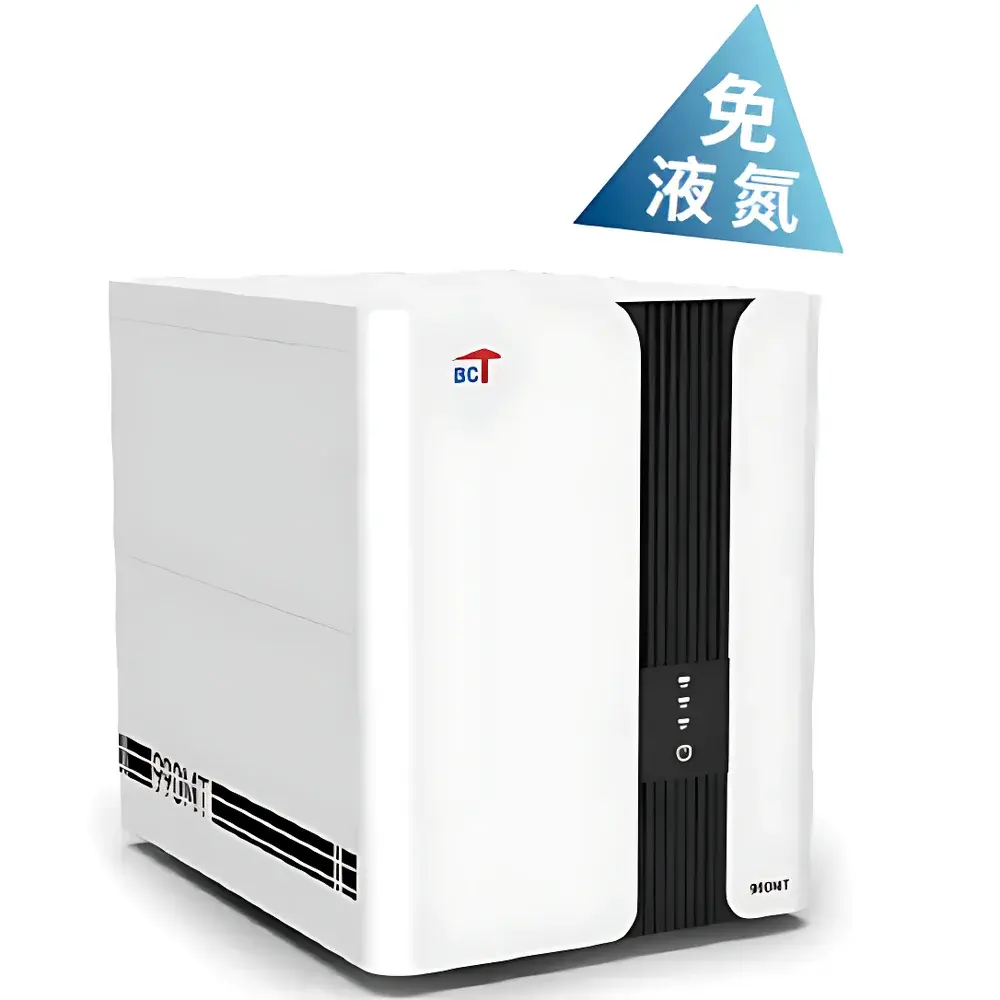
BCT BCT 990MT Atmospheric Pre-concentrator (Cryogen-Free)
| Brand | BCT |
|---|---|
| Origin | Beijing, China |
| Manufacturer Type | Direct Manufacturer |
| Regional Classification | Domestic (China) |
| Model | BCT 990MT |
| Pricing | Upon Request |
Overview
The BCT BCT 990MT Atmospheric Pre-concentrator is a cryogen-free, electronically cooled three-stage trap system engineered for high-fidelity pre-concentration of volatile and semi-volatile organic compounds (VOCs and SVOCs) from ambient air or gas-phase samples. It operates on the principle of cryogenic trapping followed by rapid thermal desorption, enabling quantitative enrichment of analytes ranging from C2 to C20, including polar species (e.g., aldehydes, ketones, organic acids), non-polar hydrocarbons (e.g., BTEX, n-alkanes), and reactive sulfur- and nitrogen-containing compounds (e.g., H2S, CS2, NO2, amines). Unlike liquid nitrogen–dependent systems, the BCT 990MT employs solid-state thermoelectric cooling to achieve trap temperatures as low as –160 °C, eliminating logistical constraints, safety hazards, and operational variability associated with cryogenic consumables. The instrument is designed for seamless integration with gas chromatography–mass spectrometry (GC–MS) or GC–flame ionization detection (GC–FID) platforms, delivering full-spectrum VOC analysis in a single injection—with detection limits routinely sub-part-per-trillion (pptv) in air.
Key Features
- Cryogen-free operation using proprietary multi-stage thermoelectric cooling—no liquid nitrogen, LN2 dewars, or associated infrastructure required.
- Three-stage cold trap architecture: primary (coarse) trap for water/CO2/N2 removal, secondary (analyte) trap for broad-spectrum VOC capture, and tertiary (focusing) trap for narrow-band thermal desorption into the GC inlet.
- Pressure-based dual-canister metering technology: replaces conventional mass flow controllers (MFCs) with absolute pressure transducers and temperature-compensated volume calculation—ensuring metrological accuracy independent of sample matrix, humidity, or trace gas composition.
- Wide dynamic sampling range: 5–1000 mL per analysis, validated across both high-concentration (e.g., industrial stack emissions) and ultra-low-concentration (e.g., ambient background monitoring) applications.
- High-speed, adaptive flow control: programmable capture flow rates from 150 mL/min; typical 300 mL sampling completed in <3 minutes with <±1.5% volumetric repeatability (n=10).
- Splitless focusing trap: dedicated third-stage trap operates independently during desorption—eliminating分流 losses and maximizing transfer efficiency to the GC column.
Sample Compatibility & Compliance
The BCT 990MT accommodates gaseous matrices including ambient air, indoor air, workplace breathing zone samples, landfill/soil gas, and industrial process streams. Its inert stainless-steel and SilcoNert®-coated flow path ensures minimal adsorption or catalytic degradation of labile compounds (e.g., formaldehyde, hydrogen sulfide, nitric oxide). The system meets design requirements for EPA Method TO-14A, TO-15, and ASTM D5504 (for reduced sulfur compounds); supports compliance with ISO 16000-6 (indoor air VOC measurement) and EU Directive 2008/50/EC (ambient air quality assessment). Instrument firmware includes audit-trail logging and user-access controls aligned with GLP and 21 CFR Part 11 readiness—supporting electronic signatures, data integrity verification, and change history retention.
Software & Data Management
Controlled via BCT’s Windows-based PC software (v3.2+), the system provides intuitive method setup, real-time pressure/temperature monitoring, and automated calibration sequence execution. All acquisition parameters—including trap temperatures, desorption ramp profiles, valve timing, and flow setpoints—are stored with timestamped metadata in a relational SQLite database. Raw data export is supported in CSV and .CDF (NetCDF-compatible) formats for LIMS integration. Software includes built-in QC checks: automatic leak detection (via pressure decay test), trap performance validation (using certified permeation standards), and post-run diagnostic reporting.
Applications
- Ambient and urban air quality monitoring networks (EPA SLAMS, EEA AirBase)
- Indoor air quality (IAQ) assessments in commercial buildings, schools, and healthcare facilities
- Occupational exposure monitoring per OSHA ID-255 and NIOSH 1501/1600 series methods
- Soil vapor intrusion (SVI) investigations and landfill gas characterization
- Method development and validation for emerging contaminants (e.g., fluorotelomer alcohols, halogenated benzenes)
- Reference laboratory support for proficiency testing and inter-laboratory comparison studies
FAQ
Does the BCT 990MT require liquid nitrogen or other cryogens for operation?
No—this system uses solid-state thermoelectric cooling exclusively; no cryogenic liquids, gases, or compressors are needed.
How does pressure-based metering improve accuracy over traditional MFCs?
Pressure-volume-temperature (PVT) calculation eliminates flow dependency on gas composition, viscosity, or thermal conductivity—critical for variable-matrix samples such as humid air or biogas.
Can the instrument handle high-humidity samples without ice formation?
Yes—the first-stage trap actively removes water vapor at –30 °C prior to deep-cold trapping, and optional heated sample lines suppress condensation upstream.
Is the system compatible with autosamplers and unattended operation?
It supports RS-232, Ethernet, and TTL I/O interfaces for synchronization with third-party autosamplers and central lab automation systems.
What maintenance is required for long-term reliability?
Annual verification of trap integrity, pressure sensor calibration, and valve actuation cycle testing—documented in the included PM checklist and supported by remote diagnostics.



