
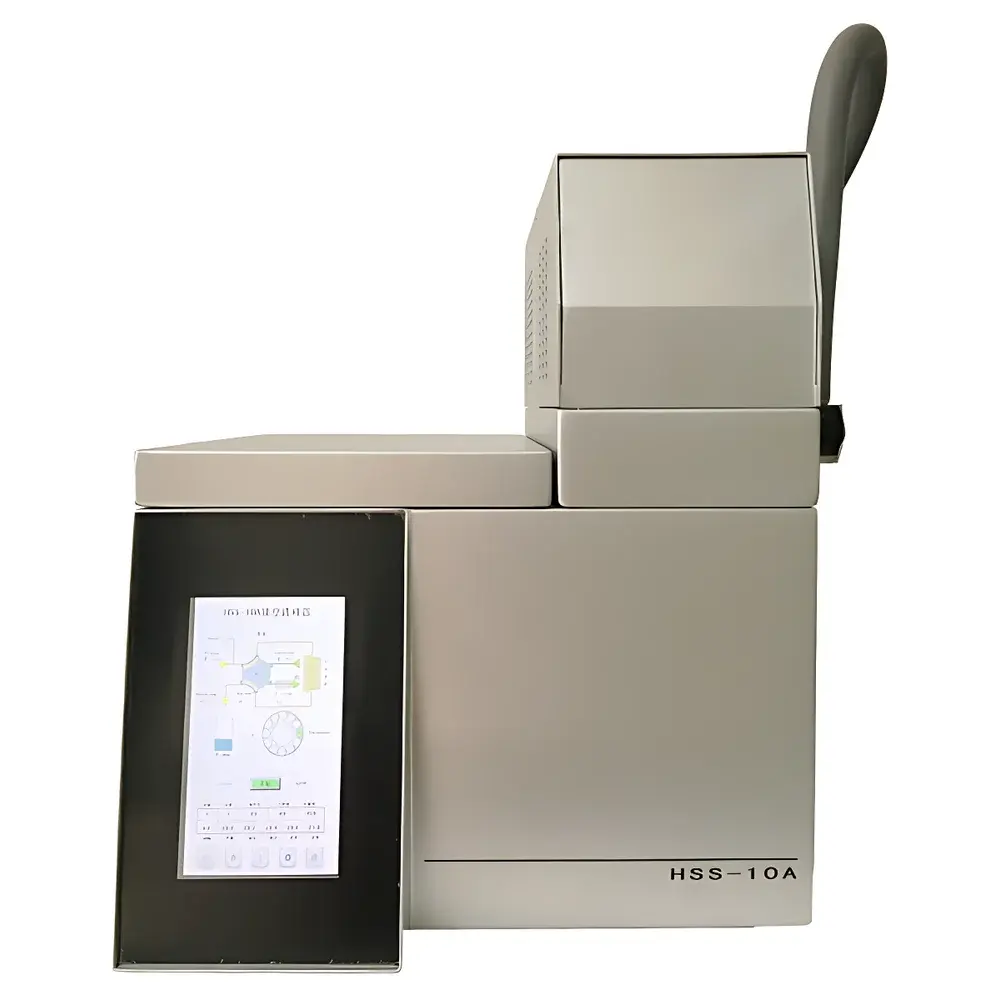
BCT HSS-10A Automated Static Headspace Sampler
| Brand | BCT |
|---|---|
| Origin | Beijing, China |
| Manufacturer Type | Original Equipment Manufacturer (OEM) |
| Instrument Type | Static Headspace Sampler |
| Automation Level | Fully Automatic |
| Oven Temperature Range | Ambient to 225 °C |
| Valve & Transfer Line Temperature Range | Ambient to 225 °C |
| Sample Loop Volume | 1 mL |
| Sample Position Capacity | 12 positions |
| Vial Sizes Supported | 10 mL and 20 mL vials |
Overview
The BCT HSS-10A is a fully automated static headspace sampler engineered for precise, reproducible, and unattended volatile organic compound (VOC) extraction from solid, liquid, or semi-solid matrices prior to gas chromatographic analysis. It operates on the principle of equilibrium static headspace sampling: samples are sealed in crimp-top vials and heated to a user-defined temperature, allowing VOCs to partition into the vapor phase above the sample (the “headspace”). Once thermal and phase equilibrium is achieved, the instrument pressurizes the vial and transfers a fixed volume (1 mL) of headspace gas—via a thermostatted six-port valve and inertized quantitative loop—directly into the GC injection port using carrier gas. Unlike syringe-based systems, the HSS-10A maintains the entire sample path—including vial, transfer line, valve, and loop—at precisely controlled elevated temperatures, eliminating condensation, adsorption losses, and bias toward high- or low-boiling analytes. This design ensures representative sampling across a broad volatility range (C2–C20+), supporting compliance with pharmacopeial methods (e.g., USP , EP 2.4.24) and environmental standards (EPA Method 502.2, 8260D).
Key Features
- Fully automated 12-position carousel with programmable sequence execution and overnight operation capability
- Independent, high-stability temperature control for sample oven, valve block, and transfer line (±0.1 °C), minimizing cold spots and analyte loss
- Inertized flow path (silco-treated stainless steel and fused silica components) to suppress adsorption, carryover, and catalytic degradation of reactive VOCs
- Integrated pressure regulation with ±0.1 kPa precision for consistent vial pressurization and loop filling across all vials
- Intelligent sample overlap scheduling: system calculates optimal vial loading timing based on GC run time and user-defined equilibration duration, maximizing throughput without compromising equilibrium integrity
- Automated leak detection and one-touch purge/clean cycle—no manual intervention or procedural expertise required
- 7-inch color touchscreen interface with intuitive workflow navigation, real-time status monitoring, and diagnostic tools for valve timing, heater performance, and pressure validation
- Support for up to 10 independent method templates, each storing full temperature ramp profiles, timing parameters, and GC trigger logic
Sample Compatibility & Compliance
The HSS-10A accommodates standard 10 mL and 20 mL crimp-cap headspace vials, compatible with widely adopted septa (e.g., PTFE/silicone) and sealing protocols. Its robust thermal management and inert flow path enable reliable analysis of diverse matrices—including pharmaceutical formulations, polymer extracts, wastewater, soil slurries, food emulsions, and forensic evidence—without matrix-induced bias. The instrument meets essential requirements for GLP and GMP environments: audit-trail-capable method storage, parameter locking, and operational logs support 21 CFR Part 11 readiness when paired with compliant LIMS or GC software. It is routinely validated per ICH Q2(R2) guidelines for headspace method robustness, precision, and linearity in residual solvent testing.
Software & Data Management
The embedded firmware provides full local control via the touchscreen interface; no PC dependency is required for routine operation. All methods—including equilibration time, oven ramp rates, valve actuation delays, and GC start triggers—are stored internally with timestamps and user IDs. Exportable CSV logs capture every analytical event: vial position, actual temperatures, pressure readings, loop fill success/failure, and GC synchronization status. For enterprise integration, RS-232 and Ethernet ports support bidirectional communication with third-party GC and CDS platforms (Agilent OpenLab, Thermo Chromeleon, Shimadzu GCsolution), enabling centralized scheduling, remote diagnostics, and electronic record archiving aligned with ALCOA+ principles.
Applications
- Residual solvent quantification in APIs and finished drug products (ICH Q3C)
- VOC profiling in drinking water, leachates, and industrial effluents (EPA 524.4, 8260D)
- Flavor and fragrance compound analysis in beverages and dairy products
- Off-gassing evaluation of packaging materials and automotive interior components
- Environmental forensics: BTEX, chlorinated solvents, and petroleum hydrocarbons in soil and sediment
- Quality control of adhesives, coatings, and composite resins where monomer or catalyst residues must be monitored
FAQ
Does the HSS-10A support dynamic headspace (purge-and-trap) mode?
No—the HSS-10A is designed exclusively for static headspace analysis. It does not include a purge gas manifold, trap, or thermal desorption module.
Can it be used with GC-MS systems?
Yes—its carrier-gas-driven transfer mechanism and timing-synchronization protocol are fully compatible with all major GC-MS platforms, including those requiring splitless or cold-on-column injection modes.
What maintenance is required to sustain long-term accuracy?
Routine maintenance includes quarterly verification of oven and valve temperature calibration, annual replacement of septa and O-rings, and biannual cleaning of the quantitative loop using certified solvent protocols provided in the service manual.
Is method transfer from other headspace samplers straightforward?
Yes—equilibration time, vial temperature, pressurization pressure, and loop fill time are directly translatable; minor optimization of GC trigger delay may be needed depending on column dimensions and carrier gas velocity.
How is data integrity ensured during unattended runs?
Each run generates a timestamped log file with checksum-verified entries for all critical parameters; failed steps (e.g., temperature deviation >±0.5 °C, pressure fault) automatically halt the sequence and flag the vial position for review.
Related Products





