
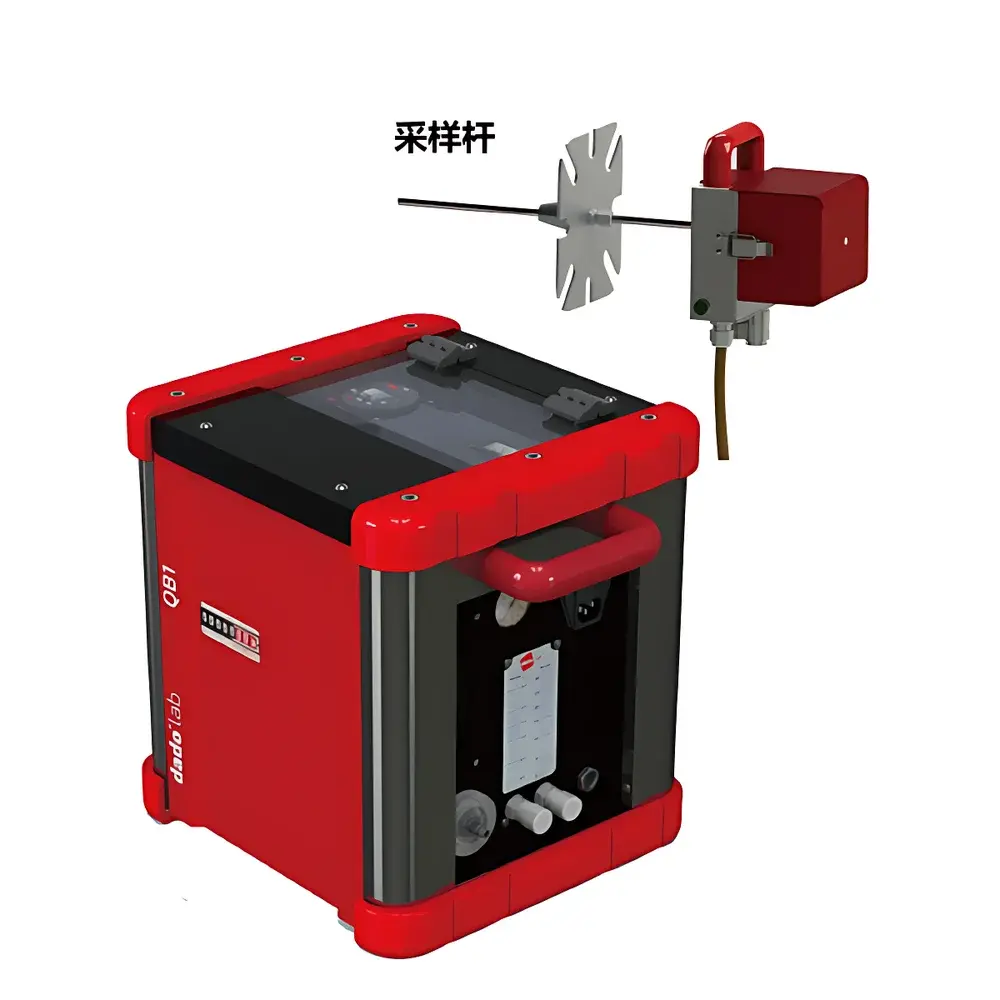
BCT QB-D Dilution Sampler
| Brand | BCT |
|---|---|
| Origin | Italy |
| Manufacturer Type | Manufacturer |
| Origin Category | Imported |
| Model | BCT QB-D |
| Instrument Type | Flue Gas Sampler |
| Sample Type | Flue Gas |
| Flow Accuracy | ±0.1% |
| Sampling Flow Rate | 5 mL/s |
| Flue Gas Velocity | 1 m/s |
| Moisture Content | 5% |
Overview
The BCT QB-D Dilution Sampler is an engineered solution for representative, low-bias sampling of volatile organic compounds (VOCs) from hot, humid flue gas streams in industrial emission monitoring applications. It operates on the principle of controlled isokinetic dilution—introducing a precise, clean dilution gas (typically nitrogen or zero air) directly into the probe tip to reduce the concentration and thermodynamic load of the raw flue gas prior to transport. This single-tube dilution architecture eliminates the need for dual-line systems (separate sample and dilution gas lines), minimizing pressure drop, condensation risk, and adsorptive losses. By diluting the sample 3× or 4× at the point of capture, the QB-D effectively lowers the dew point and absolute temperature of the transported stream—thereby preventing water condensation in transfer lines and sorbent tubes, suppressing thermal desorption artifacts, and preserving labile VOCs such as aldehydes, ketones, and light aromatics.
Key Features
- Single-tube integrated dilution design: Eliminates complex dual-line routing, reducing installation footprint, calibration burden, and potential for flow mismatch.
- High-precision mass flow control: Achieves ±0.1% flow accuracy across the nominal sampling flow rate of 5 mL/s, ensuring stoichiometric dilution ratio repeatability.
- Isokinetic-capable probe configuration: Optimized for flue gas velocities up to 1 m/s, supporting compliance with EN 13649-1 and ISO 16000-6 for representative sampling under dynamic stack conditions.
- Passive thermal management: Dilution-induced cooling reduces line temperature without active heating or cooling elements—lowering power demand and eliminating cold-trap formation.
- Material compatibility: Probe and internal wetted surfaces constructed from inert, low-adsorption materials (e.g., electropolished stainless steel and PTFE-lined components) to minimize VOC retention and memory effects.
- Modular probe integration: Designed for direct coupling with standard BCT sampling rods or third-party isokinetic probes compliant with ASTM D6348 and EPA Method 18 interfaces.
Sample Compatibility & Compliance
The QB-D is validated for continuous or integrated sampling of VOCs—including benzene, toluene, ethylbenzene, xylenes (BTEX), formaldehyde, acetaldehyde, and chlorinated solvents—from combustion exhaust, incinerator stacks, and process ducts containing up to 5% moisture by volume. Its dilution strategy aligns with the technical rationale outlined in EPA Draft Method TO-17A (2022) for mitigating breakthrough and hydrolysis during sorbent tube sampling. The system supports regulatory workflows requiring adherence to ISO 16000-6 (indoor air), EN 13649-1 (stationary source emissions), and EU IED (Industrial Emissions Directive) Annex VI monitoring protocols. All flow control components are traceably calibrated to NIST-traceable standards, and the unit is suitable for GLP-compliant laboratories conducting method validation per ISO/IEC 17025.
Software & Data Management
While the QB-D operates as a hardware-integrated passive sampler without embedded firmware, it is fully compatible with industry-standard data acquisition systems (e.g., Campbell Scientific CR series, Siemens Desigo CC, or custom SCADA platforms) via analog 4–20 mA or digital RS-485 outputs for real-time flow and dilution ratio logging. Optional BCT DataBridge module provides timestamped audit trails, automatic dilution factor tagging, and CSV export aligned with FDA 21 CFR Part 11 requirements—including electronic signatures, user access logs, and immutable record storage. All calibration certificates and system verification reports are archived in PDF/A-1b format for long-term regulatory retention.
Applications
- Continuous emission monitoring (CEM) of VOCs from waste-to-energy plants and cement kilns.
- Source testing for compliance with local air quality permits (e.g., U.S. State Implementation Plans, German TA Luft).
- Method development and validation studies for sorbent tube-based GC–MS analysis of polar and semi-volatile organics.
- Field deployment in mobile labs where space, power, and maintenance logistics constrain traditional heated-line systems.
- Research on VOC speciation in biomass combustion and catalytic converter efficiency testing.
FAQ
What dilution ratios does the QB-D support?
The QB-D is factory-configured for fixed 3:1 or 4:1 dilution ratios; custom ratios between 2:1 and 5:1 are available upon request and require recalibration.
Can the QB-D be used with thermal desorption (TD) autosamplers?
Yes—its stable, low-moisture output stream is compatible with mainstream TD units (e.g., Markes UNITY-xr, Gerstel CIS) without pre-drying or cryofocusing, provided the sorbent tube is rated for the diluted flow rate and VOC concentration range.
Does the QB-D require external heating or cooling?
No—its design relies on adiabatic dilution cooling; no active temperature control is needed for typical stack temperatures ≤200 °C and moisture ≤5%.
How is flow accuracy verified in the field?
Users perform periodic verification using a NIST-traceable primary standard (e.g., dry calibrator or bubble meter) at the probe outlet under simulated isokinetic conditions; full calibration is recommended annually or after mechanical servicing.
Is the QB-D compatible with EPA Method 18?
Yes—the system satisfies the “representative sampling” and “minimized adsorption loss” criteria of Method 18 when deployed with a certified isokinetic probe and documented dilution ratio traceability.







