
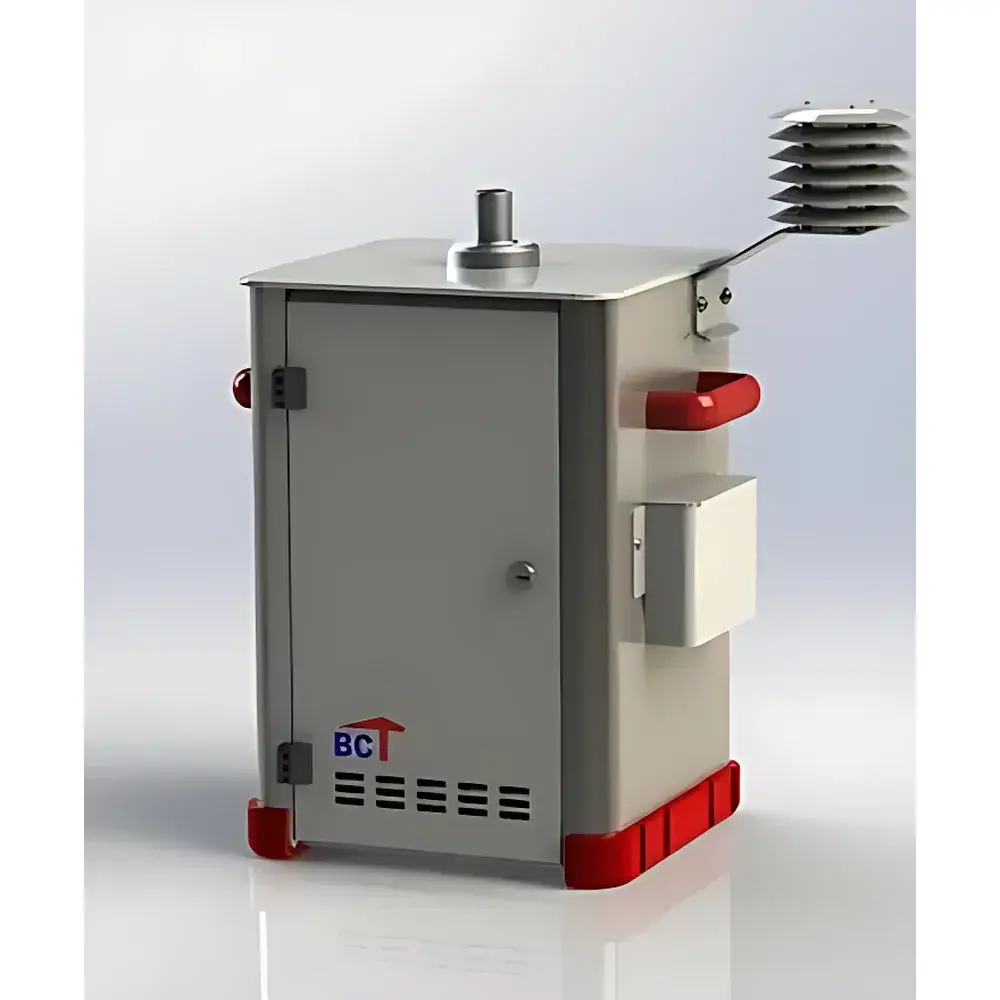
BCT SF HV Organic Pollutant PUF Sampler
| Brand | BCT |
|---|---|
| Origin | Italy |
| Manufacturer Type | Manufacturer |
| Origin Category | Imported |
| Model | BCT SF PU |
| Instrument Type | Flue Gas and Particulate Sampler |
| Target Analytes | Heavy Metals, Polycyclic Aromatic Hydrocarbons (PAHs), Polychlorinated Dibenzo-p-dioxins and Dibenzofurans (PCDD/PCDF) |
| Flow Accuracy | ±1% |
| Sampling Flow Rate | 4.5–8.5 m³/h |
| Flue Gas Velocity Range | 100–500 L/min |
| Moisture Content Tolerance | 10% |
Overview
The BCT SF HV Organic Pollutant PUF Sampler is a high-precision, field-deployable flue gas and ambient air sampling system engineered for the quantitative collection of semi-volatile organic compounds (SVOCs) and trace inorganic species—including heavy metals, polycyclic aromatic hydrocarbons (PAHs), and PCDD/PCDF congeners—on polyurethane foam (PUF) sorbent media and inert particulate filters. Designed in strict compliance with EN 12341:2014 for ambient particulate matter monitoring and aligned with ISO 16362, EPA Method TO-9, and ISO 12884 for integrated gas–particle phase sampling, the instrument employs a differential pressure-controlled orifice plate flow metering architecture—eliminating reliance on dry gas meters (DGM)—to achieve rapid dynamic response and metrological stability across variable backpressure conditions typical of high-efficiency filter and PUF cartridge configurations.
Key Features
- Orifice-based flow control system delivering ±1% volumetric accuracy over the full operational range (4.5–8.5 m³/h), independent of ambient temperature and humidity fluctuations up to 10% moisture content.
- Modular sampling head compatibility: supports EN-LVS (PM10/PM2.5/PM1) and U.S. EPA-designated inlet geometries without mechanical recalibration.
- Chemically inert filtration assembly: POM (polyoxymethylene) housing eliminates leachable metal contamination; stainless-steel mesh substrates coated with PTFE prevent analyte–substrate interactions during extended-duration SVOC capture.
- Tool-free filter access: bottom-mounted extraction mechanism enables safe, glove-compatible handling of 150 mm or 100 mm diameter membranes and PUF cartridges under GLP-compliant field conditions.
- Expandable sensor integration: optional wind speed and direction transducers synchronize meteorological metadata with time-stamped sampling logs for regulatory-grade environmental correlation analysis.
- High-flow capability: configurable with brushless DC fan modules enabling sustained operation at 100–500 L/min—validated for radiometric isotope quantification (e.g., 210Pb, 7Be) and large-volume stack emission profiling per ISO 16362 Annex C.
Sample Compatibility & Compliance
The BCT SF HV sampler is validated for co-sampling of particulate-bound and gaseous-phase pollutants using standardized multi-stage configurations. For PM10/PM2.5 fractionation, it interfaces with EN-LVS impactor heads and certified glass fiber or quartz filters. For organic pollutant enrichment, it accommodates 102 mm membrane filters paired with 100 mm PUF plugs in tandem arrangements compliant with EPA TO-9 and ISO 12884 protocols. All wetted components meet EU RoHS Directive 2011/65/EU and are free of cadmium, lead, mercury, and hexavalent chromium. The system supports audit-ready documentation aligned with ISO/IEC 17025:2017 laboratory accreditation requirements and facilitates traceability under FDA 21 CFR Part 11 when integrated with validated data logging firmware.
Software & Data Management
Onboard microcontroller firmware records real-time flow rate, elapsed sampling time, cumulative volume, pressure differentials across filter/PUF stages, and optional meteorological inputs. Data are stored in CSV-formatted files with UTC timestamps and checksum validation. USB-C interface enables direct export to LIMS platforms or third-party QA/QC software such as QI Analyst or EPA’s AirData Toolkit. Firmware updates maintain backward compatibility with legacy calibration certificates and support user-defined sampling sequences—including multi-point flow ramping and duty-cycled operation—for method flexibility in long-term monitoring networks.
Applications
- Regulatory compliance monitoring of dioxin/furan emissions from municipal waste incinerators and metallurgical facilities per EU Directive 2010/75/EU (IED).
- Atmospheric deposition studies targeting PAH speciation and heavy metal bioavailability in urban and industrial receptor zones.
- Source apportionment campaigns integrating isotopic tracer analysis (e.g., 206Pb/207Pb ratios) with concurrent organic pollutant profiling.
- Method development and inter-laboratory comparison exercises under ILAC G19:2014 guidelines for SVOC reference materials.
- Stack testing for hazardous air pollutants (HAPs) in accordance with EPA Methods 0010, 0020, and 0030 where high-volume, low-pressure-drop sampling is required.
FAQ
Does the BCT SF HV comply with EN 12341:2014 for PM2.5 monitoring?
Yes—the system achieves full conformance when operated with certified EN-LVS PM2.5 sampling heads and calibrated at 2.3 m³/h nominal flow, with documented uncertainty budgets traceable to national metrology institutes.
Can the sampler be used for simultaneous particle and vapor-phase PAH collection?
Yes—using the 102 mm filter + 100 mm PUF configuration per ISO 12884, it maintains stable flow partitioning between stages across the 200 L/min operating point.
Is PTFE coating applied to all internal metal surfaces?
No—only the stainless-steel filter support mesh receives electropolished PTFE coating; structural components are passivated 316L stainless steel or POM polymer to minimize catalytic degradation of labile organics.
What is the maximum allowable stack moisture content during operation?
The system is rated for continuous use at ≤10% volumetric moisture content; condensation management requires optional heated inlet lines or Nafion™ dryers for higher-humidity applications.
Are calibration certificates provided with each unit?
Each instrument ships with a factory-issued flow calibration certificate (ISO/IEC 17025-accredited), including orifice discharge coefficient, pressure tap locations, and uncertainty budget at three flow points (4.5, 6.5, and 8.5 m³/h).







