
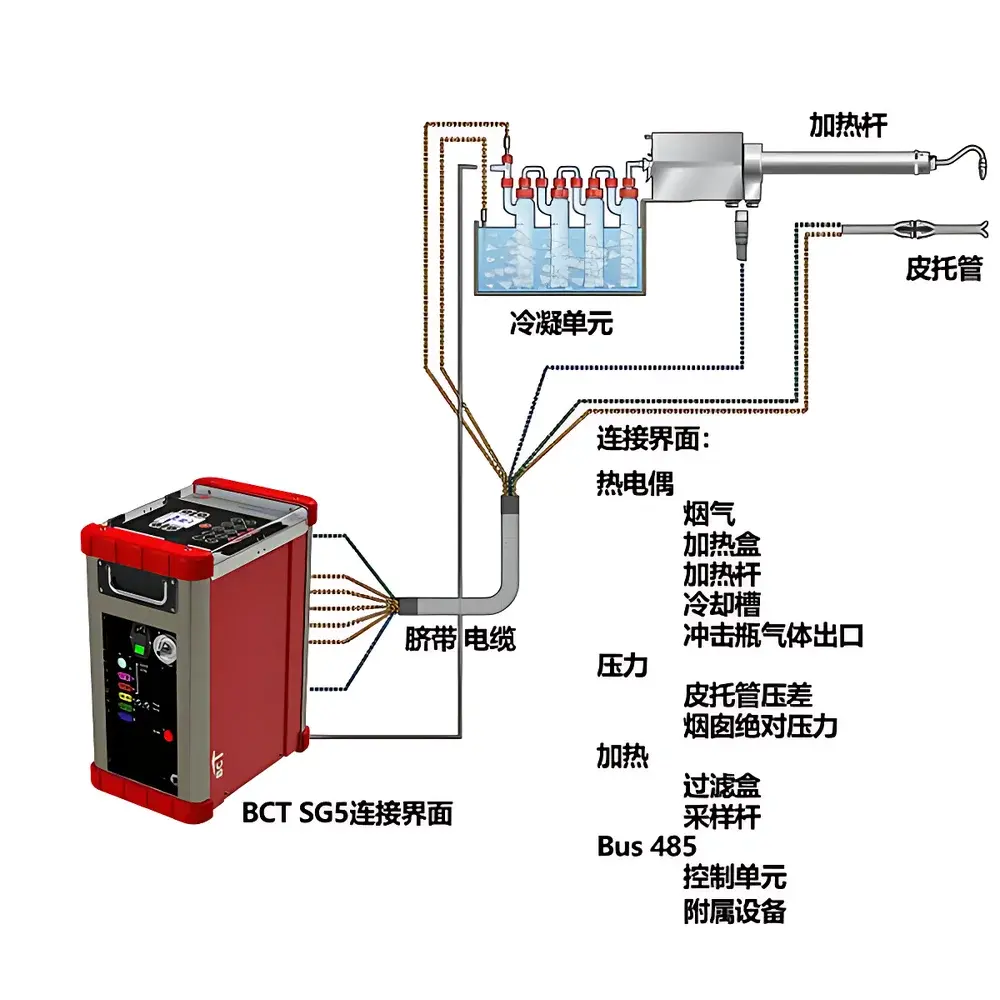
BCT SG5 Automatic Isokinetic Sampler
| Brand | BCT |
|---|---|
| Origin | Italy |
| Manufacturer Type | Manufacturer |
| Origin Category | Imported |
| Model | BCT SG5 |
| Instrument Type | Flue Gas and Particulate Sampler |
| Sample Type | Flue Gas |
| Flow Accuracy | ±2% |
| Sampling Flow Rate | 5–60 L/min |
| Flue Gas Velocity Range | 0.4–6.0 m³/h |
| Moisture Content Detection Limit | 0.1% |
Overview
The BCT SG5 Automatic Isokinetic Sampler is an engineered solution for regulatory-compliant, high-fidelity flue gas and particulate sampling in industrial emission monitoring applications. Designed in accordance with the physical principle of isokinetic sampling—where the linear velocity of sampled gas at the probe inlet matches the undisturbed flue gas velocity—the SG5 ensures representative collection of both gaseous pollutants (e.g., HCl, Hg⁰/Hg²⁺) and solid-phase constituents (e.g., PM₁₀, PM₂.₅, fly ash, PCDD/Fs, heavy metals). This velocity-matching requirement is mandated by international standards including EN 15295, ISO 16911-1, and EPA Method 5/17/23/26A, where deviation beyond ±10% introduces significant bias in mass concentration data. The SG5 achieves real-time isokinetic control via a built-in thermal mass flow meter (±2% full-scale accuracy), coupled with dynamic pressure and temperature sensing, enabling continuous closed-loop adjustment of sampling flow rate across variable stack conditions.
Key Features
- Real-time isokinetic control: Integrated thermal mass flow sensor and Pitot-static probe enable automatic flow modulation to maintain velocity matching within ±5% across the full operational range (0.4–6.0 m³/h).
- Ruggedized field architecture: All-metal housing (IP54 rated), reinforced internal manifold, and shock-absorbing mounting interface ensure mechanical stability during prolonged deployment on vibrating stacks or rooftops.
- Condensate protection system: Embedded moisture sensor continuously monitors internal dew point; upon detection of condensate formation (>0.1% v/v), the system triggers automatic flow diversion and alerts the operator—preventing liquid ingress into critical sensors and pumps.
- Thermal drift-compensated pressure measurement: High-stability piezoresistive pressure transducers with active temperature compensation deliver long-term zero stability (<0.02% FS/°C) under ambient fluctuations from –10°C to +50°C.
- Electromagnetic resilience: Next-generation PCB layout with multi-stage filtering, shielded signal paths, and conformal coating meets IEC 61000-4-3 (radiated immunity) and IEC 61000-4-4 (electrical fast transient) requirements for use near VFDs, SCR systems, and induction furnaces.
Sample Compatibility & Compliance
The SG5 supports standardized sampling trains per EN 15295 (dioxins/furans), UNI EN 1611-1 (heavy metals), ISO 16911-1 (isokinetic performance verification), and EPA Methods 5 (particulates), 23 (PCDD/Fs), 26A (HCl), and 101A (mercury). It interfaces seamlessly with certified glassware (e.g., quartz filter holders, impingers with KCl/H₂O/H₂SO₄ solutions) and sorbent tubes (e.g., XAD-2, activated carbon, gold-coated quartz). All flow and pressure calibration certificates are traceable to national metrology institutes (e.g., INRIM, NPL). The device complies with GLP data integrity requirements through time-stamped audit logs and non-volatile memory retention of all raw sensor outputs.
Software & Data Management
The embedded firmware supports dual-mode operation: standalone field mode (with backlit LCD and tactile keypad) and PC-connected mode via USB-C or optional Wi-Fi module. The companion software (SG5 Control Suite v3.2) provides stack parameter library management—storing up to 200 unique chimney geometries, thermocouple placements, and historical velocity profiles. All sampling sessions generate ISO/IEC 17025-compliant CSV reports containing timestamped flow, ΔP, T, RH, and moisture status. Audit trails meet FDA 21 CFR Part 11 requirements with electronic signatures, role-based access control, and immutable event logging.
Applications
- Continuous compliance monitoring for waste-to-energy plants, cement kilns, and coal-fired boilers under EU IED Directive and U.S. NSPS Subpart Ea.
- Source testing campaigns targeting ultra-trace analytes: PCDD/Fs (sub-pg/Nm³), elemental mercury (sub-ng/m³), and Cr/Ni/Pb/Cd speciation in fly ash.
- Method validation studies requiring repeatable isokinetic capture efficiency across varying load conditions (e.g., ramp-up/down, soot-blowing events).
- Research-grade emission factor development for emerging pollutants (e.g., PFAS precursors, brominated dioxins) where sample representativeness directly impacts risk assessment outcomes.
FAQ
What standards does the SG5 comply with for dioxin sampling?
The SG5 is configured to meet EN 15295 and UNI EN 1611-1 requirements when used with the MCS2 sampling train, including mandatory isokinetic verification, blank control protocols, and chain-of-custody documentation.
Can the SG5 operate unattended for extended periods?
Yes—fully autonomous operation is supported for up to 72 hours with external power and conditioned probe heating; all critical parameters are logged at 1-second intervals and buffered locally.
How does the moisture sensor prevent instrument damage?
The capacitive moisture sensor detects condensate accumulation in the sampling line pre-filter; upon threshold exceedance (≥0.1% v/v), the system isolates the main flow path and activates purge air to evacuate residual liquid before resuming sampling.
Is calibration traceable to national standards?
All factory calibrations for flow, pressure, and temperature sensors are performed using NIST-traceable reference instruments, with certificates issued per ISO/IEC 17025:2017 Annex A.
What maintenance intervals are recommended for field deployment?
Routine inspection every 200 operating hours includes filter replacement, O-ring integrity check, and flow verification against a primary standard; annual recalibration is advised for regulatory reporting applications.
Related Products







