
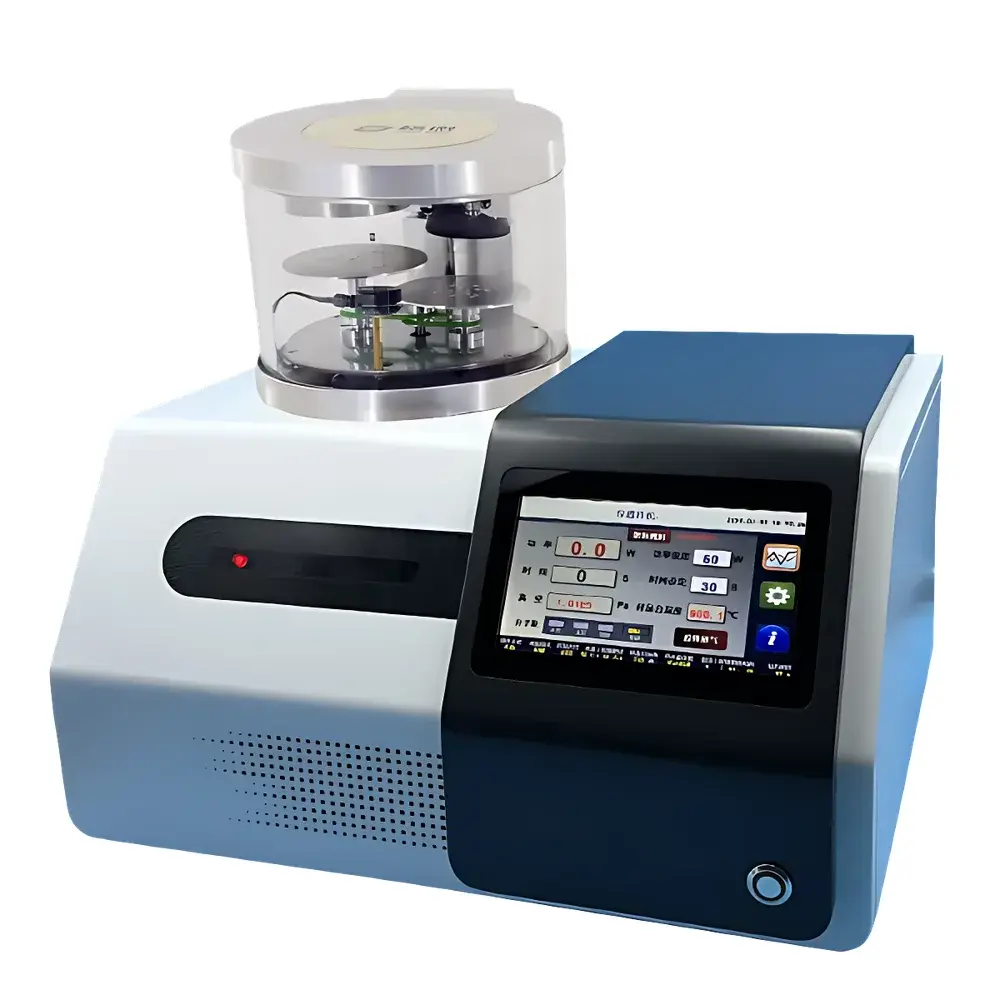
Beam Convergence GVC5000T High-Vacuum Multi-Function Coater
| Brand | Beam Convergence |
|---|---|
| Origin | Beijing, China |
| Manufacturer Type | Direct Manufacturer |
| Model | GVC5000T |
| Dimensions | 480(L)×390(D)×460(H) mm |
| Power Supply | 220 VAC / 1200 W |
| Sputtering Target Diameter | φ57 mm |
| Sputtering Current Range | 5–200 mA |
| Sputtering Time Range | 0–999 s |
| Evaporation Source | φ0.8 mm Carbon Fiber |
| Evaporation Sources | 1–4 units |
| Evaporation Modes | Continuous & Pulsed |
| Vacuum Chamber | Borosilicate Glass, φ200×130 mm |
| Base Pressure | <5×10⁻³ Pa |
| Pumping Speed | 90 L/s (Turbo) + 1.1 L/s (Rotary) |
| Pump-Down Time | ≤5 min to 5×10⁻³ Pa |
| Human-Machine Interface | 7-inch TFT Color Touchscreen |
| Maximum Sample Stage Diameter | φ125 mm |
| Pre-Sputtering | Integrated Automatic Baffle |
| Protection Features | Overcurrent, Vacuum Interlock, Turbo Pump Thermal Protection |
| Anti-Contamination Design | Dual-Isolation Architecture for Sputtering & Evaporation Modules |
| Optional Quartz Crystal Thickness Monitor | Real-time Thickness Display, Setpoint Control, Resolution: 0.1 nm, Range: 1–999 nm per cycle, Max. Measurable Thickness: 10 μm |
Overview
The Beam Convergence GVC5000T High-Vacuum Multi-Function Coater is an integrated thin-film deposition system engineered for electron microscopy sample preparation under ultra-clean, high-reproducibility conditions. It combines two complementary physical vapor deposition (PVD) techniques—DC magnetron sputtering and resistive thermal evaporation—within a single vacuum chamber architecture. This dual-mode design enables precise, contamination-controlled metallization (e.g., Au, Pt, Cr, W) and carbon coating (via carbon fiber filaments) without mechanical reconfiguration. The system operates under high vacuum (<5×10⁻³ Pa), achieved via a compound pumping system comprising a 90 L/s turbo-molecular pump backed by a 1.1 L/s rotary vane pump—ensuring rapid pump-down (<5 minutes) and stable base pressure essential for nanoscale film uniformity and low-amorphous-background imaging in SEM and TEM. Its borosilicate glass vacuum chamber (φ200×130 mm) provides optical access and chemical inertness, while the fully automated control logic—including pre-sputtering baffle actuation, real-time source status monitoring, and interlocked safety protocols—supports GLP-aligned operational traceability.
Key Features
- Dual-PVD Architecture: Independent yet co-located magnetron sputtering and thermal evaporation modules with physical isolation barriers to eliminate cross-contamination between metal and carbon deposition processes.
- One-Touch Mode Switching: Seamless transition between sputtering and evaporation modes via touchscreen interface—no hardware disassembly or chamber venting required.
- Intelligent Source Management: Automatic detection and status reporting of up to four independently controllable carbon fiber evaporation sources; configurable continuous or pulsed power delivery for optimized carbon film morphology.
- Pre-Sputtering Functionality: Integrated motorized baffle enables automatic target cleaning prior to sample exposure, reducing oxide layer interference and improving film adhesion consistency.
- Robust Vacuum Integrity: High-silica borosilicate chamber, all-metal sealed feedthroughs, and helium-leak-tested flange interfaces ensure long-term vacuum stability and compatibility with high-resolution imaging workflows.
- Comprehensive Safety System: Hardware-enforced interlocks including vacuum-level threshold monitoring, sputtering current over-limit cutoff, and turbo pump thermal shutdown—fully compliant with IEC 61000-6-2/6-4 EMC and general laboratory equipment safety directives.
Sample Compatibility & Compliance
The GVC5000T accommodates standard EM specimen stubs (up to φ125 mm) and supports flat, irregular, or multi-tiered samples including bulk metals, ceramics, biological tissues, and polymer films. Its compact footprint and modular electrical layout facilitate integration into shared microscopy facilities and cleanroom environments (ISO Class 5–7). The system meets requirements for routine SEM conductive coating in accordance with ASTM E1558 (Standard Guide for Preparation of Specimens for X-Ray Microanalysis) and ISO/IEC 17025-accredited laboratories performing failure analysis or materials characterization. Optional quartz crystal microbalance (QCM) integration supports thickness-critical applications aligned with USP <1051> (Coating Uniformity) and internal SOPs requiring audit-ready deposition logs.
Software & Data Management
Control is executed through a dedicated embedded firmware platform hosted on a 7-inch capacitive TFT touchscreen. All process parameters—including sputtering current, time, evaporation pulse width/duty cycle, vacuum status, and source temperature—are logged with timestamped entries in non-volatile memory. The interface supports user-defined recipe storage (≥50 profiles), password-protected administrator mode, and USB export of CSV-formatted operation records. When equipped with the optional QCM module, real-time thickness data (0.1 nm resolution) is displayed alongside setpoint-driven termination logic, enabling closed-loop process control. Audit trail functionality satisfies basic FDA 21 CFR Part 11 expectations for electronic record integrity, including operator ID tagging and immutable event logging.
Applications
- High-resolution SEM imaging: Ultra-thin, grain-free Pt or Au coatings for topographic fidelity at 1–5 kV accelerating voltage.
- Charge dissipation for insulating specimens: Low-stress carbon films (≤5 nm) preserving surface nanostructure in backscattered electron (BSE) and energy-dispersive X-ray spectroscopy (EDS) modes.
- TEM grid support film enhancement: Uniform tungsten or chromium layers for improved mechanical stability during FIB lift-out and cryo-transfer.
- Electrode fabrication for in situ TEM: Patterned metal films deposited through shadow masks under controlled argon partial pressure.
- Reference material certification: Reproducible, metrologically traceable coatings for instrument calibration and inter-laboratory comparison studies.
FAQ
What vacuum level is required for optimal sputtering performance?
A base pressure of ≤5×10⁻³ Pa is recommended prior to initiating sputtering; the system achieves this within ≤5 minutes using its dual-pump configuration.
Can the GVC5000T be used for reactive sputtering (e.g., TiO₂, SiO₂)?
No—the standard configuration supports only inert-gas (Ar) DC magnetron sputtering. Reactive gas inlets and RF power supply are not included but may be available as custom OEM upgrades.
Is the carbon evaporation source compatible with tungsten or molybdenum boats?
No—the system exclusively employs φ0.8 mm carbon fiber filaments; boat-based evaporation is not supported in this model.
Does the touch interface support remote monitoring or network connectivity?
The embedded controller operates as a standalone unit; Ethernet or Wi-Fi connectivity is not natively provided but can be implemented via external industrial gateways for facility-wide SCADA integration.
What maintenance intervals are recommended for the turbo-molecular pump?
Per manufacturer specifications, the turbo pump requires annual bearing inspection and every 5,000 operating hours of rotor balancing—log files from the HMI assist in predictive scheduling.




